Ventilator Breathing Circuit Market Analysis & Forecast: 2026-2033

The ventilator breathing circuit market was valued at USD 1.8 Bn in 2026 and is forecast to reach a value of USD 2.82 Bn by 2033 at a CAGR of 3.5% between 2026 and 2033.
A breathing circuit consists of one or two pieces of plastic tubing and a bag that connects a fresh gas flow (wall oxygen or ventilator) to the patient's airway, such as a face mask, laryngeal mask airway (LMA), or endotracheal tube (ETT). The breathing circuit has two main functions: To carry oxygen and fresh gases e.g. nitrous oxide, nitric oxide or anesthetic gases, to the patient, and to carry exhaled carbon dioxide from the alveolar gases away from the patient. Increasing number of product launches by market players are expected to fuel growth of the global ventilator breathing circuit market over the forecast period.
|
Current Event |
Description and its Impact |
|
Mindray Introduces New Ventilators in North America |
|
|
Lungpacer’s FDA-Approved AeroPace® System Utilized in ICU Patients |
|
Uncover macros and micros vetted on 75+ parameters: Get instant access to report
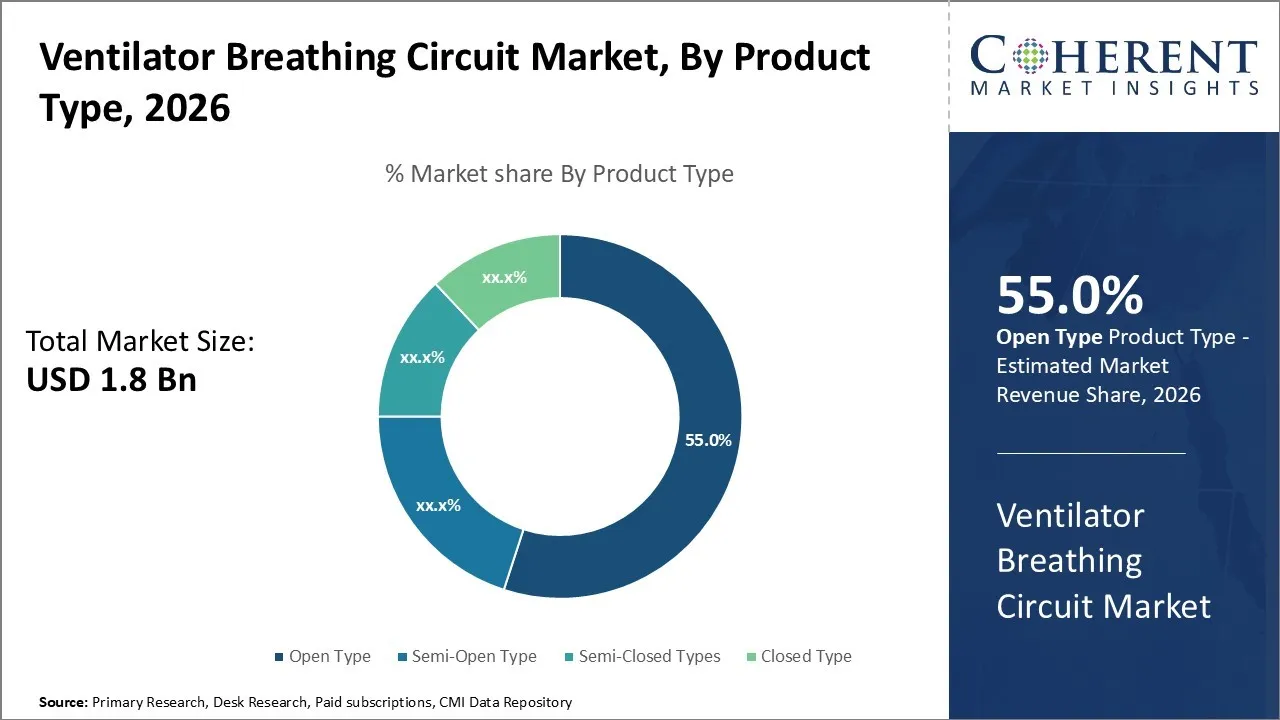
In terms of product type, the open type segment is expected to lead the market with 55% share in 2026, owing largely to its widespread adoption in critical care units and emergency medical services across the globe. Open type ventilator breathing circuits have historically been the preferred choice due to their simplicity, cost-effectiveness, as well as compatibility with a broad range of ventilator models as well as clinical scenarios.
For instance, in October 2025, GaleMed has introduced a new anesthesia breathing circuit called BioVent-Circuit at MEDICA 2025 in Germany. This is the first breathing circuit made from sugarcane-based bioplastic, making it more eco-friendly while still safe for utilization during surgeries.
In terms of application, the anesthesia segment is expected to hold 65% share of the market in 2026. This leadership stems from the extensive utilization of ventilator breathing circuits in surgical settings where anesthesia administration is critical. The key role of ventilator breathing circuits in anesthesia is to make sure the safe delivery of anesthetic gases and oxygen to patients having surgical procedures, support controlled ventilation as well as maintaining patient respiratory stability.
Hospitals and surgical centers worldwide depend on advanced ventilator breathing circuits designed specifically for anesthesia to minimize risks associated with anesthesia delivery, such as hypoxia or contamination of anesthetic gases, thereby enhancing patient safety and outcomes.
In terms of patient type, the adult segment is projected to account for 75% share of the market in 2026. This is because adults, especially middle-aged and older people, are more likely to undergo surgeries, intensive care, or require mechanical ventilation due to serious lung problems like COPD, acute respiratory distress syndrome (ARDS), and other respiratory complications. The combination of aging populations, increasing prevalence of chronic lung diseases, as well as advanced healthcare infrastructure drives high demand for ventilator breathing circuits in adult patients.
For instance, a report from May 2025 shows that COPD becomes more common with age: only 0.4% of adults aged 18–24 have it, but 10.5% of adults aged 75 and older have COPD. This explains why ventilator circuits are mostly used for adults.
In terms of end user, the hospital segment is projected to capture 70% share in 2026, hospitals are critical hubs for intensive and acute care, equipped with technologically advanced infrastructure, which makes them the primary consumers of ventilator breathing circuits. The prevalence of severe respiratory conditions, especially in critical care units such as Intensive Care Units (ICUs), Neonatal Intensive Care Units (NICUs), and Emergency Departments, necessitates the continuous use of ventilators and their associated breathing circuits.
To learn more about this report, Request Free Sample
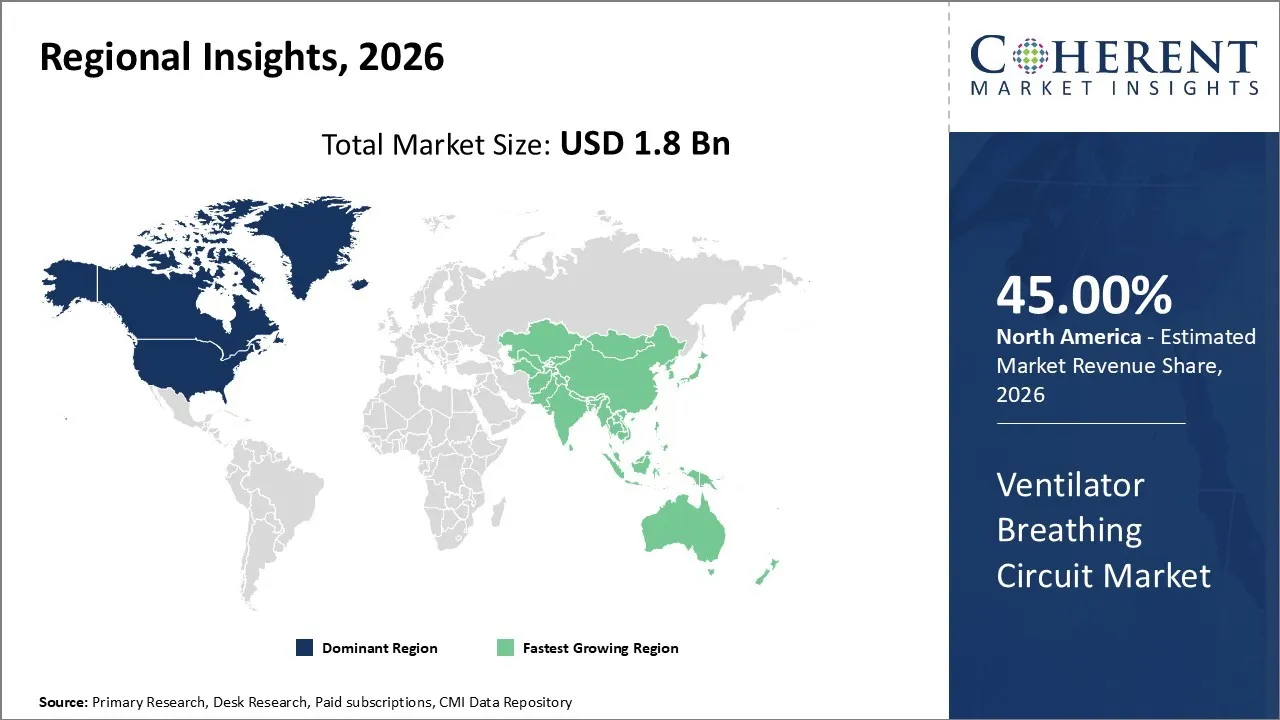
North America is expected to dominate the Ventilator Breathing Circuit market with 45% share in 2026, owing primarily to advanced healthcare infrastructure, high adoption of cutting-edge medical technologies, and robust funding for critical care facilities. The U.S., being the dominant country in North America, has experienced major investments to upgrade hospital respiratory care systems, particularly in response to the escalating demand for ventilators during the COVID-19 pandemic.
For instance, in November 2024, CorVent Medical has announced that its RESPOND ventilator is now approved by the U.S. FDA. The RESPOND ventilator is affordable, easy to use, and safe, helping hospitals and healthcare providers give better care to patients.
Asia Pacific is expected to exhibit the fastest growth, this acceleration is intricately tied to the escalating urbanization and healthcare infrastructure expansion occurring throughout countries such as China, India, and Southeast Asian nations, where large populations are creating heightened demand for critical respiratory care solutions. The World Health Organization has highlighted the rising burden of chronic respiratory diseases and acute respiratory failure in these densely populated countries, which increases the pressure to equip hospitals with advanced ventilator breathing circuits.
For instance, in June 2025, Aerogen, a company from Ireland that makes medicine delivery devices for lungs, expanded its work in Japan. The company plans to invest more to help hospitals treat all kinds of breathing problems. This expansion will make it easier for patients in Japan to get access to Aerogen’s advanced lung medicine delivery systems.
The U.S. contributes the highest share in the Ventilator Breathing Circuit Market in the region, owing to several critical factors rooted in its advanced healthcare infrastructure, extensive ICU capacity, and a robust presence of medical device manufacturers. The U.S. healthcare system is characterized by a high adoption of cutting-edge technologies, driven by a large population base with a high demand for ventilatory support, particularly given the country’s aging demographic and the high occurrence of respiratory diseases such as chronic obstructive pulmonary disease (COPD), acute respiratory distress syndrome (ARDS), etc.
For instance, in December 2025, Lungpacer Medical announced that doctors in a large U.S. hospital have utilized its FDA-approved AeroPace System for the first time. The system aids stimulate the diaphragm to support ICU patients on mechanical ventilators. This is an important step in using this technology to help patients breathe better in critical care.
China contributes the highest share in the ventilator breathing circuit market within the region, primarily owing to its expansive healthcare infrastructure, government-driven initiatives, and significant manufacturing capabilities.
The Chinese government swiftly ramped up production capacities, with domestic manufacturers responding by scaling output of ventilator breathing circuits and associated disposables, ensuring the availability of critical respiratory care components nationwide.
| Report Coverage | Details | ||
|---|---|---|---|
| Base Year: | 2025 | Market Size in 2026: | USD 1.8 Bn |
| Historical Data for: | 2020 To 2024 | Forecast Period: | 2026 To 2033 |
| Forecast Period 2026 to 2033 CAGR: | 3.5% | 2033 Value Projection: | USD 2.82 Bn |
| Geographies covered: |
|
||
| Segments covered: |
|
||
| Companies covered: |
Armstrong Medical, Fisher & Paykel Healthcare Limited., Koninklijke Philips N.V., Drägerwerk AG & Co. KGaA, Advin Health Care, Life-O-Line Technologist, Hamilton Medical, Altera, GE Healthcare, Bio-Med Devices, CAE Inc., Medtronic, Great Group Medical Co., Ltd., Vincent Medical Holdings Limited, and Vyaire Medical, Inc. |
||
| Growth Drivers: |
|
||
| Restraints & Challenges: |
|
||
Uncover macros and micros vetted on 75+ parameters: Get instant access to report
The increasing prevalence of respiratory diseases, particularly chronic obstructive pulmonary disease (COPD), has emerged as a significant driver in the expansion of the ventilator breathing circuit market. COPD, characterized by persistent respiratory symptoms and airflow limitation, affects millions globally, leading to a surge in hospitalizations and the need for advanced respiratory support.
The global increase in the geriatric population, which is inherently more vulnerable to respiratory complications, is significantly propelling the demand for ventilator breathing circuits. As individuals age, the prevalence of chronic respiratory conditions such as Chronic Obstructive Pulmonary Disease (COPD), pneumonia, and other pulmonary infections rises, often requiring advanced respiratory support.
The expansion in emerging markets with developing healthcare infrastructures presents a significant opportunity for the ventilator breathing circuit market. Many low- and middle-income countries are witnessing rapid improvements in their healthcare systems, driven by increased government spending, international aid, and private sector investments. These developments are crucial because ventilator breathing circuits are essential components in critical care settings, enabling effective respiratory support for patients with severe respiratory conditions.
The ventilator breathing circuit market is experiencing major attention due to its critical role in respiratory care, particularly amidst the increasing prevalence of respiratory diseases. A primary driver for this market is the high demand for mechanical ventilation in intensive care units as well as emergency settings, which necessitates reliable, sterile, and efficient breathing circuits to ensure patient safety along with optimal ventilation support.
Additionally, advancements in material technology, such as the introduction of lightweight, disposable, as well as antimicrobial breathing circuits, are enhancing product efficacy as well as reducing cross-contamination risks.
However, the market faces challenges related to high costs of advanced breathing circuit systems along with stringent regulatory requirements that can slow down product approvals as well as market entry. Moreover, the demand for skilled healthcare professionals to work ventilators effectively may limit the use in under-resourced regions. Despite these constraints, expanding applications in homecare settings as well as high geriatric populations present major growth opportunities.
Geographically, North America currently dominates the market owing to the presence of advanced healthcare infrastructure, higher adoption rates of ventilator technologies, as well as supportive healthcare initiatives by governmental authorities.
Meanwhile, the Asia-Pacific region is budding as the fastest-growing market, driven by advancing healthcare services, rising investments in medical infrastructure, as well as a large patient pool requiring respiratory support. The growing focus on post-operative care along with the increasing incidence of chronic respiratory diseases globally will further bolster the demand, making this market an epicenter for innovation along with strategic investment in the coming years.
Share
Share
Manisha Vibhute is a consultant with over 5 years of experience in market research and consulting. With a strong understanding of market dynamics, Manisha assists clients in developing effective market access strategies. She helps medical device companies navigate pricing, reimbursement, and regulatory pathways to ensure successful product launches.
Joining thousands of companies around the world committed to making the Excellent Business Solutions.
View All Our Clients