Surgical Microscopes Market Analysis & Forecast: 2026-2033

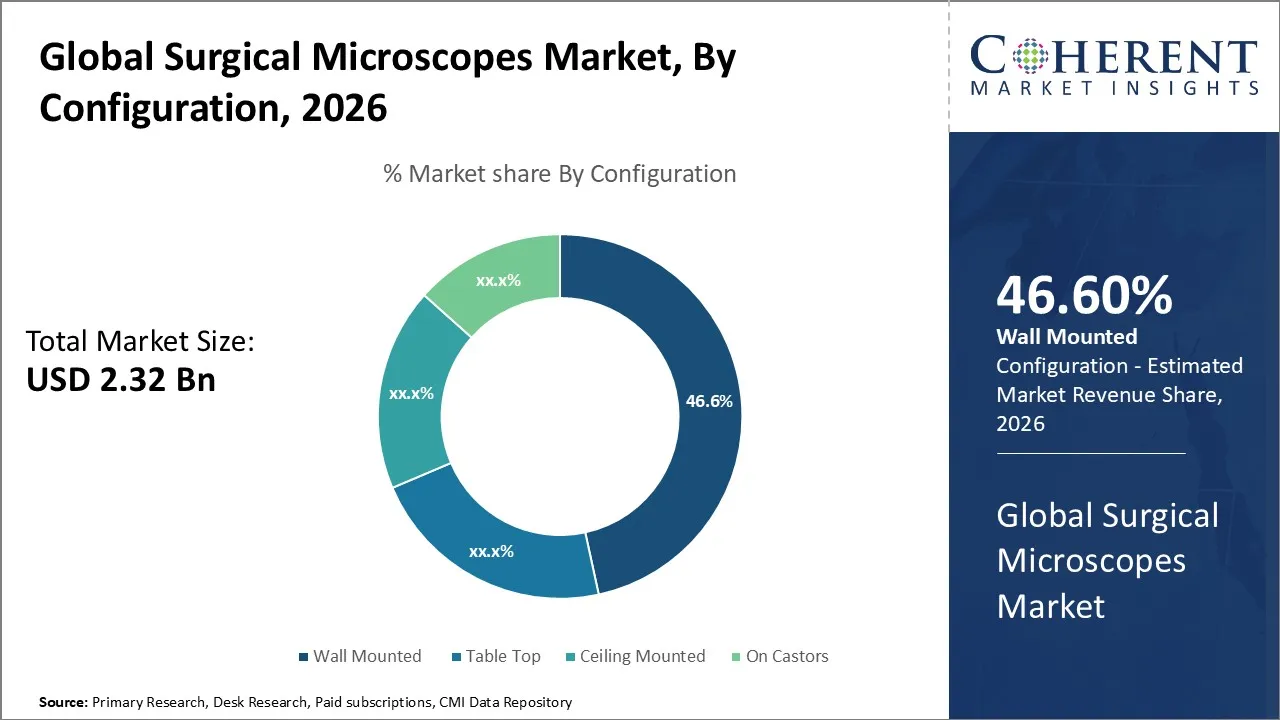
The Surgical Microscopes Market is estimated to be valued at USD 2.32 Bn in 2026 and is expected to reach USD 4.78 Bn by 2033, exhibiting a compound annual growth rate (CAGR) of 11.7% from 2026 to 2033.
The Surgical Microscopes Market is rapidly evolving as healthcare providers increasingly demand precision and minimally invasive solutions for neurosurgery, ophthalmology, ENT, and spine procedures. Surgeons are adopting advanced technologies such as high‑definition optics, 3D visualization, digital imaging, and robotic integration to improve surgical accuracy and patient outcomes. Hospitals and specialty clinics drive this adoption, leveraging expanding healthcare infrastructure, skilled professionals, and the rising number of complex surgical cases, which collectively propel the market’s continued global growth.
|
Current Events |
Description and its impact |
|
Geopolitical and Trade Dynamics |
|
|
Technological Innovations and Advancements |
|
|
Economic Factors and Healthcare Spending |
|
Uncover macros and micros vetted on 75+ parameters: Get instant access to report
Wall mounted expected to hold largest market share of 46.60% in 2026. Healthcare facilities are increasingly adopting wall‑mounted surgical microscopes to create space-efficient and stable operating environments. These microscopes maintain consistent positioning, minimize vibrations, and enhance precision during delicate procedures. Surgeons utilize their ergonomic, adjustable designs, while hospitals benefit from simpler installation compared to ceiling-mounted systems. Outpatient and specialty clinics actively prefer wall-mounted units because they optimize floor space, streamline workflow, and support repeated procedures, making these microscopes a practical and increasingly popular choice for modern surgical settings.
Neurosurgery and spine surgery microscopes hold the largest market share of 43.3% in 2026. Hospitals and specialty centers are increasingly adopting neurosurgery and spine surgery microscopes to ensure precision in complex procedures. Rising cases of neurological disorders, spinal injuries, and degenerative conditions are prompting surgeons to perform interventions that demand enhanced visualization. Surgeons rely on advanced microscopes equipped with high‑definition optics, 3D imaging, and integrated navigation or digital systems to boost accuracy and outcomes. The widespread use of minimally invasive techniques, along with an aging population and expanding healthcare infrastructure, actively drives the growth of these specialized microscopes. For instance, in July 2025, Leica Microsystems, a Danaher company, has launched the ARveo 8x hybrid surgical microscope for neurosurgery, spine, and plastic reconstructive procedures.
Hospitals acquired the prominent market share of 39.2% in 2026. Hospitals are actively driving the the surgical microscopes market growth by performing numerous complex surgeries in neurosurgery, ophthalmology, ENT, and spine procedures. Surgeons rely on advanced microscopes featuring enhanced optics, 3D visualization, and digital integration to achieve greater precision and better patient outcomes. With skilled teams and robust infrastructure, hospitals efficiently deploy these systems across multiple departments. Their commitment to quality care, minimally invasive techniques, and optimized workflows motivates them to continually invest in modern surgical microscope technology. For instance, in March 2025, CARL ZEISS launched the KINEVO 900 neurosurgical microscope at JSS Hospital, where SP Manjunath inaugurated the system and senior neurosurgeons from the hospital addressed the event.
To learn more about this report, Download Free Sample
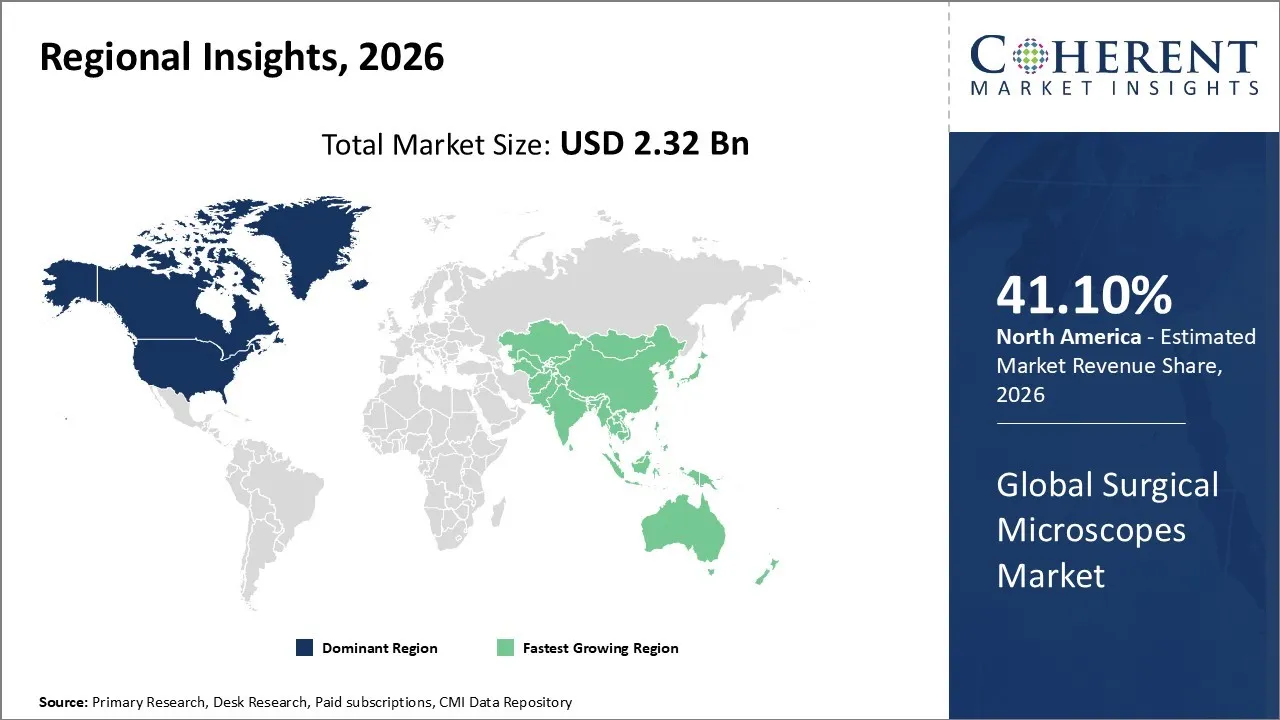
North America dominates the overall market with an estimated share of 41.10% in 2026. Healthcare providers in North America are actively shaping the surgical microscopes market by adopting advanced technologies such as high‑definition optics, 3D visualization, and robotic-assisted integration. Hospitals and specialty centers perform precision surgeries in neurosurgery, ophthalmology, ENT, and spine procedures, which drives the demand for innovative microscopes. The region leverages strong healthcare infrastructure, skilled surgeons, and a focus on minimally invasive techniques to accelerate market growth. Supportive reimbursement policies, informed patients, and ongoing research and development further strengthen North America’s leadership in this market. For instance, in September 2025, Haag-Streit USA launched two new innovations—the Elara 900 and Refractor 900.
Hospitals and specialty clinics across Asia-Pacific are actively expanding the surgical microscopes market by adopting advanced imaging and visualization technologies to enhance surgical precision. Surgeons are increasingly using high-definition optics, 3D imaging, and ergonomic designs to improve outcomes. Growing awareness of minimally invasive procedures, rising cases of neurological and spinal disorders, and the development of healthcare infrastructure are driving demand. Government investments in healthcare, increasing patient awareness, and the establishment of modern surgical centers are further accelerating the region’s growth in surgical microscopes. For instance, in April 2025, ZEISS Medical Technology unveiled new innovations at APAO AIOC 2025, including the ARTEVO 850 and ARTEVO 750 ophthalmic microscopes, the AT ELANA® 841P trifocal IOL, and the CIRRUS PathFinder AI tool to enhance visualization, lens performance, and AI-driven decision-making.
Hospitals and specialty surgical centers in the United States are actively advancing the surgical microscopes market by integrating cutting-edge technologies, including high-definition optics, 3D visualization, and robotic-assisted systems, to improve surgical precision. Surgeons are increasingly performing complex procedures in neurosurgery, ophthalmology, ENT, and spine care, which drives the adoption of these systems. Strong healthcare infrastructure, skilled professionals, and widespread use of minimally invasive techniques support market expansion, while favorable reimbursement policies, high patient awareness, and continuous research efforts reinforce the country’s leadership in surgical microscope innovation. For instance, True Digital Surgery and Aesculap, Inc. have announced the U.S. availability of the Aesculap Aeos™ Robotic Digital Microscope, which uses a multi-axis robotic arm to support precise movements in neurosurgery, spine, and ENT procedures.
Hospitals and specialty clinics in India are actively expanding the surgical microscopes market by adopting advanced visualization technologies to enhance surgical precision and outcomes. Surgeons are increasingly using high-definition optics, 3D imaging, and ergonomic designs for neurosurgery, ophthalmology, ENT, and spine procedures. Growing awareness of minimally invasive surgeries, expanding healthcare infrastructure, and government initiatives to modernize medical facilities are driving demand. Rising patient awareness, medical tourism, and investments in state-of-the-art surgical centers are further establishing India as an emerging market for surgical microscopes. For instance, in November 2024, HP Ghosh Hospital launched Eastern India’s first robotic-assisted spine surgery system, supported by five modular operating theatres equipped with advanced microscopes, navigation, robotics, and neuromonitoring technologies.
Artificial intelligence plays a transformative role in modern surgical microscopes by enhancing visualization, precision, and decision-making during procedures. AI-powered algorithms analyze surgical images in real time, enabling better tissue differentiation, identification of critical anatomical structures, and early detection of potential risks. These systems can provide smart overlays, alerts, and guidance, helping surgeons perform complex procedures with greater accuracy and confidence.
In April 2025, ZEISS Medical Technology showcased new innovations aimed at advancing surgical precision and workflow efficiency, including the ARTEVO 850 and ARTEVO 750 ophthalmic microscopes, the AT ELANA® 841P trifocal intraocular lens, and the ZEISS CIRRUS PathFinder AI decision support tool—designed to enhance visualization, premium lens performance, and AI-driven clinical insights
The market is increasingly driven by the integration of high-definition optics, 3D imaging, and digital visualization systems into surgical microscopes. Surgeons are adopting these technologies to enhance precision, depth perception, and intraoperative decision-making in neurosurgery, ophthalmology, ENT, and spine procedures. Hospitals are investing in microscopes with features such as AR overlays and real-time imaging to improve patient outcomes, reduce surgical risks, and support minimally invasive approaches, creating demand for technologically advanced systems.
Minimally invasive procedures are gaining popularity across multiple surgical specialties due to reduced recovery time, lower complications, and improved patient satisfaction. Surgical microscopes play a critical role by offering magnification, illumination, and enhanced visualization in confined surgical spaces. This trend is prompting manufacturers to design compact, maneuverable, and ergonomically optimized microscopes, allowing surgeons to perform precise interventions while improving efficiency and patient safety in modern operating rooms.
Advancements in high-definition optics, 3D visualization, augmented reality, and AI-assisted systems present opportunities for manufacturers to differentiate their products. Developing microscopes with integrated digital imaging, robotic compatibility, and workflow-enhancing features can address surgeon demands for precision and ease of use. Offering customizable, modular, and ergonomically optimized systems allows companies to capture specialized markets, strengthen brand loyalty, and meet the evolving requirements of high-complexity surgeries.
| Report Coverage | Details | ||
|---|---|---|---|
| Base Year: | 2025 | Market Size in 2026: | USD 2.32 Bn |
| Historical Data for: | 2020 To 2024 | Forecast Period: | 2026 To 2033 |
| Forecast Period 2026 to 2033 CAGR: | 11.7% | 2033 Value Projection: | USD 4.78 Bn |
| Geographies covered: |
|
||
| Segments covered: |
|
||
| Companies covered: |
Carl Zeiss Meditec AG, Leica Microsystems, Takagi., Topcon, Alcon, Alltion (Wuzhou) Co., Ltd., HAAG-STREIT GROUP, Seiler Instrument Inc., ARI Medical Equipment Co., Ltd., CHAMMED, ACCU-SCOPE, IRIDEX Corporation and Aesculap, Inc. |
||
| Growth Drivers: |
|
||
| Restraints & Challenges: |
|
||
Uncover macros and micros vetted on 75+ parameters: Get instant access to report
Share
Share
About Author
Komal Dighe is a Management Consultant with over 8 years of experience in market research and consulting. She excels in managing and delivering high-quality insights and solutions in Health-tech Consulting reports. Her expertise encompasses conducting both primary and secondary research, effectively addressing client requirements, and excelling in market estimation and forecast. Her comprehensive approach ensures that clients receive thorough and accurate analyses, enabling them to make informed decisions and capitalize on market opportunities.
Missing comfort of reading report in your local language? Find your preferred language :
Transform your Strategy with Exclusive Trending Reports :
Frequently Asked Questions
Joining thousands of companies around the world committed to making the Excellent Business Solutions.
View All Our Clients
 Schedule a meeting with report Author