
Ulcerative Colitis Market Analysis & Forecast: 2026-2033
Ulcerative Colitis Market Size and Forecast – 2026 – 2033
The Global Ulcerative Colitis Market size is estimated to be valued at USD 8.70 billion in 2026 and is expected to reach USD 15.30 billion by 2033, exhibiting a compound annual growth rate (CAGR) of 8.5% from 2026 to 2033.
Global Ulcerative Colitis Market Overview
Ulcerative colitis is a chronic inflammatory bowel disease that affects the lining of the large intestine (colon) and rectum. It causes persistent inflammation and ulcers in the intestinal mucosa, leading to symptoms such as diarrhea, abdominal pain, rectal bleeding, urgency to pass stool, and fatigue. The disease typically follows a relapsing and remitting course, with periods of flare-ups and remission. Although the exact cause is unknown, ulcerative colitis is thought to result from an abnormal immune response influenced by genetic and environmental factors. Management focuses on reducing inflammation, maintaining remission, and improving quality of life.
Key Takeaways
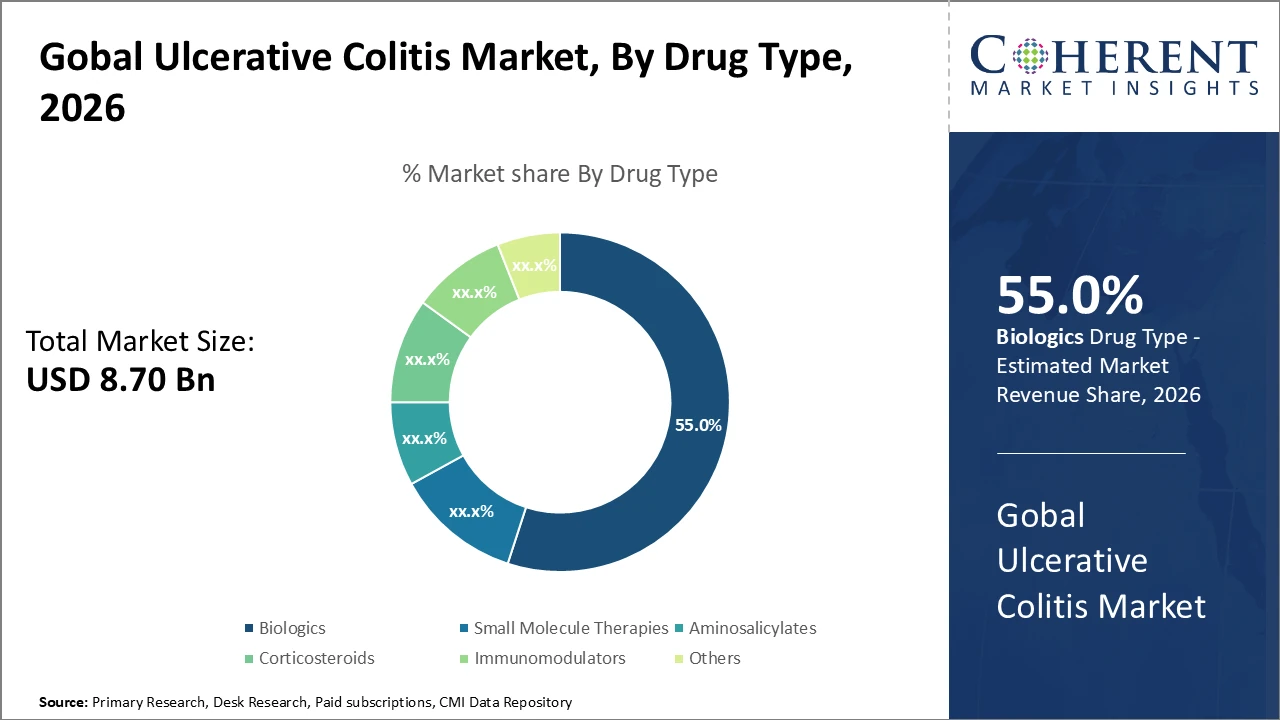
By Drug Type, Biologics dominate the ulcerative colitis market with a 55% share, driven by their superior efficacy and safety. Small-molecule therapies are a key growth segment, supported by advancements in oral formulations.
By Treatment Approach, Maintenance therapy, particularly combination approaches, continues to grow due to high recurrence rates and emphasis on long-term disease management.
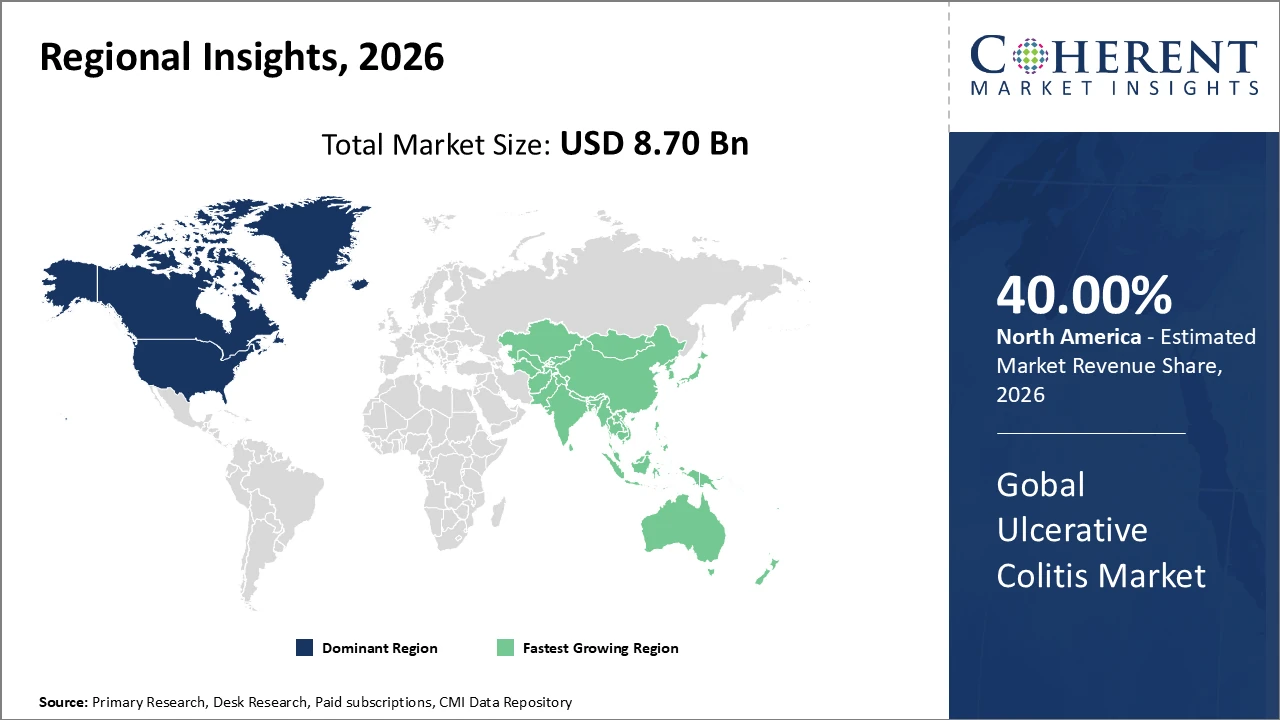
Regional Focus, North America holds the largest industry share, supported by advanced healthcare infrastructure and extensive R&D activities. Asia Pacific is the fastest-growing market, with a CAGR above 10%, fueled by increasing healthcare access and government initiatives.
Ulcerative Colitis Market Segmentation Analysis
To learn more about this report, Download Free Sample
Ulcerative Colitis Market Insights, By Drug Type
Biologics lead the ulcerative colitis market, driven by their targeted mechanisms of action and strong patient adherence. This segment is further supported by robust pipeline innovation addressing refractory cases. Small-molecule therapies represent the fastest-growing subsegment, gaining traction due to improved oral bioavailability and ease of administration, making them appealing alternatives to biologics for maintenance therapy. Aminosalicylates, used primarily for mild to moderate disease, maintain consistent demand, while corticosteroids and immunomodulators serve supportive roles, mainly in induction therapy or combination regimens to manage acute flares. Together, these therapies form a comprehensive treatment landscape for ulcerative colitis.
Ulcerative Colitis Market Insights, By Treatment Type
Maintenance therapy dominates the ulcerative colitis market as long-term remission and relapse prevention become central to patient management. The segment is strengthened by biologics and small-molecule therapies, while combination approaches are rapidly growing, driven by synergistic regimens that enhance efficacy and safety. Induction therapy remains essential for managing acute flares but generates comparatively lower revenue due to shorter treatment durations. The ‘others’ category includes emerging personalized therapies still in clinical evaluation, representing potential future growth and innovation opportunities within the market.
Ulcerative Colitis Market Insights, By End-User
Hospital pharmacies lead the ulcerative colitis market, driven by acute care settings where specialist oversight is essential for administering complex biologics and infusion therapies. Growth in this segment is supported by rising hospital admissions and the expansion of gastroenterology centers. Online pharmacies are the fastest-growing channel, fueled by digital transformation and increasing patient preference for home delivery and discreet access to medications. Retail pharmacies maintain steady demand as primary dispensing points for oral and maintenance therapies. The ‘others’ category includes emerging direct-to-patient distribution models, supported by the growing integration of telemedicine and home-based care solutions.
Ulcerative Colitis Market Trends
The growing adoption of biosimilars has reduced treatment costs, exemplified by Samsung Bioepis’ biosimilar infliximab capturing 20% market share by 2026.
Digital transformation in healthcare, including telehealth platforms and AI-powered diagnostics, has improved patient management and monitoring, resulting in a 15% increase in treatment adherence in recent years.
Strengthened regulatory frameworks, particularly in emerging regions, are accelerating market growth by streamlining product approvals, as demonstrated by India’s expedited biologic drug approvals in 2025.
Ulcerative Colitis Market Insights, By Geography
To learn more about this report, Download Free Sample
North America Ulcerative Colitis Market Analysis and Trends
In North America, the ulcerative colitis market is dominated by strong healthcare infrastructure, high disease prevalence, and significant R&D investment. The region represents around 40% of the global market, supported by widespread access to advanced biologic therapies and high patient diagnosis rates. Leading companies, including AbbVie and Pfizer, drive innovation through collaborative research initiatives and robust pharmaceutical supply chains. The region benefits from well-established gastroenterology centers, specialist care, and supportive reimbursement frameworks, which enhance patient access to therapies. These factors collectively sustain market leadership, encourage pipeline development, and promote adoption of emerging treatments in both the U.S. and broader North American region.
Asia Pacific Ulcerative Colitis Market Analysis and Trends
The Asia Pacific region is the fastest-growing ulcerative colitis market, with a CAGR exceeding 10%, fueled by improving healthcare access, government reimbursement programs, and rising public awareness. Expansion of hospital networks, specialty care centers, and increasing disease prevalence are driving strong demand, particularly in China and India. Government initiatives in China’s biopharmaceutical sector support local manufacturing and production capacity, further bolstering market growth. Combined with rising adoption of advanced therapies and growing patient diagnosis rates, these factors position Asia Pacific as a key growth region, offering significant opportunities for both global and regional pharmaceutical companies in the ulcerative colitis market.
Ulcerative Colitis Market Outlook for Key Countries
USA Ulcerative Colitis Market Analysis and Trends
The USA remains a central market for ulcerative colitis, driven by high incidence rates and advanced healthcare standards. By 2025, prevalence reached around 250 cases per 100,000 population, supporting significant treatment volumes and substantial market revenue. Leading companies, including AbbVie and Johnson & Johnson, have introduced key biologics and innovative therapies, such as adalimumab and ustekinumab. A competitive environment encourages ongoing pipeline innovation, while supportive regulatory frameworks enable faster drug approvals. Together, these factors reinforce the United States’ leadership in market share, shape industry trends, and maintain its position as a benchmark for ulcerative colitis treatment globally.
Germany Ulcerative Colitis Market Analysis and Trends
Germany is a key European market for ulcerative colitis, supported by progressive healthcare policies and strong insurance reimbursement systems. The patient population is gradually expanding, driving rising demand for combination therapies in outpatient care. Companies such as Takeda and F. Hoffmann-La Roche have leveraged local production and partnerships with healthcare providers to strengthen their market presence. By 2025, biosimilar adoption reached 18%, enhancing price competitiveness and improving treatment accessibility. Germany’s emphasis on integrated care models and the use of real-world evidence further reinforces its role as a major growth driver in the regional ulcerative colitis market.
Analyst Opinion
Increasing adoption of biologic therapies is a key driver of market revenue. In 2025, biologics accounted for approximately 55% of the therapeutic market share, reflecting a 12% year-over-year increase due to targeted mechanisms and improved patient outcomes, highlighting a preference over conventional treatments.
Rising patient diagnosis rates globally are fueling demand. In 2024, the US reported an incidence of 15.3 per 100,000 individuals, with Europe showing similar growth, expanding the market through increased clinical visits and diagnostic interventions.
Pricing pressures from biosimilars are reshaping competition. By 2026, biosimilars captured 20% of the biologics segment, reducing treatment costs and supporting market growth, particularly in emerging regions.
Geographic expansion, especially in Asia Pacific, is enhancing supply-side capabilities. Production and export capacity from pharmaceutical hubs in India and China increased by 18% in 2025, driving market share gains alongside healthcare infrastructure investments.
Market Scope
| Report Coverage | Details | ||
|---|---|---|---|
| Base Year: | 2025 | Market Size in 2026: | USD 8.70 billion |
| Historical Data for: | 2020 To 2024 | Forecast Period: | 2026 To 2033 |
| Forecast Period 2026 to 2033 CAGR: | 8.5% | 2033 Value Projection: | USD 15.30 billion |
| Geographies covered: |
|
||
| Segments covered: |
|
||
| Companies covered: | AbbVie Inc., Pfizer Inc., Johnson & Johnson, Ely Lilly and Company, Mylan N.V., Amgen Inc., AstraZeneca PLC, UCB S.A., Biogen Inc., GlaxoSmithKline plc | ||
| Growth Drivers: |
|
||
Uncover macros and micros vetted on 75+ parameters: Get instant access to report
Ulcerative Colitis Market Growth Factors
Increasing government funding for inflammatory bowel disease research has accelerated the development of new ulcerative colitis therapies, with global public investment rising 10% in 2025. Growing patient preference for personalized medicine has boosted adoption of advanced biologic and combination therapies, reflected in a 13% increase in maintenance therapy use in 2026. Technological advancements, including non-invasive biomarkers and AI-enabled imaging, have reduced diagnostic delays by 9% in 2024, enabling earlier treatment and better outcomes. Expansion of healthcare infrastructure in Asia Pacific and the Middle East has strengthened distribution, with retail and online pharmacy channels growing 17% in 2025, supporting market penetration.
Ulcerative Colitis Market Development
In 2025, AbbVie expanded its ulcerative colitis portfolio with the launch of an advanced biologic therapy, demonstrating improved efficacy and safety for moderate to severe patients. Clinical trials highlighted significant reductions in relapse rates and enhanced long-term remission, accelerating adoption in North America and Europe. This launch reinforced AbbVie’s leadership in targeted therapies and strengthened its pipeline for combination treatment regimens, driving substantial market revenue growth.
Meanwhile, Takeda introduced a next-generation small-molecule oral therapy aimed at maintenance treatment, particularly for patients seeking alternatives to biologics. Early uptake in Asia Pacific and Europe showed improved patient adherence and convenience, positioning Takeda as a key player in expanding access to innovative ulcerative colitis therapies and capturing emerging market opportunities.
Key Players
Leading Companies of the Market
AbbVie Inc.
Pfizer Inc.
Johnson & Johnson
Eli Lilly and Company
Mylan N.V.
Amgen Inc.
AstraZeneca PLC
UCB S.A.
Biogen Inc.
GlaxoSmithKline plc
Several leading market players have leveraged strategic alliances and acquisitions to strengthen their pipelines and expand market presence. For instance, AbbVie’s partnership with Samsung Bioepis in 2024 accelerated biosimilar development, resulting in a 25% revenue increase for biosimilar products. Likewise, Takeda’s targeted collaborations in emerging markets contributed to an estimated 15% growth in regional market share by 2025, enhancing access to innovative therapies and reinforcing its competitive positioning. These strategic initiatives enable companies to optimize product reach, accelerate innovation, and capture new growth opportunities in the global ulcerative colitis market.
Ulcerative Colitis Market Future Outlook
The ulcerative colitis market is expected to experience strong growth driven by innovations in biologics, small-molecule therapies, and combination treatment approaches. Advances in personalized medicine and targeted therapies will continue to improve patient outcomes, while the adoption of biosimilars is likely to reduce treatment costs and expand accessibility. Technological progress in diagnostics, including AI-enabled imaging and non-invasive biomarkers, will enable earlier intervention and better disease management. Geographic expansion, particularly in Asia Pacific and the Middle East, supported by growing healthcare infrastructure and digital distribution channels, will further fuel market growth. Investment in gene and cell therapies may reshape long-term treatment paradigms.
Ulcerative Colitis Market Historical Analysis
The ulcerative colitis market has experienced steady growth over the past decade, initially driven by conventional therapies such as aminosalicylates, corticosteroids, and immunomodulators for symptom management. The introduction of biologics in the 2010s, including TNF inhibitors and integrin receptor antagonists, marked a significant shift toward targeted treatment, improving patient outcomes and expanding market value. North America led early adoption due to advanced healthcare infrastructure, high disease prevalence, and widespread access to specialist care, followed by Europe. Gradual growth in Asia Pacific was fueled by increasing disease awareness, expanding healthcare access, and rising investment in diagnostic and treatment capabilities, setting the stage for current market dynamics.
Sources
Primary Research Interviews:
Gastroenterologists
Pharmaceutical R&D professionals
Colorectal surgeons
Clinical researchers in IBD
Databases:
World Health Organization (WHO) – Global Health Observatory
GlobalData Healthcare Databases
Centers for Disease Control and Prevention (CDC) – IBD Statistics
European Crohn’s and Colitis Organisation (ECCO) Registry
Magazines:
Pharmaceutical Technology
Fierce Biotech
Rare Disease Report
Genetic Engineering & Biotechnology News
MedTech Insight
Journals:
Journal of Crohn’s and Colitis
Gastroenterology
Clinical Gastroenterology and Hepatology
Journal of Gastroenterology and Hepatology
Inflammatory Bowel Diseases Journal
Newspapers:
The New York Times (Health)
The Guardian (Health)
Financial Times (Healthcare)
The Hindu (Health)
Reuters Health
Associations:
Crohn’s & Colitis Foundation (CCF)
European Crohn’s and Colitis Organisation (ECCO)
World Gastroenterology Organisation (WGO)
National Institute for Health and Care Excellence (NICE)
American Gastroenterological Association (AGA)
Share
Share
About Author
Ghanshyam Shrivastava - With over 20 years of experience in the management consulting and research, Ghanshyam Shrivastava serves as a Principal Consultant, bringing extensive expertise in biologics and biosimilars. His primary expertise lies in areas such as market entry and expansion strategy, competitive intelligence, and strategic transformation across diversified portfolio of various drugs used for different therapeutic category and APIs. He excels at identifying key challenges faced by clients and providing robust solutions to enhance their strategic decision-making capabilities. His comprehensive understanding of the market ensures valuable contributions to research reports and business decisions.
Ghanshyam is a sought-after speaker at industry conferences and contributes to various publications on pharma industry.
Missing comfort of reading report in your local language? Find your preferred language :
Transform your Strategy with Exclusive Trending Reports :
Frequently Asked Questions

Credibility and Certifications

860519526

9001:2015

27001:2022


Need a Custom Report?
We can customize every report - free of charge - including purchasing stand-alone sections or country-level reports
Customize NowSelect a License Type
Joining thousands of companies around the world committed to making the Excellent Business Solutions.
View All Our Clients
 Schedule a meeting with report Author