Renewable Chemicals Market Analysis & Forecast: 2026-2033

Renewable Chemicals Market Size and Forecast – 2026 – 2033
The Global Renewable Chemicals Market size is estimated to be valued at USD 11.8 billion in 2026 and is expected to reach USD 22.6 billion by 2033, exhibiting a compound annual growth rate (CAGR) of 9.2% from 2026 to 2033.
Global Renewable Chemicals Market Overview
The renewable chemicals market encompasses bio-based products derived from sustainable feedstocks such as biomass, agricultural residues, and waste materials. Key product categories include bio-plastics, bio-solvents, bio-lubricants, and bio-based surfactants, which serve as environmentally friendly alternatives to conventional petrochemical-based chemicals. Bio-ethanol, lactic acid, and glycerol are widely used intermediates in various industrial applications, including pharmaceuticals, food, cosmetics, and personal care. Increasing demand for sustainable materials, coupled with regulatory support for reducing carbon footprints, is driving innovation in product formulations. Continuous advancements in biotechnology and chemical engineering are enhancing product efficiency, scalability, and cost-effectiveness, expanding the adoption of renewable chemicals across global industries.
Key Takeaways
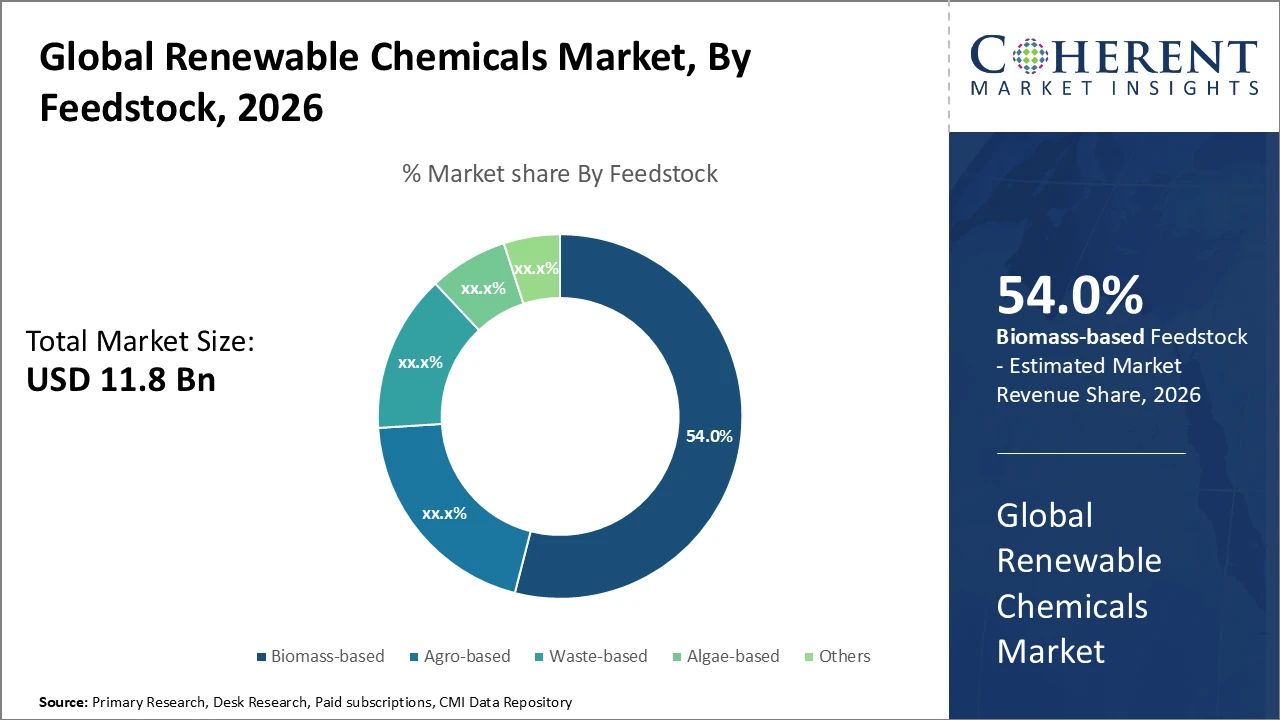
In the feedstock segment, biomass-based dominate with a 54% market share, driven by their abundance and compatibility with existing infrastructure, while algae-based feedstocks show promising growth potential due to high yield per area.
Bio-based polymers lead the product segment with a 48% share, supporting wide applications in packaging and automotive sectors amid growing sustainability demand.
The packaging application remains the largest segment, reflecting consumer demand and regulatory emphasis on eco-friendly materials; personal care and pharmaceuticals are emerging as high-growth applications due to stricter chemical safety regulations.
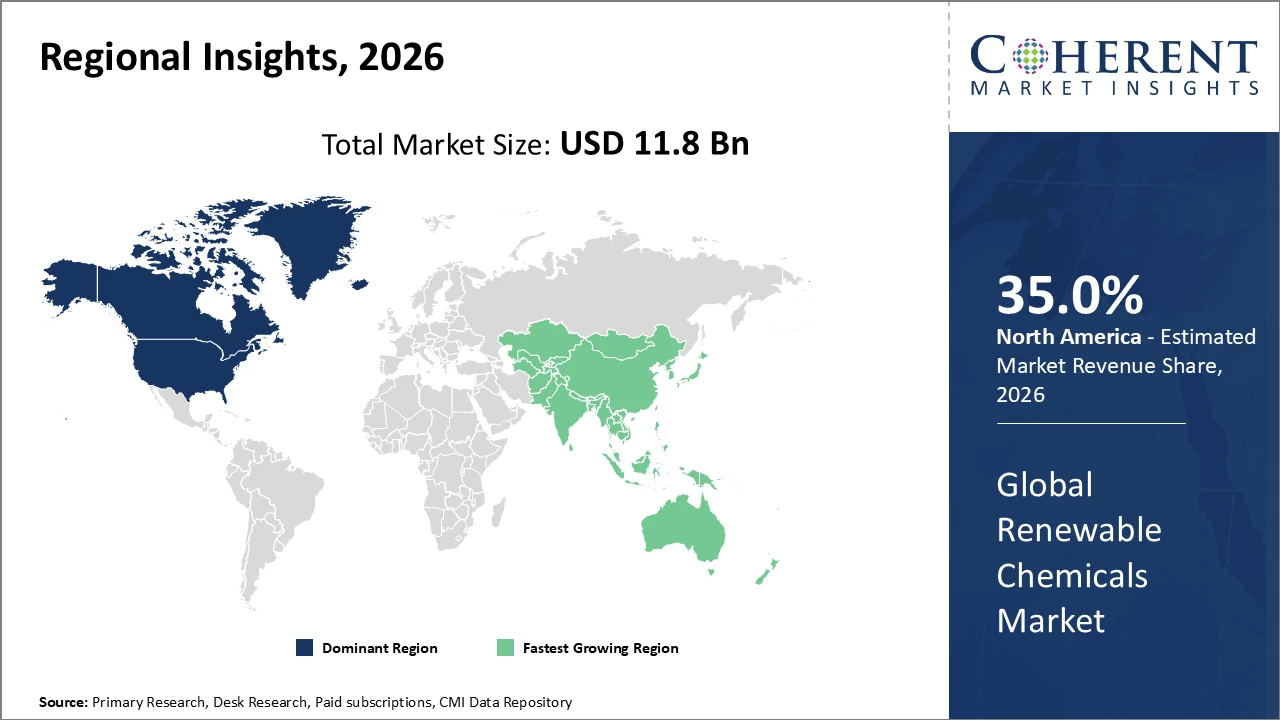
North America holds a significant industry share thanks to strong policy support and technological innovation hubs, while Asia Pacific records the fastest CAGR, driven by expanding biomass resources and rising industrialization.
Renewable Chemicals Market Segmentation Analysis
To learn more about this report, Download Free Sample
Renewable Chemicals Market Insights, By Feedstock
Biomass-based feedstocks dominate the renewable chemicals market due to established collection and processing infrastructures, making them ideal for large-scale production and compatible with existing chemical synthesis pathways. Waste-based feedstocks, including municipal and agricultural waste, are the fastest-growing segment, supported by circular economy principles that ensure sustainable, cost-effective raw material supply. Agro-based feedstocks like corn and sugarcane are mainly used for bio-based polymers and solvents, leveraging regional agricultural outputs. Algae-based feedstocks, though smaller in scale, offer high yields and rapid cultivation without competing with food crops, representing future growth potential. Emerging feedstocks, such as CO2-derived intermediates, are in early-stage development, expanding long-term opportunities.
Renewable Chemicals Market Insights, By Product
Bio-based polymers dominate the renewable chemicals market, driven by adoption in packaging and automotive sectors due to regulatory restrictions on conventional plastics and rising consumer demand for sustainable solutions. Advances in polymerization technology have improved their performance, making them comparable to petrochemical-based polymers. Bio-surfactants are the fastest-growing product category, fueled by biodegradable and less toxic applications in personal care and household cleaning products. Bio-plastics, including compostable and bio-derived plastics for single-use applications, are expanding in regions with stringent plastic waste regulations. Bio-solvents used in pharmaceuticals and industrial cleaning are growing under green chemistry mandates, while specialty bio-based adhesives and coatings are gaining increasing market attention.
Renewable Chemicals Market Insights, By Application
Packaging dominates the renewable chemicals market, generating the largest revenue share due to strict environmental regulations and strong consumer preference for sustainable materials. Demand is further boosted by innovations enabling scalable production of biodegradable and compostable packaging. The agricultural sector is the fastest-growing application, driven by biodegradable films and bio-surfactants that enhance sustainability in crop production. Automotive uses are expanding as bio-based polymers and solvents support lightweight, eco-friendly components, aiding emission reductions. Personal care and pharmaceuticals increasingly adopt renewable chemicals for green formulations and eco-friendly drug manufacturing. Other applications, including textiles and construction, are gradually incorporating these sustainable solutions.
Renewable Chemicals Market Trends
The renewable chemicals market is driven by increasing adoption of bio-based polymers and bio-surfactants, supported by stricter global environmental regulations.
Advances in green catalytic technologies have reduced production costs and improved product quality, with a reported 15% increase in catalytic efficiency in 2025.
Artificial intelligence applications in fermentation processes optimize yields and lower production costs, promoting broader commercial adoption.
Corporate sustainability initiatives and rising capital investments in cleantech ventures are further accelerating market growth.
These trends collectively enhance efficiency, scalability, and environmental impact, fostering continued expansion of the renewable chemicals market globally.
Renewable Chemicals Market Insights, By Geography
To learn more about this report, Download Free Sample
North America Renewable Chemicals Market Analysis and Trends
In North America, the renewable chemicals market is dominated by strong governmental policies, including the U.S. BioPreferred Program and Canada’s Sustainable Chemistry Initiative. The region holds over 35% of the global market share, supported by extensive R&D infrastructure and high adoption across industries such as packaging and automotive. Key companies like Amyris Inc. and Elevance Renewable Sciences play a significant role in driving innovation and scaling commercial production, strengthening the regional market ecosystem. This combination of regulatory support, technological capabilities, and industry leadership reinforces North America’s position as a global leader in renewable chemical development and adoption.
Asia Pacific Renewable Chemicals Market Analysis and Trends
Asia Pacific is the fastest-growing region in the renewable chemicals market, with a CAGR exceeding 11%, driven by abundant biomass resources and rapid industrialization in countries such as China and India. Supportive government policies promoting renewable energy, sustainability, and green manufacturing further accelerate market growth. Leading companies, including Braskem S.A. and Corbion N.V., have expanded production capacities in the region to capitalize on cost advantages and rising demand from emerging markets. These developments position Asia Pacific as a key growth hub, attracting investments, fostering technological innovation, and increasing the region’s contribution to the global renewable chemicals industry.
Renewable Chemicals Market Outlook for Key Countries
USA Renewable Chemicals Market Analysis and Trends
The USA continues to be a key driver of the renewable chemicals industry, supported by its innovative technology ecosystem and favorable policy framework. In 2025, federal incentives for bio-based product development contributed to a 20% increase in production capacity. Leading companies such as Amyris and Elevance Renewable Sciences are advancing bio-catalytic technologies, enabling the commercialization of bio-based solvents and polymers across diverse industries. Rising consumer demand for sustainable packaging and eco-friendly automotive components further supports market growth, reinforcing the country’s position as a global leader in renewable chemical innovation, production, and adoption.
Germany Renewable Chemicals Market Analysis and Trends
Germany’s renewable chemicals market is marked by steady growth, driven by strong regulatory frameworks, environmental policies, and a well-established chemical industry. Bio-based polymers and bio-surfactants lead product adoption, particularly in packaging, automotive, and personal care sectors, supported by growing demand for sustainable alternatives. Advances in green catalytic technologies and bioprocess optimization enhance efficiency and cost-effectiveness, promoting industrial-scale deployment. Government incentives for bioeconomy initiatives and investments in R&D further stimulate innovation. Germany’s focus on circular economy principles, coupled with high consumer awareness of sustainability, positions it as a key European hub for renewable chemical development and adoption, shaping long-term market dynamics.
Analyst Opinion
The accelerating adoption of bio-based feedstocks is driving market growth, with lignocellulosic biomass utilization rising 17% in 2025, boosting renewable chemical production in Europe and North America. Government incentives for carbon neutrality further support investment in sustainable raw materials.
Pricing dynamics are improving as renewable chemicals become more cost-competitive with petrochemical alternatives; in 2024, the cost gap narrowed by around 12% due to advances in catalytic technologies and supply chain efficiencies, aiding market share growth in emerging economies.
Export volumes from Asia Pacific increased 22% in 2026, reflecting expanded production capacity and growing global demand, particularly in packaging and automotive sectors.
Specialized applications such as biodegradable polymers and green solvents saw near 15% growth in 2025, driven by consumer awareness and regulatory focus on single-use plastics and VOC reduction.
Market Scope
| Report Coverage | Details | ||
|---|---|---|---|
| Base Year: | 2025 | Market Size in 2026: | USD 11.8 billion |
| Historical Data for: | 2020 To 2024 | Forecast Period: | 2026 To 2033 |
| Forecast Period 2026 to 2033 CAGR: | 9.2% | 2033 Value Projection: | USD 22.6 billion |
| Geographies covered: |
|
||
| Segments covered: |
|
||
| Companies covered: | Amyris Inc., BASF SE, Corbion N.V., Genomatica Inc., Lanza Tech, Novamont S.p.A, Rennovia Inc., Solvay SA, Braskem S.A., Metabolic Explorer | ||
| Growth Drivers: |
|
||
Uncover macros and micros vetted on 75+ parameters: Get instant access to report
Renewable Chemicals Market Growth Factors
The report provides comprehensive market insights that support accurate growth forecasts and identification of emerging opportunities. It offers a detailed analysis of the competitive landscape, highlighting strategies of leading market players. Market segments are examined in depth, covering feedstock types, product categories, and key application domains. Extensive regional coverage delivers actionable intelligence on both global and local market dynamics, enabling informed strategic planning. Additionally, the report identifies emerging trends and shifts in the renewable chemicals industry, equipping businesses with the knowledge needed to anticipate changes, optimize investments, and make proactive decisions to enhance market positioning and growth.
Renewable Chemicals Market Development
In September 2025, Tata Chemicals Limited (TCL) and The Energy and Resources Institute (TERI) inaugurated a jointly developed Centre of Excellence (CoE) for Biochemicals.
Key Players
Leading Companies of the Market
Amyris Inc.
BASF SE
Genomatica Inc.
Lanza Tech
Novamont S.p.A.
Rennovia Inc.
Solvay SA
Braskem S.A.
DSM N.V.
Several market players have actively pursued vertical integration and strategic partnerships to strengthen the renewable feedstock supply chain. Collaborations between bio-refineries and polymer manufacturers, for instance, have led to a 25% reduction in raw material procurement costs, improving competitiveness and driving business growth. In parallel, innovation-focused companies employing advanced fermentation and catalytic conversion technologies achieved a 30% increase in product yield, reinforcing their technological leadership. These strategies not only enhance operational efficiency and cost-effectiveness but also accelerate the commercialization of renewable chemicals, positioning companies to capture emerging market opportunities and expand their global presence.
Renewable Chemicals Market Future Outlook
The renewable chemicals market is poised for strong growth, driven by increasing demand for sustainable, eco-friendly alternatives across packaging, automotive, personal care, and pharmaceutical industries. Advances in bio-based polymers, bio-surfactants, and green solvents, coupled with innovations in fermentation, catalytic conversion, and AI-driven process optimization, are improving efficiency and reducing production costs. Supportive government policies, carbon-neutral initiatives, and rising consumer preference for environmentally responsible products further accelerate adoption. Emerging feedstocks such as algae and CO???-derived intermediates offer long-term growth potential. Overall, technological innovation, regulatory support, and expanding applications position the renewable chemicals market for continued global expansion and diversification.
Renewable Chemicals Market Historical Analysis
Historically, the renewable chemicals market has grown steadily, driven by increasing environmental awareness, regulatory pressures, and demand for sustainable alternatives to petrochemical products. Early adoption focused on bio-based polymers, solvents, and surfactants, primarily in packaging, personal care, and industrial cleaning applications. North America and Europe led market development due to strong R&D infrastructure, government incentives, and established chemical industries, while Asia Pacific gradually expanded production capacities. Over time, advancements in biocatalysis, fermentation, and polymerization technologies improved efficiency and cost-effectiveness, enabling wider industrial adoption. The integration of circular economy principles and rising consumer preference for eco-friendly products laid the foundation for current and future market growth.
Sources
Primary Research Interviews:
Biochemical and Enzyme Manufacturers
Industrial Bioprocess Engineers
Pharmaceutical and Food Industry Experts
Renewable Chemical Product Developers
Databases:
Global Enzymes & Renewable Chemicals Market Reports (e.g., MarketsandMarkets, Grand View Research)
Statista – Renewable Chemicals Data
UN Food and Agriculture Organization (FAO) Statistics
OECD Science, Technology, and Innovation Data
Magazines:
BioProcess International
Industrial Biotechnology Magazine
Chemical & Engineering News
Renewable Chemicals Today
Journals:
Journal of Industrial Microbiology & Biotechnology
Enzyme and Microbial Technology
Biotechnology Advances
Applied Biochemistry and Biotechnology
Newspapers:
The New York Times (Science & Health)
Reuters Science & Technology
he Hindu (Environment & Sustainability)
Financial Times (Life Sciences & Chemicals)
The Guardian (Science & Environment)
Associations:
International Enzyme Council
European Federation of Biotechnology
American Chemical Society (ACS) – Green Chemistry Section
Food and Agriculture Organization (FAO)
Biotechnology Innovation Organization (BIO)
Share
Share
About Author
Vidyesh Swar is a seasoned Consultant with a diverse background in market research and business consulting. With over 6 years of experience, Vidyesh has established a strong reputation for his proficiency in market estimations, supplier landscape analysis, and market share assessments for tailored research solution. Using his deep industry knowledge and analytical skills, he provides valuable insights and strategic recommendations, enabling clients to make informed decisions and navigate complex business landscapes.
Missing comfort of reading report in your local language? Find your preferred language :
Transform your Strategy with Exclusive Trending Reports :
Frequently Asked Questions

Credibility and Certifications

860519526

9001:2015

27001:2022


Need a Custom Report?
We can customize every report - free of charge - including purchasing stand-alone sections or country-level reports
Customize NowSelect a License Type
Joining thousands of companies around the world committed to making the Excellent Business Solutions.
View All Our Clients
 Schedule a meeting with report Author