Rehabilitation Products Market Analysis & Forecast: 2026-2033

Rehabilitation Products Market Size and Forecast – 2026 – 2033
The Rehabilitation Products Market is projected to grow from about USD 15.9 billion in 2026 to around USD 19.8 billion by 2033, expanding at a CAGR of 5.7 %, driven by rising chronic conditions, aging populations, and increasing adoption of assistive and home‑based rehabilitation solutions.
Global Rehabilitation Products Market Overview
Rehabilitation products are medical and assistive devices designed to aid individuals in regaining or improving physical, cognitive, and functional abilities following injury, illness, or surgery. They include mobility aids (wheelchairs, walkers), physiotherapy equipment, prosthetics, orthotics, and home-based rehabilitation tools. These products enhance independence, quality of life, and recovery outcomes, particularly for aging populations and patients with chronic conditions. Technological advancements, such as smart and sensor-based devices, are transforming rehabilitation by enabling personalized and remote therapy. The growing prevalence of disabilities, post-operative care needs, and awareness of rehabilitation benefits are driving global market growth in this sector.
Key Takeaways
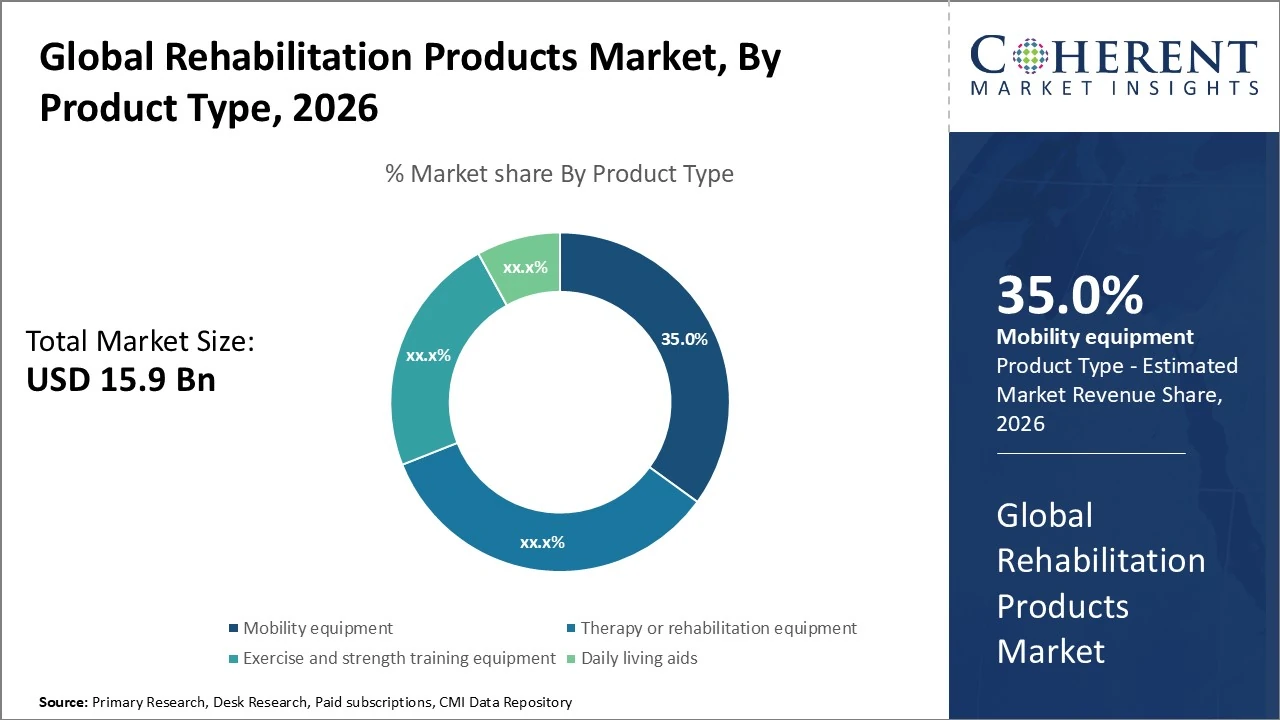
Product Type- Mobility equipment leads, typically holding around 35 %.
The global rehabilitation products market is led by technology in Manual rehabilitation devices which hold ~50 % share.
Hospitals & clinics are the dominant end‑users, capturing roughly 40% of market share.
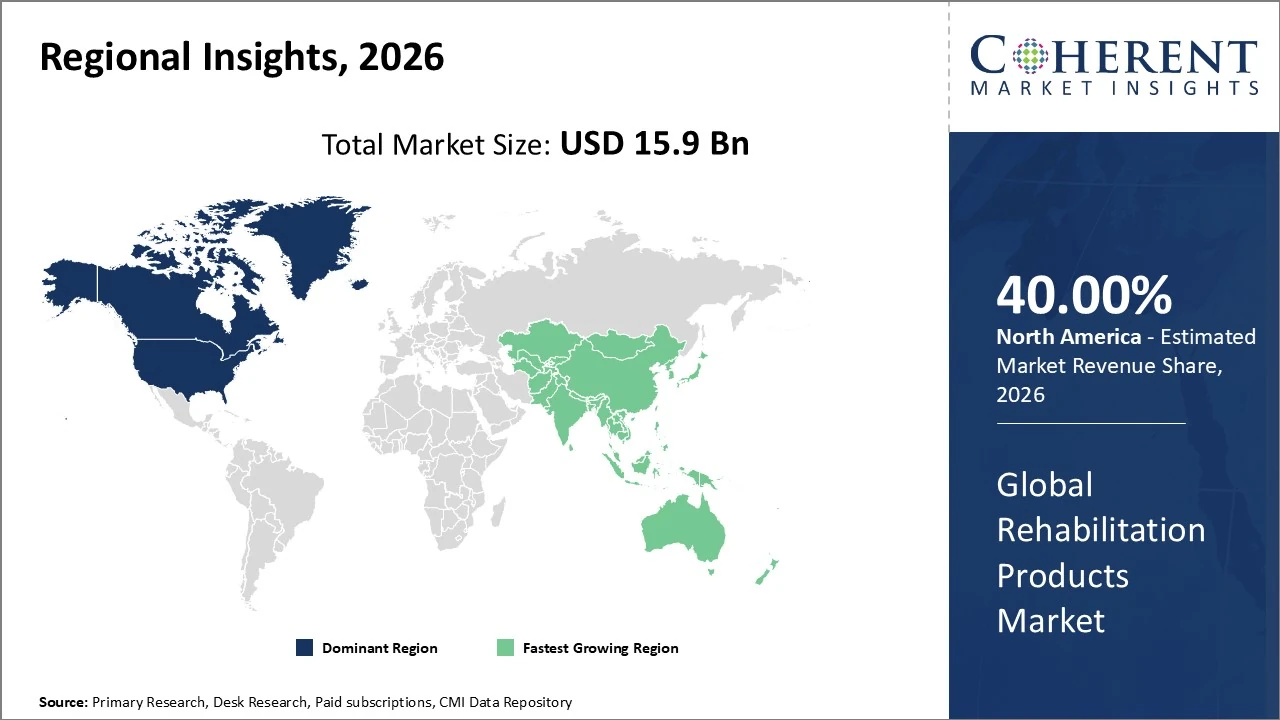
The North America rehabilitation products market dominates globally, holding about 40% of the total market.
The Asia Pacific rehabilitation products market accounts for about 22% of the global rehabilitation equipment market.
The U.S. rehabilitation products market is a major contributor to the global rehabilitation equipment value, accounting for around 28% of the world market.
The German rehabilitation products market is rapidly expanding, projected to grow at a ~9.5% CAGR
Rehabilitation Products Market Segmentation Analysis
To learn more about this report, Download Free Sample
Rehabilitation Products Market Insights, By Product Type
In the global Rehabilitation Products Market, Mobility equipment leads, typically holding around 35 % of the product‑type share, driven by demand for wheelchairs, walkers, and scooters. Therapy or rehabilitation equipment often represents the largest or a close second share at ~34 %. Exercise and strength training equipment contributes roughly 23 %, while Daily living aids account for about 8% of the market. Other segments like body support devices and orthotic/ wearable aids make up the remaining share, with some sub‑segments growing faster due to technology adoption and aging populations.
Rehabilitation Products Market Insights, By Technology
The global rehabilitation products market is segmented by technology into Manual rehabilitation devices (~50 % share), still widely used for basic mobility and support, Electrical or smart rehabilitation devices (~30 %), driven by demand for AI‑integrated, data‑enabled systems, and Wearable rehabilitation devices (~20 %), gaining traction for remote monitoring and personalized therapy. Smart and sensor‑enabled equipment adoption is rising, with over one‑third of facilities deploying connected tools for tracking patient progress. Technology integration, especially in wearable and robotic systems, is reshaping treatment approaches and enhancing outcomes across clinical and home settings.
Rehabilitation Products Market Insights, By End-User
In the global rehabilitation products market, Hospitals & clinics are the dominant end‑users, capturing roughly 40% of market share as they integrate advanced devices for inpatient and outpatient recovery. Rehabilitation centers follow with about 30%, offering specialized therapeutic programs using diverse equipment. Home‑care settings account for around 20%, driven by rising demand for in‑home recovery and portable products. Smaller segments like Physiotherapy/ specialty clinics and nursing care contribute the remaining 10%, supporting outpatient and niche rehabilitation needs. These trends reflect shifts toward decentralized and patient‑centric care models.
Rehabilitation Products Market Trends
Increasing demand for portable and user-friendly devices is driving growth in home-care rehab solutions, especially among aging populations and post-surgery patients.
Advanced technologies like AI, IoT, and robotics are being incorporated into rehabilitation devices, improving patient monitoring, personalized therapy, and remote treatment capabilities.
Rehabilitation products are increasingly used for managing chronic conditions such as stroke, arthritis, and cardiovascular diseases, boosting demand across hospitals, clinics, and long-term care facilities.
Rehabilitation Products Market Insights, By Geography
To learn more about this report, Download Free Sample
North America Rehabilitation Products Market Analysis and Trends
The North America rehabilitation products market dominates globally, holding about 40% of the total market share in 2026, driven by advanced healthcare infrastructure, a large aging population, and high prevalence of chronic conditions such as musculoskeletal and neurological disorders. Home rehabilitation and outpatient therapy services are rapidly growing, with tele‑rehabilitation adoption rising, while Canada and Mexico contribute smaller but expanding portions to regional growth.
Asia Pacific Rehabilitation Products Market Analysis and Trends
The Asia Pacific rehabilitation products market accounts for about 22% of the global rehabilitation equipment market, driven by rapid healthcare infrastructure expansion, a growing geriatric population, and rising chronic disease prevalence. China leads the region (largest country share within APAC), followed by Japan and India, with India showing faster growth rates. The market is expanding due to increased adoption of advanced technologies such as robotic assisted devices and smart wearable systems, particularly in hospitals and outpatient settings. Home‑based rehabilitation solutions and tele‑rehabilitation are gaining traction, supported by government initiatives and rising awareness of rehabilitation benefits among patients.
Rehabilitation Products Market Outlook for Key Countries
USA Rehabilitation Products Market Analysis and Trends
The U.S. rehabilitation products market is a major contributor to the global rehabilitation equipment value, accounting for around 28% of the world market in 2026, driven by increasing chronic diseases and an aging population. Therapy and mobility equipment dominate sales, with physical therapy devices and daily living aids expanding rapidly. Adoption of home‑based rehabilitation and tele‑rehabilitation is rising, while regulatory support and reimbursement systems boost market demand.
Germany Rehabilitation Products Market Analysis and Trends
The German rehabilitation products market is rapidly expanding, projected to grow at a 9.5% CAGR, driven by an aging population and rising chronic conditions demand. Mobility and therapy equipment lead with major share, while tele‑rehabilitation and smart devices are the fastest‑growing segments as digital health adoption increases. Hospitals and home‑care settings are key buyers, supported by strong health insurance reimbursement and government digital health initiatives that boost in‑home care solutions and innovative robotics integration.
Analyst Opinion
Increasing elderly demographics and rising prevalence of chronic diseases are major drivers, sustaining consistent demand for rehabilitation devices.
Analysts see a trend of decentralization, with portable devices and tele‑rehabilitation gaining prominence over traditional hospital-centric models.
Integration of robotics, AI, and IoT in rehabilitation equipment is enhancing therapy efficiency and patient monitoring, creating high-value opportunities.
North America and Europe lead in market maturity, while Asia Pacific and Latin America show rapid growth potential.
Market expansion heavily depends on healthcare insurance coverage, government incentives, and digital health policy frameworks.
Market Scope
| Report Coverage | Details | ||
|---|---|---|---|
| Base Year: | 2025 | Market Size in 2026: | USD 15.9 Billion |
| Historical Data for: | 2020 To 2024 | Forecast Period: | 2026 To 2033 |
| Forecast Period 2026 to 2033 CAGR: | 5.7% | 2033 Value Projection: | USD 19.8 Billion |
| Geographies covered: |
|
||
| Segments covered: |
|
||
| Companies covered: | Invacare Corporation, Medline Industries, Inc., Dynatronics Corporation, Drive DeVilbiss Healthcare, Ekso Bionics | ||
| Growth Drivers: |
|
||
Uncover macros and micros vetted on 75+ parameters: Get instant access to report
Rehabilitation Products Market Growth Factors
The rehabilitation products market is growing rapidly due to rising chronic disease prevalence, including stroke, arthritis, and cardiovascular conditions, which increase demand for therapy and mobility aids. An aging global population further drives need for supportive and adaptive devices. Technological advancements—such as robotics, AI, IoT-enabled monitoring, and smart wearable devices—enhance treatment efficiency and home-based care adoption. Government initiatives and favorable reimbursement policies in developed regions encourage market uptake. Additionally, increased awareness of rehabilitation benefits, rising post-surgery patient numbers, and expanding outpatient and home rehabilitation services contribute to sustained market growth across regions and end-users.
Rehabilitation Products Market Development
In January 2026, Leeford Healthcare Limited, one of India’s leading healthcare companies, announced a strategic investment of INR 200 crore over the next three years to scale up its Orthopedic and Mobility Aids division, marking a significant expansion into India’s rapidly growing preventive healthcare and rehabilitation market.
Key Players
Leading Companies of the Market
Invacare Corporation
Medline Industries, Inc.
Dynatronics Corporation
Drive DeVilbiss Healthcare
Ekso Bionics
Key players include Invacare Corporation and Medline Industries, Inc. (top market share holders), Dynatronics Corporation, Drive DeVilbiss Healthcare, Ekso Bionics—all driving innovation and broad product portfolios globally.
Rehabilitation Products Market Future Outlook
The rehabilitation products market is poised for steady growth, driven by increasing geriatric populations, chronic disease incidence, and post-surgery rehabilitation needs. Technological advancements like robotics, AI, and IoT-enabled devices will enhance therapy personalization and remote care. Home-based and tele-rehabilitation solutions are expected to expand significantly, while emerging regions in Asia Pacific and Latin America offer untapped opportunities. Market players are likely to focus on innovation, strategic partnerships, and regulatory compliance to capture growth. Overall, the market’s future emphasizes patient-centric, tech-driven, and accessible rehabilitation solutions worldwide, ensuring long-term expansion.
Rehabilitation Products Market Historical Analysis
Historically, the rehabilitation products market experienced steady growth, primarily driven by hospital and clinic demand for mobility aids, therapy equipment, and post-operative care devices. North America and Europe dominated due to advanced healthcare infrastructure and reimbursement systems, while Asia Pacific had limited adoption. Growth was fueled by rising chronic diseases, aging populations, and technological advancements like early-stage physiotherapy devices and assistive equipment. Gradually, home-based rehabilitation and portable devices emerged, setting the stage for modern tele-rehabilitation solutions. Market expansion over the past decade reflects increased awareness, government support, and integration of digital health technologies into rehabilitation care.
Sources
Primary Research Interviews:
Hospital Administrators & Healthcare Providers
Rehabilitation Specialists & Physiotherapists
Medical Device Distributors & Suppliers
Industry Experts & Consultants
Databases:
PubMed / Medline
ClinicalTrials.gov
WHO Global Health Observatory
Journals:
Journal of Rehabilitation Medicine
Disability and Rehabilitation
Archives of Physical Medicine and Rehabilitation
Newspapers:
The Wall Street Journal
Financial Times
The Guardian
The New York Times
Associations:
American Physical Therapy Association (APTA)
International Society of Physical and Rehabilitation Medicine (ISPRM)
National Rehabilitation Association (NRA, USA)
World Confederation for Physical Therapy (WCPT)
Share
Share
About Author
Vipul Patil is a dynamic management consultant with 6 years of dedicated experience in the pharmaceutical industry. Known for his analytical acumen and strategic insight, Vipul has successfully partnered with pharmaceutical companies to enhance operational efficiency, cross broader expansion, and navigate the complexities of distribution in markets with high revenue potential.
Missing comfort of reading report in your local language? Find your preferred language :
Transform your Strategy with Exclusive Trending Reports :
Frequently Asked Questions

Credibility and Certifications

860519526

9001:2015
27001:2022


Need a Custom Report?
We can customize every report - free of charge - including purchasing stand-alone sections or country-level reports
Customize NowSelect a License Type
Joining thousands of companies around the world committed to making the Excellent Business Solutions.
View All Our Clients
 Schedule a meeting with report Author