Workstation Market Analysis & Forecast: 2026-2033

Workstation market is estimated to be valued at USD 80.5 Bn in 2026 and is expected to reach USD 154.8 Bn by 2033, exhibiting a compound annual growth rate (CAGR) of 9.8% from 2026 to 2033.
The demand for high-performance computing solutions in various sectors has fueled the growth of the global workstation market. Workstations are now increasingly used for applications that demand high levels of processing, for example, 3D modeling, digital content creation, scientific simulation, engineering design, and software development. Companies are now applying efforts to adopt specialized workstations that provide enhanced graphics, improved processing capabilities, and reliability compared to desktops.
|
Current Events |
and its impact |
|
US-China Technology Trade Tensions and Export Controls |
|
|
Artificial Intelligence and Machine Learning Boom |
|
Uncover macros and micros vetted on 75+ parameters: Get instant access to report
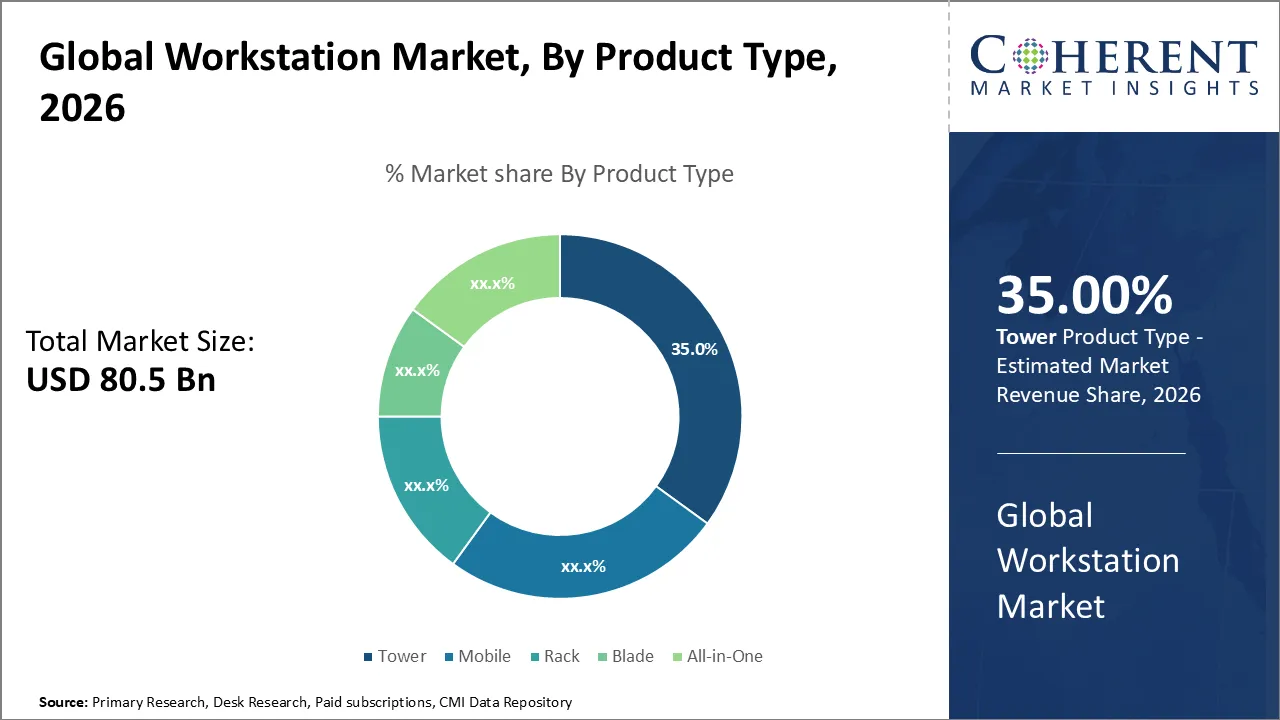
By product type, the Tower segment is likely to hold the largest market share of 35% in 2026, owing to its ability to deliver high performance and scalability for demanding applications such as engineering, CAD, and 3D design. Tower workstations are ideal for experts requiring strong CPUs, multiple GPUs, and plenty of memory resources for tasks such as simulations, rendering, and computation. They are upgradable since they are made in a modular form, which is useful for business and production establishments.
For instance, in March 2025, HP announced the launch of its Z2 Tower G1i workstation at the HP Amplify 2025 event, designed for professionals requiring high performance for AI, CAD, 3D design, and engineering workloads.
Based on operating systems, the windows segment is expected to have the highest market share of 70% in 2026, as these are widely used in the business world and are compatible with a variety of workstation software available in the market. Windows workstations are preferred for animation, scientific simulation, and office purposes.
For instance, in July 2025, Microsoft announced that Windows 11 is continuing to expand AI capabilities in the operating system with the addition of more Copilot capabilities, AI actions in File Explorer, and greatly improved search capabilities, enabling professionals like designers, engineers, and data scientists to work in an even more productive manner in Windows-powered workstations.
Based on application, the Digital Content Creation (DCC) segment is anticipated to account for the largest share of 50% by 2026. This is owing to growing market demand for animation, media, VFX, gaming, and design. DCC workstations are equipped with professional GPUs, accurate display, and fast rendering, which are essential for DCC.
For instance, in March 2025, NVIDIA announced the release of RTX PRO-series GPUs based on NVIDIA’s Blackwell, geared towards using next-generation solutions for designers, developers, data scientists, and artists.
By End Use Industry, IT & Software Industry is anticipated to be the leading segment, accounting for approximately 44% of market shares in 2026, due to widespread use of High-Performance Workstations in software development, cloud computing, data analytics, and other digital transformation activities.
For instance, in October 2025, HP announced various new products/solutions intended for supporting high-performance computing and software development tasks such as the HP ZGX Nano G1n AI Station and relevant tools for developers, researchers, data scientists, and IT professionals.
To learn more about this report, Download Free Sample
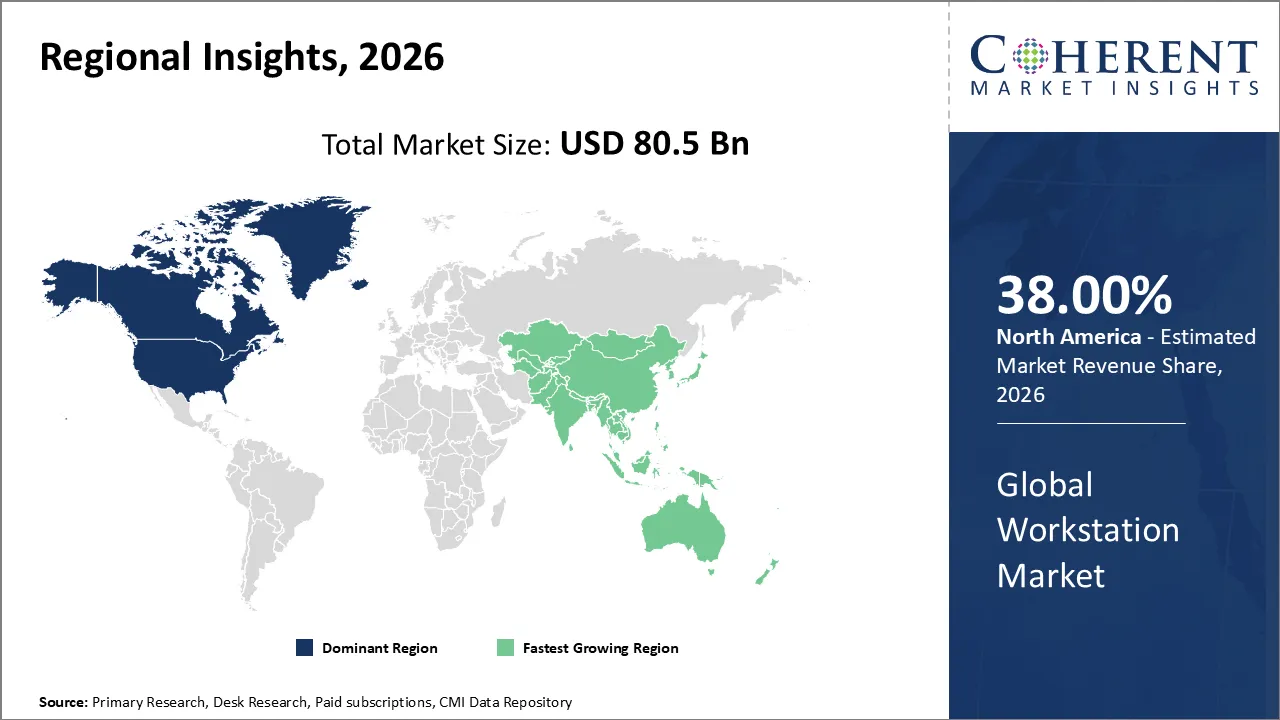
North America is projected to offer a market share of 38% by 2026 and lead the market. The growth in the market can be attributed to the presence of prominent players in the workstation market and the high adoption of advanced computing technology in the enterprises in the region.
For instance, in October 2025, HP introduced its ZGX Nano G1n AI Station for IT teams and software developers. The workstation grants as much as 1,000 TOPS of AI performance, thus allowing enterprises to run AI models, software development workloads, and high-performance computing tasks on local workstations themselves, rather than relying on cloud resources.
The Asia-Pacific market is predicted to be the fastest-growing market for workstations, driven by the rise of digital transformations, a growing information technology software market, increasing high-performance computing applications for engineering applications, and the adoption of workstation solutions for small and medium enterprises.
For instance, in January 2026, Lenovo launched the ThinkStation P2 and P3 computers that are designed for hybrid IT and creative work solutions. Such products use powerful hardware and software that is both secured and designed for software developers, designers, and engineers and have applications in Asia Pacific countries such as India, China, and Japan.
The U.S. workstation market is expected to remain competitive in 2026, buoyed by the high adoption of the latest computing solutions across IT, software development engineering, and media industries. Every organization operating in AI research, film production, automotive design, and software services continues to invest in high-performance workstations to support complicated workflows in simulation, rendering, and real-time analytics. This is bolstered by a mature enterprise ecosystem and substantial investments in digital transformation across the Fortune 500 companies.
For instance, in January 2026, HP Inc. introduced its HP EliteBoard G1a Next Gen AI PC at CES 2026, marking a significant step in workstation‑class computing for professionals and enterprises in the United States.
The workstation market in China is emerging quite strongly, especially in the small and medium enterprise segment adopting high-performance computing systems. The rising requirement for real-time rendering, complex modeling, AI inference, and data analysis in professional services, manufacturing, and tech services is driving the adoption of workstations.
For instance, in November 2025, Huawei launched two desktop computers dedicated to China, the Qingyun W515y and W585y, fueled by their Kirin 9000X CPU and designed to operate with local Linux-operating systems (UOS V20 and Galaxy Kylin V10).
| Report Coverage | Details | ||
|---|---|---|---|
| Base Year: | 2025 | Market Size in 2026: | USD 80.5 Bn |
| Historical Data for: | 2020 To 2024 | Forecast Period: | 2026 To 2033 |
| Forecast Period 2026 to 2033 CAGR: | 9.8% | 2033 Value Projection: | USD 154.8 Bn |
| Geographies covered: |
|
||
| Segments covered: |
|
||
| Companies covered: |
Acer, Inc, Apple, Inc., Dell Inc., Fujitsu Ltd., Hewlett-Packard Enterprises, Inc., Lenovo Group Limited, Microsoft Corporation, NEC Corporation, Samsung, Toshiba America Client Solutions, Inc., and Others |
||
| Growth Drivers: |
|
||
| Restraints & Challenges: |
|
||
Uncover macros and micros vetted on 75+ parameters: Get instant access to report
The increasing need for high-performance computing solutions across IT, software development, engineering, and digital content creation is driving growth in the workstation market. Organizations are adopting powerful workstations to handle complex workflows such as 3D modeling, AI processing, video rendering, and real-time simulations. This trend is particularly strong in sectors like IT services, media, automotive design, and scientific research, where reliable and scalable computing power is critical for productivity and innovation.
The market presents significant opportunities through the development of AI-enabled workstations, compact form factors, and energy-efficient designs. Companies can focus on creating solutions that support AI, machine learning, and virtual reality workloads, as well as hybrid work environments where performance and portability are both required. Additionally, the adoption of sustainable components and low-power systems can attract environmentally conscious enterprises. Introducing cloud-integrated and customizable workstation solutions for SMEs and startups can further expand market reach and revenue potential.
The workstation market is in rapid evolution, as professional and enterprise users drive the demand for machines capable of handling increasingly complex workloads. High-performance computing is no longer a nicety; what is needed from organizations are systems that manage such workloads as AI processing, 3D rendering, and simulations-in other words, being able to handle multiple tasks without compromise.
Tower and mobile workstations remain extremely strong due to the flexibility of performance and scalability, while GPU-optimized systems for digital content creation power adoption in creative industries. Operating system choices reflect that specialization: Windows is still the default choice for enterprise and creative applications; for scientific research, engineering, and AI-driven environments, Linux and Unix hold critical roles due to demands for customization and open-source optimization.
Regionally, mature markets are leading because of the presence of established IT infrastructure and creative industries, while emerging regions are catching up through localized high-performance solutions that target enterprise customers or SMEs. The market is shifting beyond generic desktops toward highly specialized, AI-ready, and workload-optimized systems with an emphasis on efficiency, scalability, and adaptability to future computing needs.
Share
Share
About Author
Ankur Rai is a Research Consultant with over 5 years of experience in handling consulting and syndicated reports across diverse sectors. He manages consulting and market research projects centered on go-to-market strategy, opportunity analysis, competitive landscape, and market size estimation and forecasting. He also advises clients on identifying and targeting absolute opportunities to penetrate untapped markets.
Missing comfort of reading report in your local language? Find your preferred language :
Transform your Strategy with Exclusive Trending Reports :
Frequently Asked Questions
Joining thousands of companies around the world committed to making the Excellent Business Solutions.
View All Our Clients
 Schedule a meeting with report Author