U.S. Influenza Vaccines Market Analysis & Forecast: 2026-2033

The U.S. Influenza Vaccines Market is estimated to be valued at USD 5.16 Bn in 2026 and is expected to reach USD 9.66 Bn by 2033, growing at a compound annual growth The rate (CAGR) of 8% from 2026 to 2033.
The U.S. influenza vaccines market is advancing significantly driven by its critical role in managing seasonal viral outbreaks, protecting high-risk populations, and the expansion of national immunization programs. The increasing demand for higher efficacy formulations and the implementation of stringent public health safety standards are expected to drive market growth over the forecast period.
The quadrivalent and trivalent formulations are high-priority biological agents mainly utilized in retail pharmacies and hospital settings to prevent the transmission of influenza, thus delivering a targeted immune response that allows clinicians to mitigate seasonal healthcare burdens with a superior role in disease prevention and community safety. These treatments play a crucial role in modern healthcare sectors such as geriatric care, pediatrics and emergency medicine. This is owing to their ability to provide broad-strain protection and ensure rapid deployment during peak infection windows or high-risk viral seasons.
The continual innovation in cell-based, recombinant, and mRNA vaccine development is reshaping the immunization industry. The demand for stable, high-purity vaccine supplies is increasing across hospitals, public health clinics, and vaccination centers. These advancements have expanded the functional scope of influenza therapy by enhancing manufacturing speed, ensuring compatibility with evolving viral strains, and enabling more precise matching of vaccine components to circulating pathogens. The top players operating in the industry are forming strategic acquisitions and launching improved manufacturing processes and supply chain resilient platforms designed mainly for streamlined clinical workflows and personalized patient care in the U.S. healthcare landscape.
|
Current Event |
Description and the Impact |
|
Macroeconomic Recovery and Healthcare Spending Trends |
|
|
Technological Advancements in Vaccine Development |
|
|
Regulatory and Policy Environment
|
|
Uncover macros and micros vetted on 75+ parameters: Get instant access to report
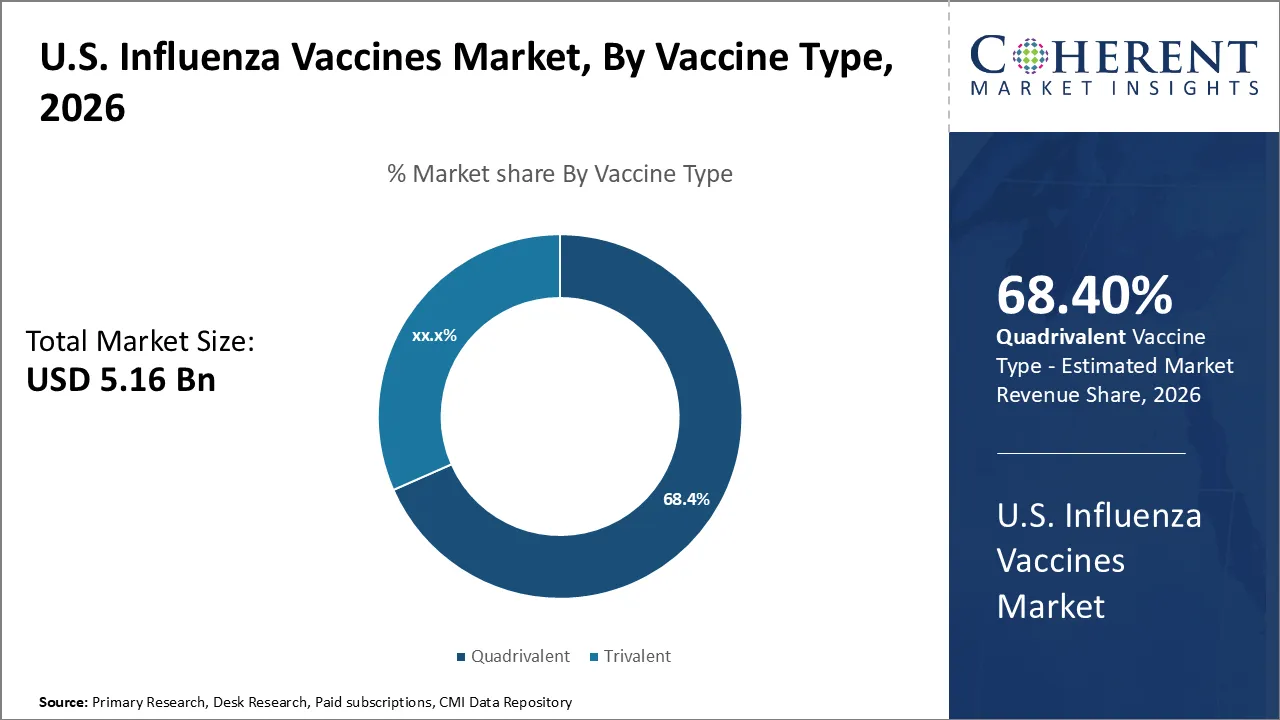
In terms of vaccine type, the quadrivalent vaccines segment contributes the highest share of 68.40% in 2026 of the U.S. influenza vaccines market. The vaccines are formulated to protect against four various virus strains. These include two influenza A strains (H1N1 and H3N2) and two influenza B strains (Victoria and Yamagata lineages). According to the U.S. FDA, this segment has become the standard of care because it eliminates the risk of strain mismatch that was associated with older trivalent vaccines. The leading pharmaceutical companies, including Sanofi, GSK, and CSL Seqirus, have capitalized on this segment by providing specialized quadrivalent products, such as high-dose and adjuvanted versions for elderly patients.
In terms of virus type, the influenza virus type A segment contributes the highest share of 63.10% in the U.S. influenza vaccines market in 2026. This increase is primarily due to Type A viruses, especially the A(H1N1) pdm09 and A(H3N2) subtypes, which are responsible for a significant portion of seasonal infections, hospitalizations, and deaths in the U.S. The regulatory bodies like the FDA require that vaccines include two Type A components in addition to one Type B strain. Furthermore, the persistent threat of highly pathogenic avian influenza (H5N1) has spurred substantial government investment in the Type A segment, with millions of dollars allocated to companies like Moderna to develop mRNA-based pandemic preparedness vaccines. The market for Type A-focused vaccines is also the leading edge for technological innovation. The advanced platforms, such as Flucelvax and Flublok, are designed to produce a more precise match to circulating Type A viruses. The segment is the most lucrative and critical component of the U.S. immunization infrastructure and ensures a steady demand for continual strain updates and higher-efficacy delivery methods.
In terms of age group, the adult segment contributes the highest share of 61.80% in the U.S. influenza vaccines market in 2026. This segment serves as the main driver of product innovation and clinical guidelines, with a strong emphasis on addressing age-related immune vulnerability. The industry is shifting toward convenience and accessibility to alleviate vaccine hesitancy. One such considerable development is the FDA’s clearance of self-administered nasal sprays. This allows adults to receive protection without having to visit a clinical setting. The adults serve as the main testing ground for mRNA-based vaccines and combination shots designed to target influenza. The implementation of these new technologies, along with easy access at local pharmacies, guarantees that adults substantially influence the U.S. vaccination system.
| Report Coverage | Details | ||
|---|---|---|---|
| Base Year: | 2025 | Market Size in 2026: | USD 5.16 Bn |
| Historical Data for: | 2020 To 2024 | Forecast Period: | 2026 To 2033 |
| Forecast Period 2026 to 2033 CAGR: | 8% | 2033 Value Projection: | USD 9.66 Bn |
| Segments covered: |
|
||
| Companies covered: |
Seqirus USA Inc., GSK plc., Sanofi, Pfizer Inc., AstraZeneca, Novartis AG, Merck & Co., Inc., Protein Sciences Corporation, Moderna, Inc., INOVIO Pharmaceuticals, Novavax and EMERGENT |
||
| Growth Drivers: |
|
||
| Restraints & Challenges: |
|
||
Uncover macros and micros vetted on 75+ parameters: Get instant access to report
The U.S. influenza vaccines market is experiencing growth owing to the persistent and rising prevalence of seasonal influenza across the country. According to the CDC, seasonal flu impacts a high number of Americans annually, thus resulting in hundreds of thousands of hospitalizations and a substantial national disease burden. This increasing incidence rate creates a steady and surging demand for annual immunization, particularly among high-risk groups like the growing geriatric population and pediatric patients. The market is shifting toward cutting-edge quadrivalent and recombinant vaccines that deliver broader protection across multiple circulating strains. The policy measures like Executive Order 13887 are translating directly into manufacturing performance gains by encouraging next-generation vaccine technologies. The growing use of cell-based and mRNA platforms is reducing lead times, thereby enhancing efficacy, and stabilizing vaccine supply despite uneven infection dynamics.
According to the CDC, as of September 2025, there have been 280 reported influenza-associated pediatric deaths, resulting in a national rate of 3.8 deaths per 1 million children.
The U.S. influenza vaccines market demonstrates structural stability driven by recurring seasonal demand, institutionalized immunization programs, and a mature regulatory and manufacturing ecosystem. Annual vaccine production volumes in the U.S. consistently exceed 140 million doses, reflecting strong preparedness and supply chain coordination among manufacturers, distributors, and public health agencies. Inactivated influenza vaccines dominate utilization due to their broad age applicability, established safety profile, and alignment with large-scale immunization campaigns.
Distribution is highly diversified, with retail pharmacies and hospital networks accounting for a significant proportion of administered doses, supported by physician offices, workplace vaccination programs, and community health initiatives. Pharmacy-based vaccination has become a critical access point, enabling high-throughput administration during peak seasons. Government-supported programs continue to play a key role in improving access among pediatric, elderly, and high-risk populations.
Vaccination coverage data indicate that approximately half of the pediatric population receives annual influenza immunization, while uptake among healthcare personnel remains substantially higher, supported by employer mandates and occupational health policies. However, notable variability persists across states, signaling uneven adoption and access.
From a technology standpoint, injectable formulations remain dominant, while recombinant and cell-based vaccines are gaining traction due to manufacturing flexibility and reduced dependency on egg-based processes. Ongoing clinical data supporting improved strain match and immunogenicity are expected to influence future product positioning. Overall, the market reflects a balance of scale efficiency, incremental innovation, and policy-driven demand continuity.
Share
Share
About Author
Nikhilesh Ravindra Patel is a Senior Consultant with over 8 years of consulting experience. He excels in market estimations, market insights, and identifying trends and opportunities. His deep understanding of the market dynamics and ability to pinpoint growth areas make him an invaluable asset in guiding clients toward informed business decisions. He plays a instrumental role in providing market intelligence, business intelligence, and competitive intelligence services through the reports.
Missing comfort of reading report in your local language? Find your preferred language :
Transform your Strategy with Exclusive Trending Reports :
Frequently Asked Questions
Joining thousands of companies around the world committed to making the Excellent Business Solutions.
View All Our Clients
 Schedule a meeting with report Author