all report title image

U.S. Hospital Beds Market Analysis & Forecast: 2026-2033

U.S. Hospital Beds Market, By Product Type (Electric Beds, Semi-Electric Beds, and Manual Beds), By Usage (Acute Care Beds, Psychiatric Care Beds, Long-Term Care Beds, and Others), By Application (Intensive Care Beds and Non-Intensive Care Beds), By End User (Home Care Settings, Hospitals, Elderly Care Facilities, Ambulatory Surgical Centers, and Others)

  • Published In : 09 Feb, 2026
  • Code : CMI996
  • Page number :151
  • Formats :
      Excel and PDF :
  • Industry : Medical Devices
  • Historical Range : 2020 - 2024
  • Forecast Period : 2026 - 2033

U.S. Hospital Beds Market Size and Forecast – 2026 to 2033

The U.S. Hospital Beds Market is estimated to be valued at USD 1.78 Bn in 2026 and is expected to reach USD 2.56 Bn by 2033, exhibiting a compound annual growth rate (CAGR) of 6.2% from 2026 to 2033.

Key Takeaways

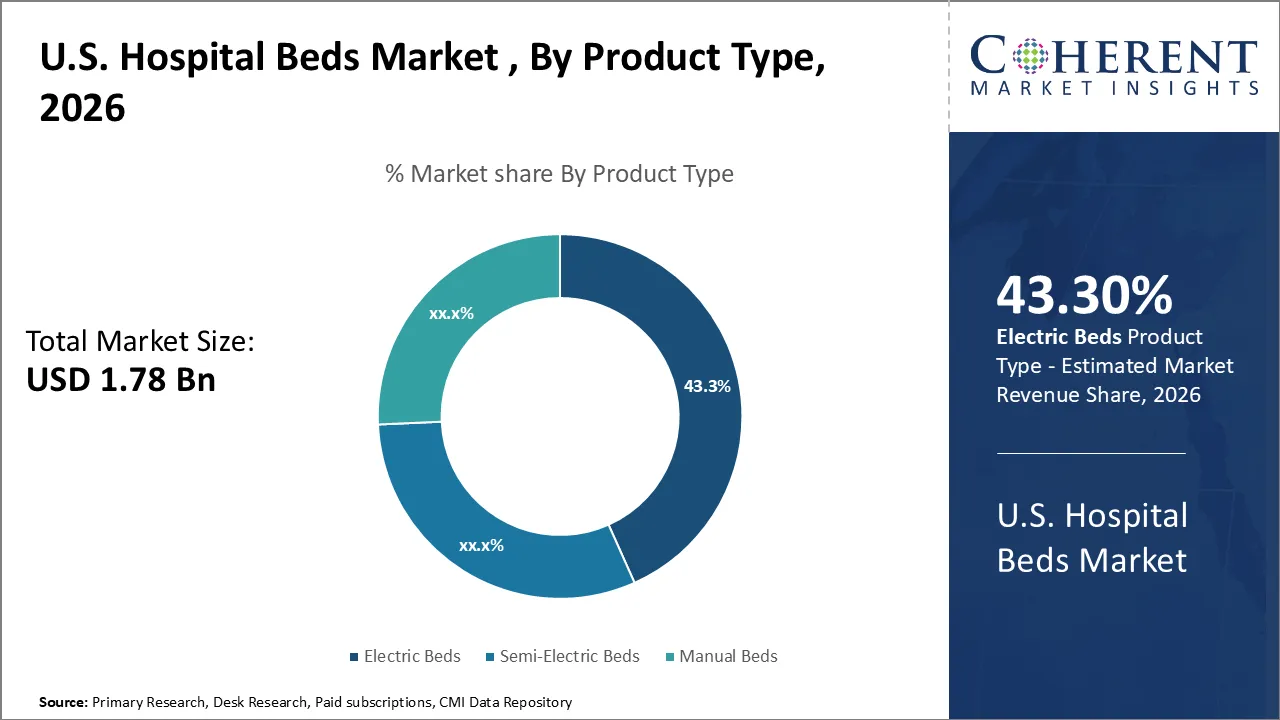
  • By Product Type, Electric Beds hold the largest market share of 43.3% in 2026 owing to its aging demographic & growing healthcare demand.
  • By Usage, Acute Care Beds expected to hold largest market share of 38.8% in 2026 owing to the increasing hospital admissions for acute & emergency conditions.
  • By Application, Intensive Care Beds acquired the prominent market share of 52.2% in 2026 owing to the rising prevalence of critical illnesses & chronic diseases.
  • By End User, Hospitals captures the largest market share of 46.6% in 2026 owing to its rising healthcare expenditure & infrastructure investment.

Market Overview

Rising healthcare demand, an aging population, and the increasing prevalence of chronic and acute diseases drive the U.S. hospital beds market. Hospitals are actively modernizing infrastructure and adopting advanced beds with electronic adjustments, smart monitoring, and enhanced patient safety features. Expanding acute, critical, and intensive care services further boost demand, while hospitals prioritize patient comfort, infection control, and value-based care by replacing outdated beds. Technological advancements and public health preparedness continue to shape the market’s growth.

Current Events and Its Impact on the U.S. Hospital Beds Market

Current Events

Description and its impact

Macroeconomic Policy Shifts

  • Description: Increased Federal Healthcare Funding under Inflation Reduction Act
  • Impact: Potential expansion in hospital infrastructure investment, driving demand for additional hospital beds.
  • Description: Rising Inflation and Labor Costs
  • Impact: Potential pressure on hospital operating budgets may limit new bed acquisitions or upgrades

Technological Advancements in Healthcare Infrastructure

  • Description: Adoption of Smart Hospital Bed Technologies (IoT-enabled monitoring)
  • Impact: Drives demand for advanced, higher-cost beds, shifting market towards technologically integrated solutions.
  • Description: Development of Modular and Prefabricated Hospital Units
  • Impact: Enables faster bed capacity scaling, affecting traditional hospital bed manufacturing and procurement dynamics.

Healthcare Industry Structural Changes

  • Description: Consolidation of Hospital Systems and Mergers
  • Impact: Likely to streamline bed capacity, close redundant facilities, or reallocate beds, affecting overall market volume regionally.
  • Description: Emphasis on Value-Based Care Models
  • Impact: Promotes efficient use of beds and shorter stays, influencing hospital bed turnover rates and replacement cycles.

Uncover macros and micros vetted on 75+ parameters: Get instant access to report

Segmental Insights 

U.S. Hospital Beds Market By Product Type

To learn more about this report, Download Free Sample

U.S. Hospital Beds Market Insights, By Product Type: Electric Beds contribute the highest share of the market owing to its focus on patient comfort, safety & outcomes.

Electric Beds hold the largest market share of 43.3% in 2026. Hospitals in the U.S. are driving demand for electric beds to enhance patient comfort and improve clinical outcomes. They are adopting technologically advanced beds with electronic positioning, remote controls, and integrated safety features to support patient mobility and ease caregiver workload. Increased focus on pressure injury prevention, the expansion of acute and long-term care services, and the push for smart, connected healthcare solutions are prompting healthcare facilities to invest actively in modern electric beds. For instance, in May 2025, EzLift Bed launched the EZ Lift Sleep-to-Stand Bed, designed to help older adults overcome mobility challenges.

U.S. Hospital Beds Market Insights, By Usage: Acute Care Beds contribute the highest share of the market owing to its growth in critical care & intensive services.

Acute Care Beds expected to hold largest market share of 38.80% in 2026. Hospitals in the U.S. are driving the acute care beds market to manage patients with short-term, high-acuity conditions more efficiently. They are expanding acute care units to accommodate rising emergency admissions, surgical procedures, and trauma cases. The increasing prevalence of chronic diseases and age-related health issues further boosts bed utilization. Healthcare facilities are investing in beds with advanced adjustability and monitoring features to enhance patient safety, streamline clinical workflows, and deliver rapid, effective care in fast-paced acute care settings. For instance, in February 2025, Stryker launched the ProCeed hospital bed, delivering a simple, efficient, and safe care platform for clinicians and patients across multiple regions.

U.S. Hospital Beds Market Insights, By Application: Intensive Care Beds contribute the highest share of the market owing to its growth in high‑risk and surgical procedures.

Intensive Care Beds acquired the prominent market share of 52.20% in 2026. Hospitals in the U.S. are driving demand for intensive care beds to treat critically ill patients with complex, life-threatening conditions. Rising cases of severe illnesses, post-surgical complications, and multi-organ disorders are prompting healthcare facilities to expand ICU capacity. They are adopting beds with advanced monitoring, electronic adjustments, and integrated safety features to provide continuous care and enhance patient outcomes. Increased focus on specialized critical care, technological innovation, and emergency surge preparedness is further motivating hospitals to invest in modern intensive care beds. For instance, VA Southern Nevada Healthcare System has launched a Tele-ICU program in partnership with the VA Midwest Health Care Network, giving ICU staff 24/7 access to critical care specialists.

U.S. Hospital Beds Market Insights, By End User: Hospitals contribute the highest share of the market owing to its demand for acute, critical & specialized care.

Hospitals capture the largest market share of 46.6% in 2026. U.S. hospitals are fueling the hospital beds market by expanding capacity to accommodate increasing patient demand and upgrading facilities with advanced infrastructure. Rising admissions from chronic illnesses, an aging population, and emergency cases are driving the need for more beds. Healthcare providers are installing beds that improve patient comfort, safety, and clinical efficiency, featuring electronic adjustments and integrated monitoring systems. Hospitals are also prioritizing infection control, value-based care, and technological enhancements, prompting the replacement of outdated beds and supporting overall market growth.

End-User Feedback and Unmet Needs in the U.S. Hospital Beds Market

  • Patient Comfort and Ergonomics: End-users highlight the need for beds that provide superior comfort, adjustable support, and easy mobility for patients. Current designs sometimes cause discomfort during long stays, and caregivers report difficulty in repositioning patients safely. Enhanced ergonomic features and pressure-relief systems remain a key unmet requirement.
  • Technological Integration and Smart Features: Healthcare providers seek beds with integrated monitoring, IoT connectivity, and automated controls to reduce manual workload. Many existing beds lack seamless integration with hospital systems, limiting real-time patient data access and remote adjustments, creating a gap between technological expectations and current offerings.
  • Safety and Infection Control: Clinicians emphasize the need for beds that minimize fall risk, prevent pressure injuries, and support infection control. Current beds may lack antimicrobial surfaces, side-rail innovations, or safety alerts. Hospitals require designs that enhance both patient safety and hygiene compliance without adding operational complexity.

U.S. Hospital Beds Market Trend

Rise of Smart and Connected Beds

Hospitals are increasingly adopting beds equipped with IoT connectivity, remote monitoring, and automated positioning systems. These smart beds allow real-time patient data tracking, reduce caregiver workload, and improve clinical decision-making. Integration with electronic health records and alerts for mobility, pressure points, or emergencies is driving adoption, reflecting a shift toward technology-enabled patient care and more efficient hospital operations.

Focus on Patient Safety and Infection Control

Healthcare facilities are prioritizing beds that enhance patient safety and reduce infection risks. Features such as antimicrobial surfaces, improved side rails, pressure-relieving mattresses, and fall prevention mechanisms are gaining prominence. Hospitals aim to minimize hospital-acquired infections and prevent injuries during patient transfers, aligning with stricter regulatory requirements and growing emphasis on quality outcomes in patient care.

U.S. Hospital Beds Market Opportunity

Customization for Specialized Care Units

Hospitals seek beds tailored to ICU, acute care, neonatal, and post-surgical recovery units. Opportunities exist for modular and multi-functional beds that can be easily adapted for different patient needs and clinical scenarios. By offering designs that improve safety, comfort, and efficiency, manufacturers can cater to a diverse range of hospital departments while addressing space constraints and operational flexibility requirements.

Market Report Scope 

U.S. Hospital Beds Market Report Coverage

Report Coverage Details
Base Year: 2025 Market Size in 2026: USD 1.78 Bn
Historical Data for: 2020 To 2024 Forecast Period: 2026 To 2033
Forecast Period 2026 to 2033 CAGR: 6.2% 2033 Value Projection: USD 2.56 Bn
Segments covered:
  • By Product Type: Electric Beds, Semi-Electric Beds, and Manual Beds
  • By Usage: Acute Care Beds, Psychiatric Care Beds, Long-Term Care Beds, and Others
  • By Application: Intensive Care Beds and Non-Intensive Care Beds
  • By End User: Home Care Settings, Hospitals, Elderly Care Facilities, Ambulatory Surgical Centers, and Others
Companies covered:

Hill-Rom Holdings, Inc., Getinge AB, Invacare Corporation, Stryker Corporation, Paramount Bed Co. Ltd., Medline Industries, Inc., and LINET Group SE.

Growth Drivers:
  • Rising Healthcare Demand
  • Healthcare Infrastructure Expansion
Restraints & Challenges:
  • High Cost of Advanced Beds
  • Staff Training Requirements

Uncover macros and micros vetted on 75+ parameters: Get instant access to report

U.S. Hospital Beds Market News

  • In July 2025, Juvare launched BedSync™, a software solution that automates healthcare bed capacity reporting in line with the CDC’s NHSN Hospital Bed Capacity Project.

Analyst Opinion (Expert Opinion)

  • The U.S. hospital beds market is at a critical juncture where structural stress points are emerging alongside technological progress. Current data show the nation has around 916,000 staffed beds with approximately 112,000 ICU beds, yet occupancy rates have climbed sharply—from about 64% pre‑pandemic to over 75% recently—and continued increases risk surpassing unsafe operational thresholds if capacity doesn’t expand. This reflects not just demographic shifts but a sustained elevation in demand that outpaces existing infrastructure.
  • Providers have shifted rapidly toward smart and electronically enhanced beds, with the U.S. accounting for the largest share of smart bed adoption globally, partly driven by investments in IoT, remote monitoring, and automation that improve patient safety and reduce caregiver burden. Hospital technology spending on patient care equipment has grown substantially, reinforcing this transition away from legacy beds toward digitally enabled platforms.
  • However, the market is being reshaped by capacity constraints and workforce shortages as much as by innovation. Analyses warn that without expanding staffed beds or reducing hospitalization rates, occupancy may reach levels linked with dysfunction and poorer outcomes, especially among vulnerable elderly and medically complex patients. This tension between innovation and unmet capacity underscores the market’s central challenge.

Market Segmentation

  • By Product Type
    • Electric Beds
    • Semi-Electric Beds
    • Manual Beds
  • By Usage
    • Acute Care Beds
    • Psychiatric Care Beds
    • Long-Term Care Beds
    • Others
  • By Application
    • Intensive Care Beds
    • Non-Intensive Care Beds
  • By End User
    • Home Care Settings
    • Hospitals
    • Elderly Care Facilities
    • Ambulatory Surgical Centers
    • Others
  • Key Players Insights
    • Hill-Rom Holdings, Inc.
    • Getinge AB
    • Invacare Corporation
    • Stryker Corporation
    • Paramount Bed Co. Ltd.
    • Medline Industries, Inc.
    • LINET Group SE.

Sources

Primary Research interviews

  • Hospital administrators and facility managers
  • Healthcare supply chain executives
  • Nursing directors and clinical staff
  • State and local health department officials

Databases

  • U.S. Centers for Medicare & Medicaid Services (CMS) Hospital Compare
  • American Hospital Association (AHA) Annual Survey Database
  • HealthData.gov
  • National Health Expenditure Accounts (NHEA)

Magazines

  • Modern Healthcare
  • Hospitals & Health Networks (H&HN)
  • Healthcare Finance News
  • Becker’s Hospital Review

Journals

  • Journal of Healthcare Management
  • Health Affairs
  • American Journal of Managed Care (AJMC)
  • Journal of Hospital Administration

Newspapers

  • The New York Times – Health Section
  • The Washington Post – Health Section
  • The Wall Street Journal – Health & Medicine
  • USA Today – Health Section

Associations

  • American Hospital Association (AHA)
  • Association of American Medical Colleges (AAMC)
  • National Association of Public Hospitals and Health Systems (NAPH)
  • American Nurses Association (ANA)

Public Domain sources

  • U.S. Census Bureau – Health Statistics
  • Centers for Disease Control and Prevention (CDC)
  • National Institutes of Health (NIH)
  • Federal Register (Health & Hospital Policies)

Proprietary Elements

  • CMI Data Analytics Tool
  • Proprietary CMI Existing Repository of information for last 8 years

Share

Share

About Author

Manisha Vibhute is a consultant with over 5 years of experience in market research and consulting. With a strong understanding of market dynamics, Manisha assists clients in developing effective market access strategies. She helps medical device companies navigate pricing, reimbursement, and regulatory pathways to ensure successful product launches.

Missing comfort of reading report in your local language? Find your preferred language :

Frequently Asked Questions

The U.S. Hospital Beds Market is estimated to be valued at USD 1.78 Bn in 2026 and is expected to reach USD 2.56 Bn by 2033.

The increasing hospitalization of patients is expected to drive the market growth over the forecast period.

Electric beds are expected to hold a major market share, owing to the growing obesity rate.

Major factors hampering the growth of the market include the rising cost of advanced beds.

Major players operating in the market include Hill-Rom Holdings, Inc., Getinge AB, Invacare Corporation, Stryker Corporation, Paramount Bed Co. Ltd., Medline Industries, Inc., and LINET Group SE.

Select a License Type

EXISTING CLIENTELE

Joining thousands of companies around the world committed to making the Excellent Business Solutions.

View All Our Clients
trusted clients logo
© 2026 Coherent Market Insights Pvt Ltd. All Rights Reserved.