Ubiquitin Enzymes Market Analysis & Forecast: 2026-2033

Ubiquitin Enzymes Market Size and Forecast – 2026 – 2033
The Global Ubiquitin Enzymes Market size is estimated to be valued at USD 4.8 billion in 2026 and is expected to reach USD 12.3 billion by 2033, exhibiting a compound annual growth rate (CAGR) of 13.5% from 2026 to 2033.
Global Ubiquitin Enzymes Market Overview
The ubiquitin enzymes market comprises a range of products essential for regulating protein degradation and cellular processes. Key product categories include E1 activating enzymes, E2 conjugating enzymes, and E3 ligases, each playing a critical role in the ubiquitination cascade. These enzymes are widely used in drug discovery, cancer research, and neurodegenerative disease studies. In addition, deubiquitinating enzymes (DUBs) serve as important tools for reversing ubiquitination and studying protein stability. Other products include assay kits, substrates, and reagents that support high-throughput screening and biochemical research. Technological advancements and growing demand for targeted therapeutics continue to drive product innovation and adoption.
Key Takeaways
The E1 Activating Enzymes segment holds a significant market share due to its essential role in initiating ubiquitination, while E3 Ligases are growing rapidly because of their specificity in drug target modulation.
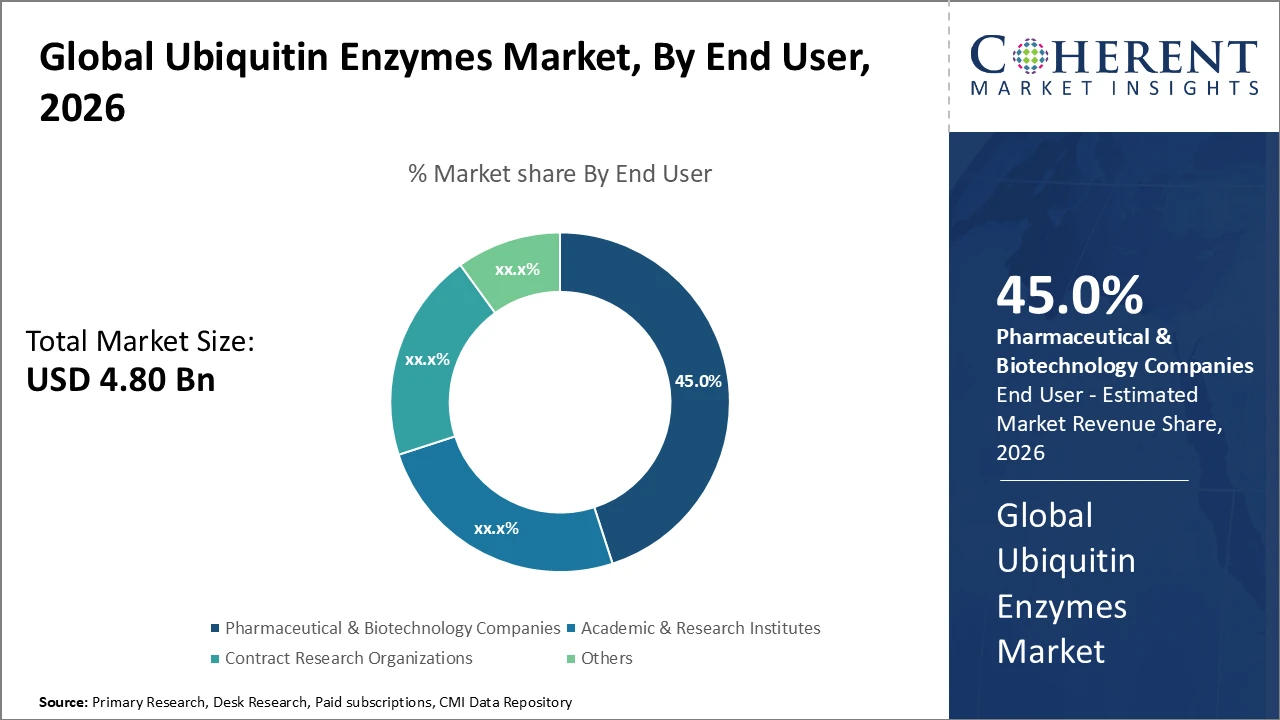
Pharmaceutical end user dominate revenue, accounting for over 45% of the market, driven primarily by developments in oncology and neurodegenerative disease treatments.
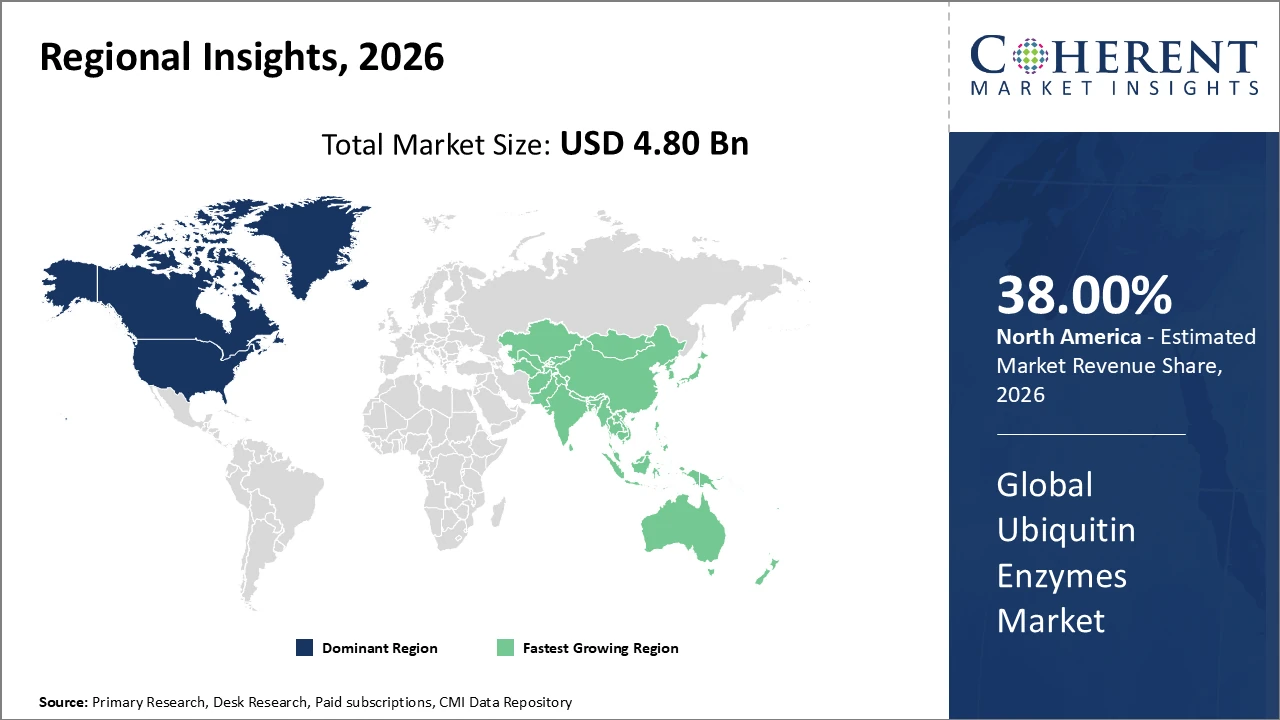
North America leads the market with more than 38% of revenue, supported by a strong biotech ecosystem and substantial government funding.
Asia Pacific is the fastest-growing region, with a CAGR exceeding 15%, fueled by expanding research infrastructure and rising adoption of industrial enzymes.
Ubiquitin Enzymes Market Segmentation Analysis
To learn more about this report, Download Free Sample
Ubiquitin Enzymes Market Insights, By Enzyme Type
E1 Activating Enzymes dominate the market due to their essential role in initiating ubiquitination, making them critical for drug targeting and diagnostic applications. Their widespread use in research and therapeutics, where enzymatic activation is a key preliminary step, reinforces their market leadership. E3 Ligases represent the fastest-growing subsegment, driven by their specificity and versatility in targeted protein degradation strategies such as PROTACs, enabling precision drug design. E2 Conjugating Enzymes facilitate the conjugation process and maintain a moderate market presence, while Deubiquitinating Enzymes are gaining attention for their ability to reverse ubiquitination, offering significant therapeutic potential. The ‘Others’ category includes emerging or less common enzyme types with specialized applications.
Ubiquitin Enzymes Market Insights, By Application
Therapeutics dominate the ubiquitin enzymes market, driven by the urgent need for targeted treatments in oncology and neurodegenerative diseases, where these enzymes regulate protein degradation pathways. Significant investments and research in therapeutic applications continue to propel this segment’s growth. Agricultural biotechnology is the fastest-growing subsegment, as ubiquitin enzymes are increasingly used to enhance crop stress tolerance and improve yields, particularly in Asia Pacific due to rising food security concerns. Diagnostics, focusing on enzyme-based biomarkers, show steady growth supported by deeper understanding of disease pathways, while research tools aid academic and industrial studies on ubiquitination. The ‘Others’ category includes specialized applications with emerging demand.
Ubiquitin Enzymes Market Insights, By End-User
Pharmaceuticals and biotechnology companies dominate the ubiquitin enzymes market, with companies utilizing these enzymes in drug discovery and development, particularly for proteasome inhibitors and ubiquitin ligase modulators targeting complex diseases. The growing pipeline of ubiquitination-based therapeutics underscores this segment’s significant contribution to market revenue. Biotechnology companies represent the fastest-growing segment, driven by advances in enzyme engineering and synthetic biology that enable novel applications in health and agriculture. Academic and research institutes act as innovation hubs, advancing fundamental science and exploratory uses. The agriculture sector is expanding through biotechnological enzyme solutions that enhance crop performance, while ‘Others’ include emerging industrial applications.
Ubiquitin Enzymes Market Trends
The ubiquitin enzymes market has seen rapid adoption of precision enzyme modulators, with a strong focus on targeted protein degradation.
PROTACs have had a significant impact, with over 35% of new drug candidates by 2025 utilizing ubiquitin enzyme pathways to achieve enhanced selectivity.
Integration of artificial intelligence in enzyme design has reduced lead discovery times by 30%, driven by biotech firms in Europe and North America.
These technological innovations are expanding market revenue streams beyond traditional therapeutic applications, fueling overall market growth.
Ubiquitin Enzymes Market Insights, By Geography
To learn more about this report, Download Free Sample
North America Ubiquitin Enzymes Market Analysis and Trends
In North America, the ubiquitin enzymes market is dominated by a strong biotech and pharmaceutical infrastructure, supported by substantial federal research funding exceeding USD 3 billion annually for protein regulation studies. Companies such as Thermo Fisher Scientific drive innovation and leverage large-scale manufacturing capabilities, enabling the region to account for approximately 38% of the global market share. Collaborative networks between academic institutions and commercial enterprises further strengthen market dynamics, fostering technological advancements, accelerating product development, and supporting sustained business growth in the region.
Asia Pacific Ubiquitin Enzymes Market Analysis and Trends
The Asia Pacific region is experiencing the fastest growth in the ubiquitin enzymes market, with a CAGR exceeding 15%. This rapid expansion is driven by the development of biotechnology research centers, supportive government initiatives promoting innovation, and increasing adoption of industrial enzymes in countries like China and India. Local companies are collaborating with global leaders to scale production and tailor solutions for regional needs. Additionally, the growing agricultural biotechnology sector is contributing to broader market revenue streams, further strengthening the region’s overall market position and growth prospects.
Ubiquitin Enzymes Market Outlook for Key Countries
USA Ubiquitin Enzymes Market Analysis and Trends
The USA’s ubiquitin enzymes market is marked by significant investment in clinical research and biotechnology innovation. In 2026, over USD 1.3 billion was allocated to studying the ubiquitin-proteasome pathway, supporting a robust drug pipeline targeting cancer and autoimmune disorders. Companies such as Thermo Fisher Scientific and Merck KGaA hold substantial operational presence, enabling rapid commercialization of novel ubiquitin enzyme kits and therapeutics. Supportive regulatory frameworks that facilitate accelerated drug approvals further drive market expansion, establishing the USA as a global leader in market size, share, and innovation within the ubiquitin enzymes industry.
Germany Ubiquitin Enzymes Market Analysis and Trends
Germany’s ubiquitin enzymes market is supported by a strong biotechnology and life sciences ecosystem, emphasizing advanced research and enzyme innovation. Academic and research institutions actively contribute to fundamental studies on ubiquitination, including deubiquitinase activity and proteasome regulation, which underpin market development. Key trends include collaborations between universities and biotech firms to translate basic research into practical enzyme tools and therapeutic applications, particularly in targeted protein degradation and E3 ligase–focused drug discovery. With robust research infrastructure and funding, Germany plays a significant role in Europe’s share of the global ubiquitin enzymes market, supporting enzyme engineering, proteomics initiatives, and the commercialization of innovative solutions.
Analyst Opinion
The rising demand for precision medicine and targeted therapeutics is boosting the market share of ubiquitin enzymes. In 2025, clinical trials reported a 22% increase in drug candidates using ubiquitin enzyme modulators for oncology, reflecting growing adoption in pharmaceutical pipelines.
Advances in recombinant protein production and enzyme engineering have expanded manufacturing capacities. In 2024, leading biotech companies increased production units by around 18%, indicating higher market revenue potential from improved supply capabilities.
The use of ubiquitin enzymes in agricultural biotechnology, including crop protection and stress tolerance, is an emerging revenue driver. In 2026, Asia Pacific saw a 15% year-on-year increase in enzyme utilization for agri-biotech applications.
Increased investment in genomics and proteomics research by governments and private entities supports market growth. For example, the USA dedicated over USD 1.3 billion in 2026 to post-translational modification studies involving ubiquitin enzymes, expanding market insights and opportunities.
Market Scope
| Report Coverage | Details | ||
|---|---|---|---|
| Base Year: | 2025 | Market Size in 2026: | USD 4.8 billion |
| Historical Data for: | 2020 To 2024 | Forecast Period: | 2026 To 2033 |
| Forecast Period 2026 to 2033 CAGR: | 13.5% | 2033 Value Projection: | USD 12.3 billion |
| Geographies covered: |
|
||
| Segments covered: |
|
||
| Companies covered: | Thermo Fisher Scientific, Merck KgaA, Abcam plc, Bio-Rad Laboratories, BPS Bioscience Inc., Boston Biochem, Cayman Chemical Company, Enzo Life Sciences, Cell Signaling Technology, Active Motif | ||
| Growth Drivers: |
|
||
Uncover macros and micros vetted on 75+ parameters: Get instant access to report
Ubiquitin Enzymes Market Growth Factors
The surge in oncology research targeting ubiquitin-proteasome pathways continues to be a key market driver, evidenced by a 20% increase in therapeutic applications in 2026. Expanding R&D budgets among biotechnology firms focused on protein degradation technologies have further fueled business growth, with global investments reaching USD 2.1 billion in 2025. Improved enzyme engineering techniques that lower production costs have enabled wider adoption in industrial applications. Additionally, increased government funding for post-translational modification research, particularly in North America and Europe, supports ongoing innovation, with grants rising over 18% between 2024 and 2026.
Ubiquitin Enzymes Market Development
In June 2021, Stablix Therapeutics, a biotechnology company focused on Targeted Protein Stabilization (TPS), announced the closing of a $63 million Series A financing
Key Players
Leading Companies of the Market
Merck KgaA
Abcam plc
Bio-Rad Laboratories
BPS Bioscience Inc.
Boston Biochem
Cayman Chemical Company
Enzo Life Sciences
Cell Signaling Technology
Active Motif
In 2025, Thermo Fisher Scientific expanded its enzyme portfolio, introducing customized ubiquitin enzyme kits that led to a 12% increase in market share within the research tools segment. Meanwhile, Merck KGaA strengthened its pipeline in ubiquitin ligase modulators through strategic acquisitions and collaborations initiated in 2024, contributing to a 15% revenue growth and reinforcing its position in the therapeutics segment.
Ubiquitin Enzymes Market Future Outlook
The ubiquitin enzymes market is poised for strong growth driven by rising demand for targeted therapeutics, precision medicine, and protein degradation technologies. Advances in PROTACs, E3 ligase modulators, and deubiquitinase inhibitors are expected to expand applications in oncology, neurodegenerative disorders, and autoimmune diseases. Integration of artificial intelligence and enzyme engineering will accelerate drug discovery, reduce development timelines, and enable cost-effective production. Emerging markets in Asia Pacific, supported by expanding biotech infrastructure and agricultural biotechnology applications, present significant opportunities. Overall, ongoing innovation, increased R&D investment, and growing adoption across pharmaceuticals, research, and industrial sectors will drive sustained market expansion through 2033.
Ubiquitin Enzymes Market Historical Analysis
The ubiquitin enzymes market has experienced steady growth over the past decade, driven by increasing interest in protein regulation and targeted therapeutics. Initially, E1 activating enzymes and E3 ligases dominated research applications due to their essential roles in the ubiquitination cascade. Pharmaceutical companies increasingly incorporated ubiquitin enzymes into drug discovery pipelines, particularly for oncology and neurodegenerative diseases, fueling revenue growth. Advances in recombinant protein production, enzyme engineering, and assay development expanded supply and accessibility. North America and Europe led the market owing to robust biotech infrastructure and research funding, while Asia Pacific began emerging as a high-growth region with expanding industrial and agricultural enzyme applications.
Sources
Primary Research Interviews:
Biotech Researchers
Pharmaceutical Scientists
Academic Researchers in Proteomics and Molecular Biology
Enzyme Manufacturing Specialists
Databases:
World Health Organization (WHO) Global Health Observatory
OECD Health Data
Global Burden of Disease (GBD) Database
PubMed and Scopus for biomedical research
Magazines:
BioCentury
Genetic Engineering & Biotechnology News (GEN)
Drug Discovery & Development
Pharmaceutical Technology
Journals:
Journal of Biological Chemistry
Molecular Cell
Cell
Nature Reviews Drug Discovery
Trends in Biochemical Sciences
Newspapers:
The New York Times (Health)
The Guardian (Health)
Financial Times (Healthcare)
The Hindu (Health)
Reuters Health
Associations:
International Society for Proteomics
European Molecular Biology Organization (EMBO)
Biotechnology Innovation Organization (BIO)
American Society for Biochemistry and Molecular Biology (ASBMB)
Share
Share
About Author
Nikhilesh Ravindra Patel is a Senior Consultant with over 8 years of consulting experience. He excels in market estimations, market insights, and identifying trends and opportunities. His deep understanding of the market dynamics and ability to pinpoint growth areas make him an invaluable asset in guiding clients toward informed business decisions. He plays a instrumental role in providing market intelligence, business intelligence, and competitive intelligence services through the reports.
Missing comfort of reading report in your local language? Find your preferred language :
Transform your Strategy with Exclusive Trending Reports :
Frequently Asked Questions

Credibility and Certifications

860519526

9001:2015

27001:2022


Need a Custom Report?
We can customize every report - free of charge - including purchasing stand-alone sections or country-level reports
Customize NowSelect a License Type
Joining thousands of companies around the world committed to making the Excellent Business Solutions.
View All Our Clients
 Schedule a meeting with report Author