all report title image

Smoke Evacuation System Market Analysis & Forecast: 2026-2033

Smoke Evacuation System Market, By Product Type (Smoke Evacuation Tubings, Smoke Evacuators - Portable and Stationary, Smoke Evacuation Wands & Pencils, Smoke Evacuation Filtration Devices and Smoke Evacuation Pencils and Wands), By Application (Laparoscopic Surgery, Open Surgery, Aesthetic Surgeries, Orthopedic Surgery, and Others), By End-user (Clinics, Ambulatory Surgical Centers, Cosmetic Surgery Centers, and Hospitals), By Geography (North America, Latin, America, Europe, Asia Pacific, Middle East, and Africa)

  • Published In : 05 Feb, 2026
  • Code : CMI3035
  • Page number :160
  • Formats :
      Excel and PDF :
  • Industry : Medical Devices
  • Historical Range : 2020 - 2024
  • Forecast Period : 2026 - 2033

Smoke Evacuation System Market Size and Forecast: 2026-2033

The Smoke Evacuation System Market is estimated to be valued at USD 232.80 Mn in 2026 and is expected to reach USD 432.60 Mn by 2033, exhibiting a compound annual growth rate (CAGR) of 9.1% from 2026 to 2033.

Key Takeaways

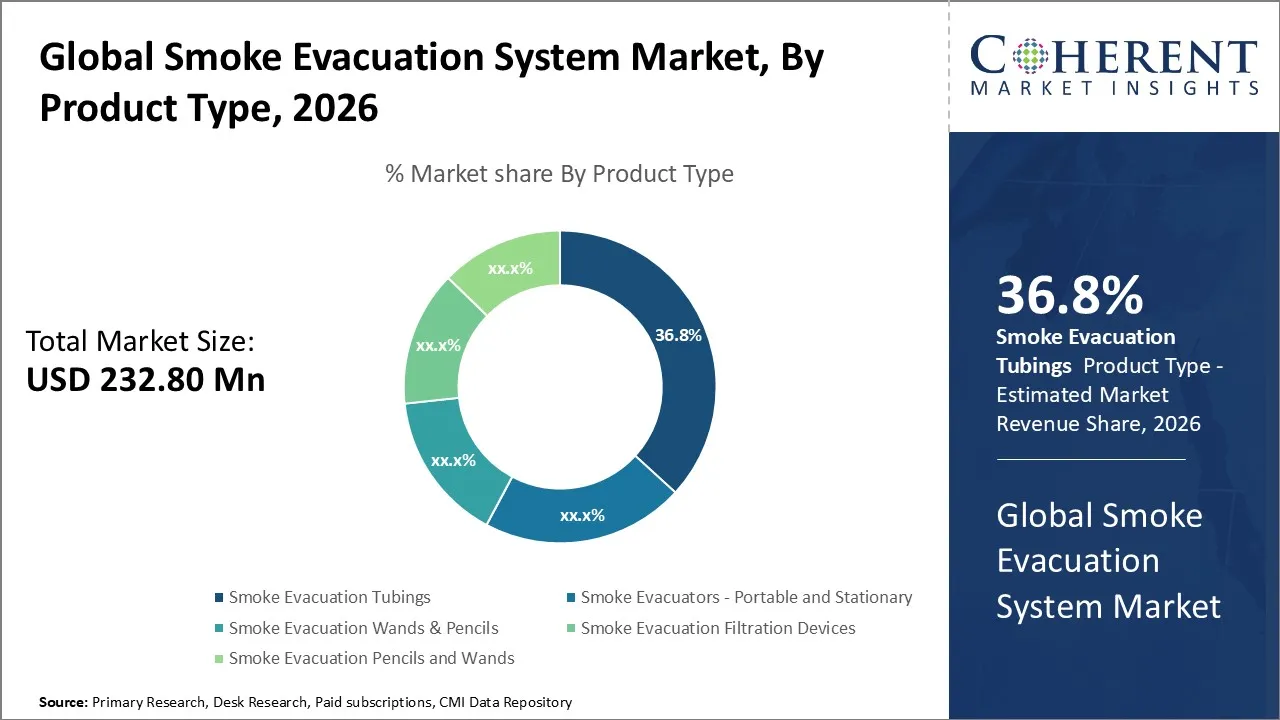
  • By Product Type, Smoke Evacuation Tubings hold the largest market share of 36.8% in 2026 owing to its rising volume of surgical procedures worldwide.
  • By Application, Laparoscopic Surgery expected to hold the largest market share of 43.3% in 2026 owing to its increasing adoption of minimally invasive (laparoscopic) procedures.
  • By End-User, Hospitals acquired the prominent market share of 39.9% in 2026 owing to the high surgical volumes and complex procedures.
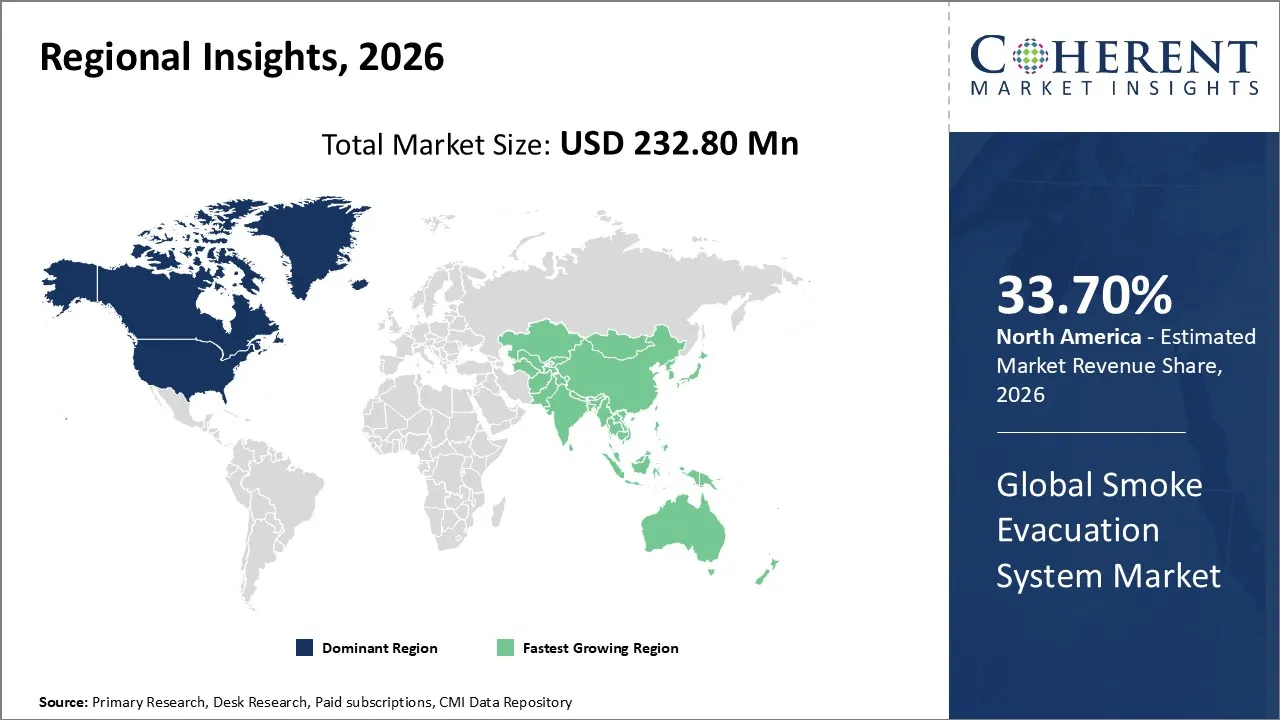
  • By Region, North America dominates the overall market with an estimated share of 33.7% in 2026 owing to the high surgical volumes across specialties.

Market Overview

The Smoke Evacuation System Market includes devices that actively remove harmful surgical smoke produced during electrosurgery, laser procedures, and laparoscopic operations. Rising surgical volumes, growing awareness of the health risks linked to surgical smoke, and stricter occupational safety guidelines in operating rooms drive market growth. Hospitals and ambulatory surgical centers remain the primary end users, while ongoing technological advancements and expanding healthcare infrastructure continue to support global market adoption.

Current Events and Its Impact on the Smoke Evacuation System Market

Current Events

Description and its impact

Technological Advancements in Surgical Equipment

  • Description: Integration of AI and IoT in Smoke Evacuation Systems
  • Impact: Enhances system efficiency and real-time monitoring, increasing demand for advanced smoke evacuation solutions.
  • Description: Development of Ultra-Compact and Portable Systems
  • Impact: Encourages adoption in outpatient and ambulatory surgery centers, expanding market reach.

Regulatory and Health Policy Changes

  • Description: Stricter OSHA and WHO Guidelines on Surgical Smoke Exposure
  • Impact: Forces healthcare providers to adopt compliant smoke evacuation systems, boosting market growth.
  • Description: Emerging Regulatory Frameworks in Asia-Pacific and Latin America
  • Impact: Opens new market opportunities as hospitals upgrade safety measures.

Geopolitical and Economic Factors

  • Description: Trade Tensions Affecting Medical Device Imports/Exports
  • Impact: Could increase costs or delay deliveries, impacting market pricing and availability.
  • Description: Government Healthcare Spending Boosts in Emerging Markets
  • Impact: Promotes adoption of advanced surgical technologies, increasing demand.

Uncover macros and micros vetted on 75+ parameters: Get instant access to report

Segmental Insights

Smoke Evacuation System Market By Product Type

To learn more about this report, Download Free Sample

Smoke Evacuation System Market Insights, By Product Type - Smoke Evacuation Tubings contribute the highest share of the market owing to its technological improvements in tubing design and materials

Smoke Evacuation Tubings hold the largest market share of 36.8% in 2026. Smoke evacuation tubings support the Smoke Evacuation System Market by efficiently channeling surgical smoke from the operative site to filtration units. The growing use of energy-based surgical instruments, increased emphasis on operating room cleanliness, and regular replacement of disposable tubing to maintain infection control drive demand. In addition, easy installation, compatibility with a wide range of surgical devices, and the rising preference for minimally invasive procedures continue to strengthen market adoption. For instance, in October 2025, KARL STORZ, a global leader in minimally invasive surgical technology, announces FDA clearance for the ENDOFLATOR™ +, a next-generation insufflator with an integrated surgical smoke evacuation system for modern operating rooms.

Smoke Evacuation System Market Insights, By Application - Laparoscopic Surgery contribute the highest share of the market owing to its health & safety concerns over surgical smoke

Laparoscopic Surgery expected to hold the largest market share of 43.3% in 2026. The growing number of laparoscopic surgeries drives the Smoke Evacuation System Market, as these minimally invasive procedures produce concentrated surgical smoke that must be efficiently removed. Hospitals and surgical centers emphasize patient safety and maintain clear visibility during operations, encouraging the use of specialized smoke evacuation systems. Rising awareness of the risks associated with surgical smoke, along with the increasing preference for faster recovery and less invasive techniques, actively boosts the adoption of advanced smoke management solutions in laparoscopic procedures.

In October 2025, Bayou Surgical, a leader in intraoperative visualization, launched the 5mm troCarWash™ system, an advanced automated laparoscope cleaner that maintains clear vision during minimally invasive surgery without removing the scope.

Smoke Evacuation System Market Insights, By End-User - Hospitals contribute the highest share of the market owing to its greater financial & technological resources

Hospitals acquired the prominent market share of 39.9% in 2026. Hospitals actively drive the Smoke Evacuation System Market by performing large volumes of diverse surgical procedures that produce substantial surgical smoke. They prioritize patient safety and protect operating room staff from harmful airborne particles, which encourages the adoption of advanced smoke evacuation solutions. Strict regulatory standards and internal safety protocols further prompt hospitals to deploy these systems. Moreover, hospitals leverage their established infrastructure, multiple operating rooms, and financial capacity to integrate efficient and technologically advanced smoke management devices.
Regional Insights

Smoke Evacuation System Market By Regional Insights

To learn more about this report, Download Free Sample

North America Smoke Evacuation System Market Trends

North America dominates the overall market with an estimated share of 33.70% in 2026. In North America, hospitals and surgical centers actively drive the Smoke Evacuation System Market by prioritizing surgical safety and complying with strict regulatory standards. Healthcare providers adopt advanced systems featuring high-efficiency filtration and ergonomic designs to protect staff from harmful surgical smoke. They increasingly integrate smoke evacuation technology with minimally invasive and energy-based surgical procedures. Growing awareness of occupational hazards, along with continuous upgrades in hospital infrastructure, further strengthens the region’s market expansion. For instance, Olympus announced a nationwide contract with Vizient Inc., giving members preferred pricing on its smoke evacuation products, including the OR-VAC™ Surgical Smoke Evacuator, Telescopic Smoke Pencil, Ultravision™ Generator, and UHI-4 Insufflator.

Asia Pacific Smoke Evacuation System Market Trends

In the Asia Pacific region, hospitals and surgical centers are actively expanding the Smoke Evacuation System Market by modernizing operating rooms and adopting advanced surgical technologies. Healthcare providers are implementing effective smoke evacuation solutions as awareness of the health risks from surgical smoke grows. Increasing numbers of minimally invasive and laparoscopic procedures, along with rising investments in healthcare infrastructure, drive demand. Additionally, medical tourism expansion and government initiatives to enhance surgical safety actively promote the adoption of smoke evacuation systems across the region.

United States Smoke Evacuation System Market Trends

In the United States, hospitals and surgical centers are actively driving the Smoke Evacuation System Market by enhancing operating room safety and protecting staff. Healthcare providers adopt systems featuring advanced filtration, ergonomic designs, and seamless integration with energy-based and minimally invasive surgical devices. Increasing awareness of the hazards of surgical smoke, combined with strict regulatory requirements and hospital accreditation standards, motivates widespread implementation. Continuous investments in upgrading surgical infrastructure further boost the adoption and growth of smoke evacuation solutions across the country.

China Smoke Evacuation System Market Trends

In China, hospitals and surgical centers are actively expanding the Smoke Evacuation System Market by upgrading facilities to meet modern surgical standards. Healthcare providers implement smoke evacuation solutions to protect staff from harmful surgical smoke and ensure patient safety. The growing number of minimally invasive and laparoscopic procedures, combined with expanding healthcare infrastructure and government initiatives to enhance surgical quality, drives demand. Additionally, rising medical tourism and increased awareness of occupational hazards actively promote the nationwide adoption of advanced smoke evacuation systems.

End-user Feedback and Unmet Needs in the Smoke Evacuation System Market

  • Ease of Use and Workflow Integration: End-users often highlight challenges in handling bulky or complex smoke evacuation systems. They seek ergonomically designed, lightweight, and easily maneuverable units that integrate seamlessly with existing surgical instruments and operating room workflows, minimizing disruption and setup time during procedures.
  • Filtration Efficiency and Air Quality: Healthcare professionals emphasize the need for high-performance filtration systems that effectively remove fine particulates, toxic gases, and pathogens. Current systems sometimes fail to maintain optimal air quality, especially during long or energy-intensive procedures, leaving a gap in ensuring staff safety and patient protection.
  • Noise Reduction and Operational Comfort: Many end-users report that smoke evacuation devices generate excessive noise, which can distract surgical teams and affect concentration. There is a clear demand for quieter systems that maintain suction efficiency without compromising the operating room environment or surgeon comfort.

Smoke Evacuation System Market Trend

Focus on Occupational Safety and Air Quality

Healthcare facilities are emphasizing staff protection against hazardous surgical smoke. This trend highlights systems equipped with high-efficiency filtration and pathogen removal capabilities. Hospitals are increasingly implementing these devices to comply with safety protocols and regulatory standards, ensuring safer operating room environments. The focus on occupational safety also encourages ongoing innovation, such as monitoring air quality in real-time and designing ergonomic systems that minimize exposure during long-duration procedures.

Smoke Evacuation System Market Opportunity

Development of Advanced Filtration and Portable Systems

Healthcare providers increasingly seek smoke evacuation devices with high-efficiency HEPA/ULPA filtration and portable, user-friendly designs. The opportunity lies in designing compact, lightweight, and easily deployable systems that maintain suction performance while reducing noise and installation complexity. Manufacturers can differentiate by offering modular solutions adaptable to multiple surgical settings, catering to hospitals, ambulatory surgical centers, and smaller clinics, thereby expanding market penetration across diverse healthcare facilities.

Market Report Scope

Smoke Evacuation System Market Report Coverage

Report Coverage Details
Base Year: 2025 Market Size in 2026: USD 232.80 Mn
Historical Data for: 2020 To 2024 Forecast Period: 2026 To 2033
Forecast Period 2026 to 2033 CAGR: 9.1% 2033 Value Projection: USD 432.60 Mn
Geographies covered:
  • North America: U.S. and Canada
  • Latin America: Brazil, Argentina, Mexico, and Rest of Latin America
  • Europe: Germany, U.K., Spain, France, Italy, Russia, and Rest of Europe
  • Asia Pacific: China, India, Japan, Australia, South Korea, ASEAN, and Rest of Asia Pacific
  • Middle East: GCC Countries, Israel, and Rest of Middle East
  • Africa: South Africa, North Africa, and Central Africa
Segments covered:
  • By Product Type: Smoke Evacuation Tubings, Smoke Evacuators - Portable and Stationary, Smoke Evacuation Wands & Pencils, Smoke Evacuation Filtration Devices and Smoke Evacuation Pencils and Wands
  • By Application: Laparoscopic Surgery, Open Surgery, Aesthetic Surgeries, Orthopedic Surgery, and Others
  • By End-user: Clinics, Ambulatory Surgical Centers, Cosmetic Surgery Centers, and Hospitals
Companies covered:

Medtronic Plc.,  BOWA-electronic GmbH & Co. KG, CooperSurgical, Inc., Symmetry Surgical, I.C. Medical, Inc., CONMED Corporation, CLS Surgimedics, Stryker Corporation, Surgiform Technologies LLC, Zimmer Biomet, Steris Corporation, and  Applied Medical Technology, Inc.

Growth Drivers:
  • Rising Surgical Volumes
  • Expansion of Healthcare Infrastructure
Restraints & Challenges:
  • Integration Complexity
  • Noise and Ergonomics

Uncover macros and micros vetted on 75+ parameters: Get instant access to report

Smoke Evacuation System Market News

  • In November 2025, MellingMedical collaborated with IC Medical to bring advanced surgical smoke evacuation systems to federal healthcare providers, using its SDVOSB status to enhance safety for veterans, active-duty military, and their families.
  • In September 2025, The NYU Fire Research Group at NYU Tandon School of Engineering has developed an artificial intelligence system that detects fires and smoke in real-time using standard security cameras, potentially improving fire safety.

Analyst Opinion (Expert Opinion)

  • The current trajectory of the Smoke Evacuation System market reflects a necessary but uneven transition in surgical practice. Although surgical smoke contains a complex mix of volatile organic compounds and ultrafine particulates that have demonstrated health effects in clinical studies, operating room personnel compliance has historically been remarkably low — documented nursing compliance with smoke evacuation during applicable procedures was under 0.5% in a 2019 audit at a major teaching hospital, later improving only to 30% after targeted policy implementation and equipment acquisition. This stark baseline underscores the latent demand for safer practices rather than the oft‑cited generic market growth narrative.
  • Clinical evidence further substantiates the tangible benefit of smoke evacuation devices: randomized measurements during breast surgeries showed significantly lower environmental volatile organic compound levels and reduced formaldehyde exposure for surgeons and nurses when evacuation systems were used, indicating these technologies do more than merely control odor — they materially reduce occupational exposure to harmful agents. Such controlled evidence should, in principle, dissolve any residual skepticism among hospital procurement leaders, yet widespread adoption remains impeded by operational inertia and variable awareness.
  • Real‑world examples reinforce this dichotomy. A U.S. facility that instituted mandatory smoke evacuation reported a 24% drop in staff call‑outs and unanimous reports of improved safety perceptions among personnel, showing that structured implementation not only improves air quality but also workforce stability and morale. Conversely, surveys in European settings reveal that even when equipment is available, usage rates can lag because of factors such as device noise, forgetfulness, and misconceptions about reliance on general ventilation — highlighting the industry’s ongoing challenge to convert availability into consistent utilization.

Market Segmentation

  • By Product Type
    • Smoke Evacuation Tubings
    • Smoke Evacuators - Portable and Stationary
    • Smoke Evacuation Wands & Pencils
    • Smoke Evacuation Filtration Devices
    • Smoke Evacuation Pencils and Wands
  • By Application
    • Laparoscopic Surgery
    • Open Surgery
    • Aesthetic Surgeries
    • Orthopedic Surgery
    • Others
  • By End-user
    • Clinics
    • Ambulatory Surgical Centers
    • Cosmetic Surgery Centers
    • Hospitals
  • By Regional Insights
    • North America
      • U.S.
      • Canada
    • Latin America
      • Brazil
      • Argentina
      • Mexico
      • Rest of Latin America
    • Europe
      • Germany
      • U.K.
      • Spain
      • France
      • Italy
      • Russia
      • Rest of Europe
    • Asia Pacific
      • China
      • India
      • Japan
      • Australia
      • South Korea
      • ASEAN
      • Rest of Asia Pacific
    • Middle East
      • GCC Countries
      • Israel
      • Rest of Middle East
    • Africa
      • South Africa
      • North Africa
      • Central Africa
  • Key Players Insights
    • Medtronic Plc.
    • BOWA-electronic GmbH & Co. KG
    • CooperSurgical, Inc.
    • Symmetry Surgical
    • C. Medical, Inc.
    • CONMED Corporation
    • CLS Surgimedics
    • Stryker Corporation
    • Surgiform Technologies LLC
    • Zimmer Biomet
    • Steris Corporation
    • Applied Medical Technology, Inc.

Sources

Primary Research interviews

  • Interviews with hospital administrators and surgical staff involved in operating room management.
  • Discussions with biomedical engineers and technical staff handling smoke evacuation systems.
  • Consultations with device manufacturers’ R&D and sales teams.
  • Feedback from regulatory and safety compliance officers.

Databases

  • ClinicalTrials.gov for ongoing and completed clinical trials involving smoke evacuation systems.
  • PubMed for research articles related to surgical smoke hazards and mitigation technologies.
  • FDA 510(k) and PMA databases for device approvals and regulatory information.
  • WHO Global Health Observatory for hospital and surgical statistics.

Magazines

  • Medical Device & Diagnostic Industry (MD+DI) for product trends and innovations.
  • OR Manager for operating room management insights and equipment updates.
  • Biomedical Instrumentation & Technology for emerging medical device technologies.

Journals

  • Journal of Hospital Infection for studies on surgical smoke hazards.
  • Surgical Endoscopy for minimally invasive surgery trends and smoke evacuation research.
  • Annals of Surgery for clinical outcomes related to smoke exposure and safety practices.
  • Journal of Occupational and Environmental Hygiene for occupational health studies related to surgical smoke.

Newspapers

  • The New York Times – healthcare technology and hospital safety news.
  • The Guardian – healthcare and medical equipment innovation news.
  • The Times of India – updates on hospital infrastructure and surgical safety in Asia-Pacific.

Associations

  • Association of periOperative Registered Nurses (AORN) – guidelines and standards for smoke evacuation.
  • American Society of Anesthesiologists (ASA) – recommendations on OR air quality and safety.
  • International Federation of Surgical Colleges – global insights on surgical safety and equipment adoption.
  • Occupational Safety and Health Administration (OSHA) – regulations on surgical smoke exposure.

Public Domain sources

  • WHO reports on hospital safety and infection control.
  • CDC guidelines on surgical smoke and operating room hazards.
  • Government health department publications on hospital infrastructure and safety standards.
  • Patent filings related to smoke evacuation technologies (USPTO database).

Proprietary Elements

  • CMI Data Analytics Tool
  • Proprietary CMI Existing Repository of information for last 8 years

Share

Share

About Author

Komal Dighe is a Management Consultant with over 8 years of experience in market research and consulting. She excels in managing and delivering high-quality insights and solutions in Health-tech Consulting reports. Her expertise encompasses conducting both primary and secondary research, effectively addressing client requirements, and excelling in market estimation and forecast. Her comprehensive approach ensures that clients receive thorough and accurate analyses, enabling them to make informed decisions and capitalize on market opportunities.

Missing comfort of reading report in your local language? Find your preferred language :

Frequently Asked Questions

The Smoke Evacuation System Market is estimated to be valued at USD 232.80 Mn in 2026 and is expected to reach USD 432.60 Mn by 2033.

The CAGR of the Smoke Evacuation System Market is projected to be 9.1% from 2026 to 2033

Hospitals dominate due to higher surgical volumes, multiple operating rooms, and stricter regulatory compliance.

High equipment and maintenance costs, limited awareness in emerging regions, noise and bulkiness of some devices, and recurring costs for consumables like filters and tubing are primary obstacles.

While not universally mandated, regulatory agencies such as OSHA, NIOSH, and AORN strongly recommend or require smoke management in operating rooms.

Select a License Type

EXISTING CLIENTELE

Joining thousands of companies around the world committed to making the Excellent Business Solutions.

View All Our Clients
trusted clients logo
© 2026 Coherent Market Insights Pvt Ltd. All Rights Reserved.