all report title image

Middle East and Turkey Immune Thrombocytopenic Purpura (ITP) Treatment Drugs Market Analysis & Forecast: 2026-2033

Middle East and Turkey Immune Thrombocytopenic Purpura (ITP) Treatment Drugs Market, By Drug Type (Steroid, Immunoglobulins, Thrombopoietin Receptor Agonist and Others, By Distribution Channel (Hospital Pharmacies, Retail Pharmacies and Online Pharmacies), By Country (Turkey, Israel, Egypt, Saudi Arabia, UAE, and Rest of Middle East)

  • Published In : 04 Feb, 2026
  • Code : CMI3171
  • Page number :153
  • Formats :
      Excel and PDF :
  • Industry : Pharmaceutical
  • Historical Range : 2020 - 2024
  • Forecast Period : 2026 - 2033

Middle East and Turkey Immune Thrombocytopenic Purpura (ITP) Treatment Drugs Market Size and Trends: 2026-2033

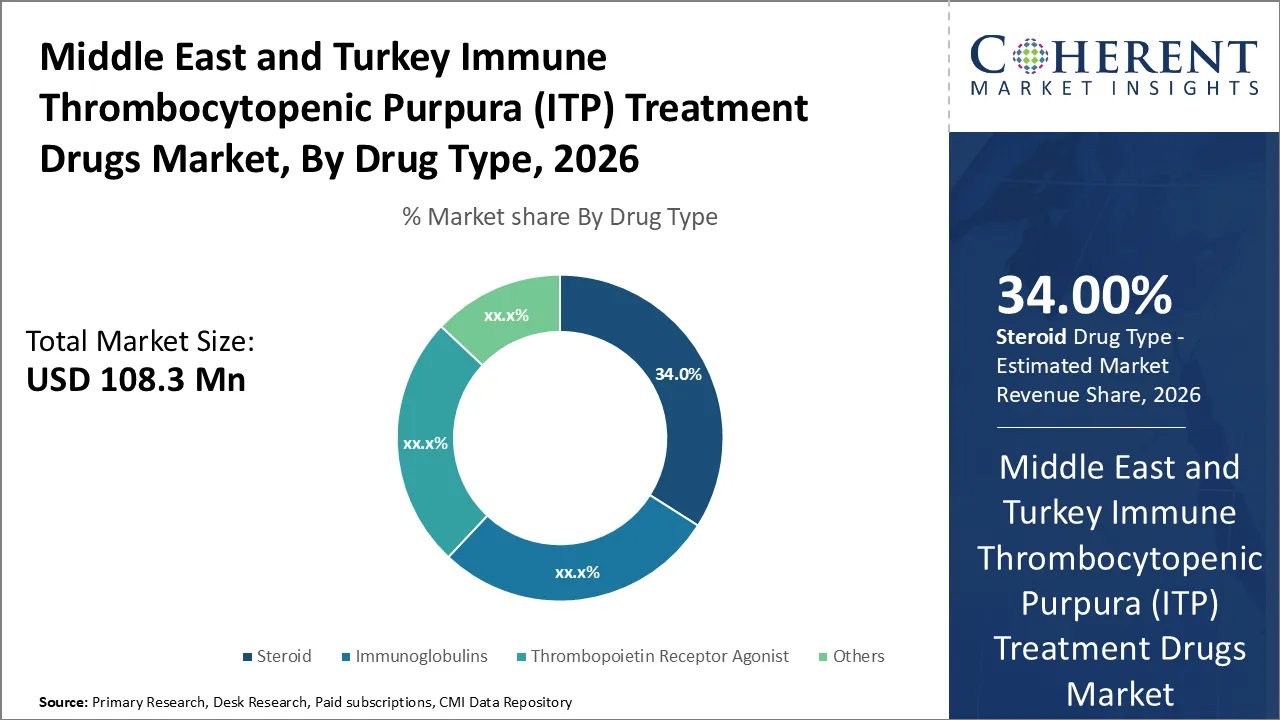
Middle East and Turkey Immune Thrombocytopenic Purpura (ITP) Treatment Drugs market is estimated to be valued at USD 108.3 Mn in 2026 and is expected to reach USD 142.4 Mn by 2033, exhibiting a compound annual growth rate (CAGR) of 4.0% from 2026 to 2033.

Key Takeaways

  • Based on Drug Type, the Steroids segment is expected to lead the Middle East and Turkey Immune Thrombocytopenic Purpura (ITP) Treatment Drugs market with 34% share in 2026, owing to their widespread use as first-line therapy and cost-effectiveness.
  • Based on Distribution Channel, the Hospital Pharmacies segment is anticipated to dominate the market with 68% share in 2026, due to high dependency on specialist care, intravenous therapies, and centralized drug procurement across the country.
  • Turkey is set to dominate the Middle East and Turkey Immune Thrombocytopenic Purpura ITP) Treatment Drugs Market with an estimated 45% share, driven by better access to advanced therapies, strong distribution networks, and higher treatment adoption.

Market Overview

The growing prevalence of immune thrombocytopenic purpura (ITP) in the Middle East and Turkey regions, coupled with the rising diagnosis rates and improved hematology care accessibility, is driving the growth of the ITP treatment drugs market. The rising awareness among healthcare professionals and patients about the early management of the disease has resulted in an increased adoption of pharmacologic therapies, especially first-line steroids and immunoglobulins. Furthermore, the rising number of specialty hospitals and government efforts to improve the infrastructure for the treatment of rare diseases are also driving the demand for ITP therapies in the countries.

Current Events and Its Impacts on the Middle East and Turkey Immune Thrombocytopenic Purpura (ITP) Treatment Drugs Market

Current Events

and its impact

 Geopolitical Tensions and Healthcare Access

  • Description: Ongoing Conflict and Instability in Israel-Palestine
  • Impact: Disrupts pharmaceutical supply chains, causing delays in drug approvals and a reduction in the allocation of healthcare funds for specialty drugs such as ITP medications
  • Description: Iran Sanctions and Restrictions on Medical Equipment
  • Impact: Reduces the availability of advanced ITP therapies and diagnostic tools, resulting in market gaps for new entrants

Turkey's Economic and Regulatory Transformation

  • Description: Turkish Lira Devaluation and Inflation Crisis
  • Impact: Increases the cost of imported ITP medications, which could drive the demand for domestic production and generic versions
  • Description: Turkey's New Drug Pricing and Reimbursement Policies
  • Impact: Influences the entry of high-end ITP therapies into the market, with cost-effective biosimilars and generic thrombopoietin receptor agonists being preferred

Uncover macros and micros vetted on 75+ parameters: Get instant access to report

How are treatment advancements driving growth in the Middle East and Turkey Immune Thrombocytopenic Purpura (ITP) Treatment Drugs Market?

  • Advancements in Targeted Therapies: Rising usage of thrombopoietin receptor agonists and monoclonal antibodies is enhancing platelet response rates and minimizing long-term steroid use, thus fueling the growth of the market.
  • Transition to Chronic Disease Management: Increasing emphasis on managing chronic and refractory ITP patients has led to an increased demand for maintenance therapies with improved safety and efficacy profiles.
  • Hospital-Based Innovation in Treatment: Presence of advanced diagnostic facilities and infusion therapies in tertiary care hospitals has improved patient outcomes, thus fueling the growth of the market through hospital-based pharmacies.
  • Increased Accessibility through Government Initiatives: National healthcare programs and reimbursement policies for rare and hematological disorders in key Middle Eastern nations are increasing patient accessibility to ITP therapies.

Segmental Insights

Middle East and Turkey Immune Thrombocytopenic Purpura (ITP) Treatment Drugs Market By Drug Type

To learn more about this report, Download Free Sample

Middle East and Turkey Immune Thrombocytopenic Purpura (ITP) Treatment Drugs Market Insights, By Drug Type – Steroids dominate due to first-line usage and cost-effectiveness

Based on the type of drug, the steroids segment is expected to account for the largest market share of 34% in 2026 in the Middle East and Turkey Immune Thrombocytopenic Purpura (ITP) Treatment Drugs market. This is because steroids are still the main first-line treatment for newly diagnosed patients with ITP because of their quick platelet response, broad clinical acceptance, and lower treatment cost. The ease of availability and presence in the standard treatment guidelines also help to ensure a continued demand for the drug in both public and private healthcare facilities in the country.

For instance, in August 2025, Novartis announced that the Phase III VAYHIT2 trial achieved its primary endpoint in ITP patients who had received corticosteroids, demonstrating statistically significant prolongation of time to treatment failure with ianalumab plus eltrombopag compared with placebo plus eltrombopag.

Middle East and Turkey Immune Thrombocytopenic Purpura (ITP) Treatment Drugs Market Insights, By Distribution Channel – Hospital pharmacies lead due to specialist care and centralized procurement

By distribution channel, the hospital pharmacies segment is projected to hold the largest market share of 68% in 2026. Hospital pharmacies are very important in the distribution of ITP treatment medications because of the need for specialized hematology management, especially for intravenous medications such as immunoglobulins and biologics. The centralized procurement of drugs, especially in the government and teaching hospitals, ensures that there is constant availability of ITP treatment medications.

For instance, in July 2025, The United Arab Emirates has approved the oral Bruton’s tyrosine kinase (BTK) inhibitor rilzabrutinib for the treatment of chronic immune thrombocytopenia (ITP), a major regulatory achievement for the country and an expansion of the treatment options available through hospital pharmacies.

Middle East and Turkey Immune Thrombocytopenic Purpura (ITP) Treatment Drugs Market Outlook for Key Countries

Is Turkey emerging as a key market for ITP treatment drugs driven by strong hospital infrastructure and public healthcare coverage?

Turkey is anticipated to lead the Middle East and Turkey Immune Thrombocytopenic Purpura (ITP) Treatment Drugs Market in 2026, with an estimated market share of around 45%. The dominance of Turkey can be attributed to factors such as a relatively advanced healthcare infrastructure, higher awareness and diagnosis rates of ITP, strong presence of multinational pharmaceutical companies, and wider availability of branded and biologic treatment options through established hospital and specialty care networks.

For instance, in August 2025, Novartis announced positive Phase III results for ianalumab plus eltrombopag in ITP patients previously treated with steroids, demonstrating significantly improved duration of disease control.

Is Israel’s advanced healthcare ecosystem accelerating adoption of innovative ITP therapies?

The market for ITP treatment drugs in Israel is distinguished by the early adoption of innovative treatments due to the technologically advanced healthcare system and a strong focus on evidence-based medicine. Israel has universal health coverage through health maintenance organizations (HMOs), which provides patients with access to both first-line steroid treatments and biologics.

For instance, in December 2025, Sanofi’s oral BTK inhibitor Wayrilz (rilzabrutinib) received approval from the European Commission as the first BTK inhibitor indicated for adults with immune thrombocytopenia (ITP) who are refractory to other therapies.

Market Report Scope

Middle East and Turkey Immune Thrombocytopenic Purpura (ITP) Treatment Drugs Market Report Coverage

Report Coverage Details
Base Year: 2025 Market Size in 2026: USD 108.3 Mn
Historical Data for: 2020 To 2024 Forecast Period: 2026 To 2033
Forecast Period 2026 to 2033 CAGR: 4.0% 2033 Value Projection: USD 142.4 Mn
Geographies covered:
  • Middle East: Turkey, GCC Countries, Israel, and Rest of Middle East
Segments covered:
  • By Drug Type: Steroid, Immunoglobulins, Thrombopoietin Receptor Agonist, and Others
  • By Distribution Channel: Hospital Pharmacies, Retail Pharmacies, and Online Pharmacies
Companies covered:

Amgen Inc., Octapharma AG, Novartis AG, Swedish Orphan Biovitrum AB, and Rigel Pharmaceuticals, Inc.

Growth Drivers:
  • Rising prevalence and diagnosis of ITP
  • Expansion of hospital pharmacies and specialist care
Restraints & Challenges:
  • Launch of novel therapies for refractory ITP
  • Expansion of hospital pharmacy networks

Uncover macros and micros vetted on 75+ parameters: Get instant access to report

Middle East and Turkey Immune Thrombocytopenic Purpura (ITP) Treatment Drugs Market Driver

Rising prevalence of ITP and increasing awareness of treatment options

The rising incidence of immune thrombocytopenic purpura (ITP) in the Middle East and Turkey, as well as the rising number of diagnoses and awareness among medical professionals, is propelling the demand for effective treatment medications. Enhanced availability of hematology services, the development of hospital pharmacies, and government-backed healthcare programs have also contributed to the adoption of both traditional and novel treatments for ITP, including thrombopoietin receptor agonists.

Middle East and Turkey Immune Thrombocytopenic Purpura (ITP) Treatment Drugs Market Opportunity

Introduction of novel therapies and expansion of hospital-based distribution

The market offers opportunities with the development of next-generation therapies such as oral SYK inhibitors and monoclonal antibody therapies for patients who are refractory to conventional therapies. The expansion of hospital pharmacy chains and specialty treatment centers in key countries such as Saudi Arabia, UAE, Turkey, and Israel improves accessibility to these novel therapies. Further, the development of biosimilars and cost-effective generics provides an opportunity for growth by making them more accessible.

Analyst Opinion (Expert Opinion)

  • The Middle East and Turkey ITP treatment drugs market is entering a phase of strategic transformation, driven not merely by rising prevalence but by a shift toward targeted therapies and hospital-centric care delivery. Clinical data from the country indicate that more than 40% of diagnosed ITP patients in Turkey and Israel do not achieve sustained response from first-line corticosteroids alone, which has prompted a notable uptick in the adoption of thrombopoietin receptor agonists and newer oral therapies like fostamatinib.
  • Hospital pharmacies remain the critical nexus for ITP treatment distribution, reflecting the dependency on intravenous therapies, close patient monitoring, and complex reimbursement structures. Evidence from hospital networks shows that over 65% of ITP therapies are dispensed through hospital pharmacies, with retail and online channels playing only a supplementary role.
  • Investment in biosimilars and locally manufactured generics is another decisive trend. For example, Turkey’s growing capacity to produce cost-effective thrombopoietin receptor agonists has already led to a reported 20–25% increase in patient access to second-line therapies in 2025 alone. This demonstrates that the market is not simply expanding in size, but evolving in sophistication, with healthcare infrastructure, specialist care, and regulatory support converging to enable more complex treatment protocols.

Top Strategies Followed by Middle East and Turkey ITP Treatment Drugs Market Players

  • Established pharmaceutical companies focus on R&D to drive innovative therapies. Leading players such as Novartis, Sanofi, and Grifols are heavily investing in the development of next-generation ITP treatments, including oral SYK inhibitors, monoclonal antibodies, and combination regimens. These companies conduct extensive clinical trials across Turkey, Israel, and the broader Middle East to validate efficacy, safety, and patient adherence.
  • Mid-sized players leverage cost-efficient manufacturing and partnerships. Companies like Kissei Pharmaceutical and Medison Israel focus on producing biosimilars or generics of thrombopoietin receptor agonists and immunoglobulins. By optimizing production and supply chains in the country, they maintain competitive pricing while expanding access to ITP therapies, particularly in hospital pharmacy networks where most patients receive treatment.
  • Small-scale and niche players specialize in targeted therapies for refractory cases. Smaller biotech firms often concentrate on novel molecules or combination therapies for patients who do not respond to conventional treatment. They form strategic collaborations with hospitals and research centers to test their drugs and gain faster regulatory approval. Local partnerships also help these players enter the Middle Eastern market efficiently despite limited distribution capabilities.

Emerging Startups in the Middle East and Turkey ITP Treatment Drugs Market

  • Innovative therapy development is a priority. Several startups are exploring first-in-class molecules and oral treatment options for chronic or refractory ITP. For instance, Israeli and Turkish biotech startups are working on novel SYK inhibitors and monoclonal antibody combinations that aim to reduce dependence on hospital-administered intravenous therapies.
  • Focus on accessibility and affordability. Startups are also developing cost-effective biosimilars and generics, addressing gaps in patient access, particularly in countries with high treatment costs. These efforts could significantly expand patient reach in Turkey and the Middle East.
  • Partnerships with hospitals and research institutes accelerate adoption. Startups frequently collaborate with tertiary hospitals, hematology clinics, and local universities to test therapies in real-world settings. These collaborations help generate clinical evidence, optimize dosing regimens, and speed up regulatory approvals, ensuring that innovative therapies reach patients faster.

Middle East and Turkey Immune Thrombocytopenic Purpura (ITP) Treatment Drugs Industry News

  • In August 2025, Novartis announced that ianalumab + eltrombopag met its primary endpoint in a Phase III ITP study, showing significant improvement in time to treatment failure and sustained platelet responses in primary ITP patients previously treated with corticosteroids.
  • In July 2025, Sobi announced the U.S. FDA approval of Doptelet® (avatrombopag) for the treatment of persistent and chronic ITP in pediatric patients (one year and older), including a new sprinkle formulation intended to improve administration flexibility for young children.

Market Segmentation

  • Drug Type Insights (Revenue, USD Mn, 2026 - 2033)
    • Steroid
    • Immunoglobulins
    • Thrombopoietin Receptor Agonist
    •  Others
  • Distribution Channel Insights (Revenue, USD Mn, 2026 - 2033)
    • Hospital Pharmacies
    • Retail Pharmacies
    •  Online Pharmacies
  • Country Insights (Revenue, USD Mn, 2026 - 2033)
    • Middle East
      • Turkey
      • GCC Countries
      • Israel
      • Rest of Middle East
  • Key Players Insights
    • Amgen Inc.
    • Octapharma AG
    • Novartis AG
    • Swedish Orphan Biovitrum AB
    • Rigel Pharmaceuticals, Inc.

Sources

Primary Research Interviews

  • Hematologists & Specialist Physicians in Turkey & Middle East
  • Pharmacy Directors & Hospital Pharmacy Managers
  • Medical Affairs & Product Managers from Pharmaceutical Companies
  • Regulatory Affairs Professionals
  • Healthcare Providers & Nurses treating ITP patients
  • Patient Advocacy Group Representatives
  • Clinical Trial Coordinators
  • Others

Databases

  • Bloomberg Terminal
  • Thomson Reuters Eikon
  • S&P Global Market Intelligence
  • Statista
  • PubMed Clinical Trials Database
  • ClinicalTrials.gov
  • Others

Magazines

  • Pharmaceutical Technology
  • FiercePharma
  • PharmaVOICE
  • PharmaTimes
  • Elsevier Pharma News
  • Others

Journals

  • Blood (Journal of the American Society of Hematology)
  • Haematologica – The Hematology Journal
  • International Journal of Hematology
  • Platelets Journal
  • European Journal of Haematology
  • Others

Newspapers

  • Financial Times (Healthcare Section)
  • The Wall Street Journal (Pharma & Biotech)
  • Reuters Health
  • Bloomberg News (Healthcare & Pharma)
  • Gulf News (Middle East Healthcare Section)
  • Others

Associations

  • International Society on Thrombosis and Haemostasis (ISTH)
  • World Federation of Hemophilia (WFH)
  • Middle East Society for Blood & Marrow Transplantation (MESBMT)
  • National Hematology Societies of Turkey & Israel
  • Others

Public Domain Sources

  • WHO – Global Health Observatory (Hematology & Blood Disorders)
  • Ministries of Health Reports (Turkey, Israel, UAE, Saudi Arabia)
  • Clinical Trial Registries (clinicaltrials.gov & EU Clinical Trials Register)
  • National Cancer & Blood Disorder Reports
  • Official Pharmaceutical Company Press Releases & Annual Reports
  • Others

Proprietary Elements

  • CMI Data Analytics Tool
  • Proprietary CMI Existing Repository of Information for the Last 8 Years

Share

Share

About Author

Ghanshyam Shrivastava - With over 20 years of experience in the management consulting and research, Ghanshyam Shrivastava serves as a Principal Consultant, bringing extensive expertise in biologics and biosimilars. His primary expertise lies in areas such as market entry and expansion strategy, competitive intelligence, and strategic transformation across diversified portfolio of various drugs used for different therapeutic category and APIs. He excels at identifying key challenges faced by clients and providing robust solutions to enhance their strategic decision-making capabilities. His comprehensive understanding of the market ensures valuable contributions to research reports and business decisions.

Ghanshyam is a sought-after speaker at industry conferences and contributes to various publications on pharma industry.

Missing comfort of reading report in your local language? Find your preferred language :

Frequently Asked Questions

The Middle East and Turkey ITP Treatment Drugs Market is estimated to be valued at USD 108.3 Mn in 2026, and is expected to reach USD 142.4 Mn by 2033.

The CAGR of the Middle East and Turkey ITP Treatment Drugs Market is projected to be 4.0% from 2026 to 2033.

Rising prevalence and diagnosis of ITP, increasing adoption of hospital-based treatments, expansion of hospital pharmacy networks, and the launch of innovative therapies such as thrombopoietin receptor agonists and oral SYK inhibitors are major growth drivers.

High treatment costs, limited access in rural areas, dependency on specialist care, and complex regulatory processes are the primary factors hampering market growth.

The steroids segment is projected to lead the market in 2026 due to their widespread use as first-line therapy and cost-effectiveness.

Amgen Inc., Octapharma AG, Novartis AG, Swedish Orphan Biovitrum AB (Sobi), and Rigel Pharmaceuticals, Inc. are the leading companies in this market.

Turkey is expected to lead the market due to its well-developed healthcare infrastructure, higher diagnosis and treatment rates for ITP, strong presence of multinational pharmaceutical companies, and established distribution networks across hospital and specialty care settings.

Select a License Type

EXISTING CLIENTELE

Joining thousands of companies around the world committed to making the Excellent Business Solutions.

View All Our Clients
trusted clients logo
© 2026 Coherent Market Insights Pvt Ltd. All Rights Reserved.