Medical Adhesives And Sealants Market Analysis & Forecast: 2026-2033
Medical adhesives and sealants market is estimated to be valued at USD 17,026 Mn in 2026 and is expected to reach USD 27,863 Mn by 2033, exhibiting a compound annual growth rate (CAGR) of 7.32% from 2026 to 2033.
The global medical adhesives and sealants market is experiencing a steady growth due to the increasing adoption of advanced wound closure and tissue sealing solutions. The increasing number of surgeries, the trend towards minimally invasive surgeries, and the need to reduce post-operative complications have all contributed to the growing demand for medical adhesives and sealants. The synthetic type of medical adhesives and sealants is currently dominating the market and has the largest share in 2026 because of its superior adhesive strength, faster setting time, and use in internal surgeries.
|
Current Events |
Description and its impact |
|
Global Supply Chain Disruptions and Raw Material Shortages |
|
|
Regulatory Changes and Medical Device Approval Processes |
|
Uncover macros and micros vetted on 75+ parameters: Get instant access to report
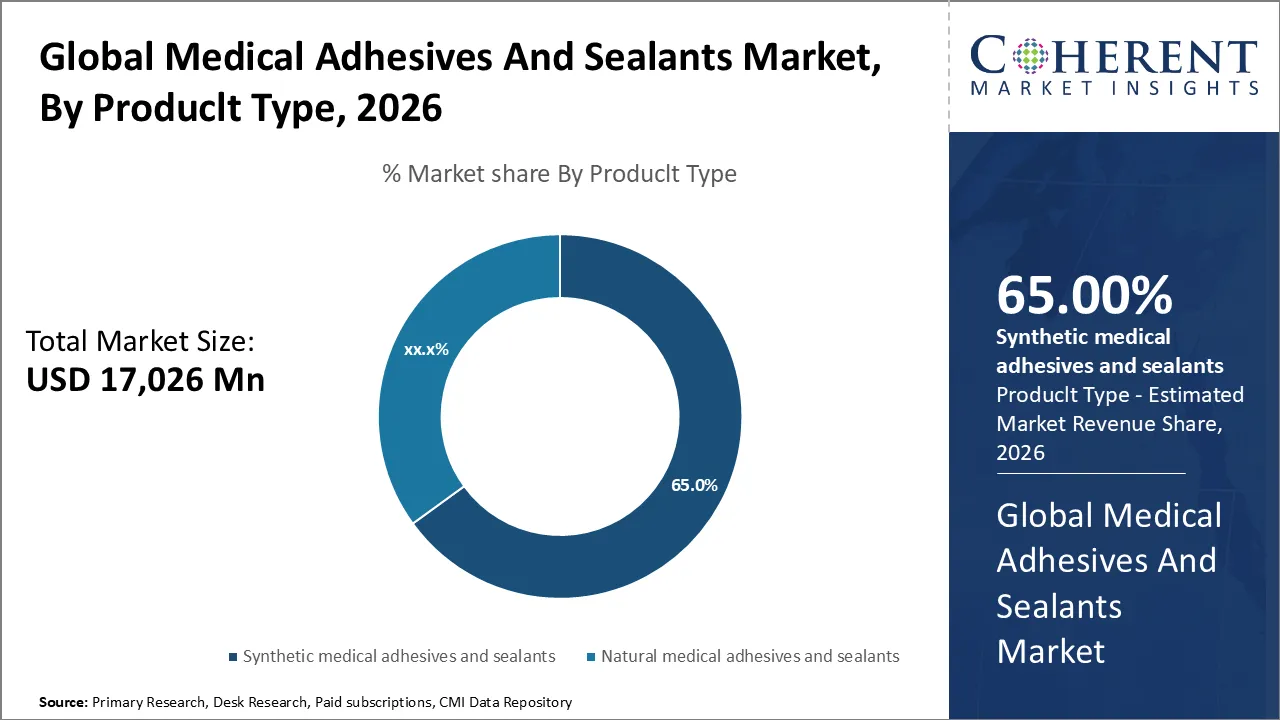
On the basis of product type, the synthetic medical adhesives and sealants market is expected to lead the market with a share of around 65% in 2026, owing to their fast-curing properties, high bonding strength, and ability to be used in multiple surgical and wound care procedures. Synthetic adhesives are gaining popularity in hospitals and surgical facilities because of their ability to effectively substitute sutures and staples.
For instance, in September 2025, Henkel introduced a new series of LED curable synthetic medical adhesives branded as Loctite, including Loctite AA 3951 / AA 3953 and Loctite AA 3961 / AA 3963, which are intended to cater to the stringent requirements of medical device assembly.
Based on application, the Internal wounds segment is expected to account for the highest market share of around 42% in 2026, as medical adhesives and sealants are being increasingly used in surgical procedures to replace traditional sutures and staples. The rise in the number of minimally invasive surgeries, cardiovascular, and orthopedic procedures has driven the demand for these products.
For instance, in October 2025, researchers at the Technion–Israel Institute of Technology created an injectable bioadhesive hydrogel that showed highly adhesive properties to wet internal organs, thus allowing for quick internal wound closure.
In terms of end user, the hospitals segment is expected to register the largest market share of approximately 55% in 2026, due to the large number of surgical procedures and advanced wound care treatments carried out in hospitals. Hospitals remain a major driver for the demand for medical adhesives and sealants as they shift from traditional methods of closure to faster, safer, and more effective methods.
For instance, in June 2025, Baxter International Inc. launched a new room‑temperature version of its Hemopatch Sealing Hemostat in Europe, improving ease of use for surgical teams in hospitals and helping control bleeding during procedures.
To learn more about this report, Download Free Sample
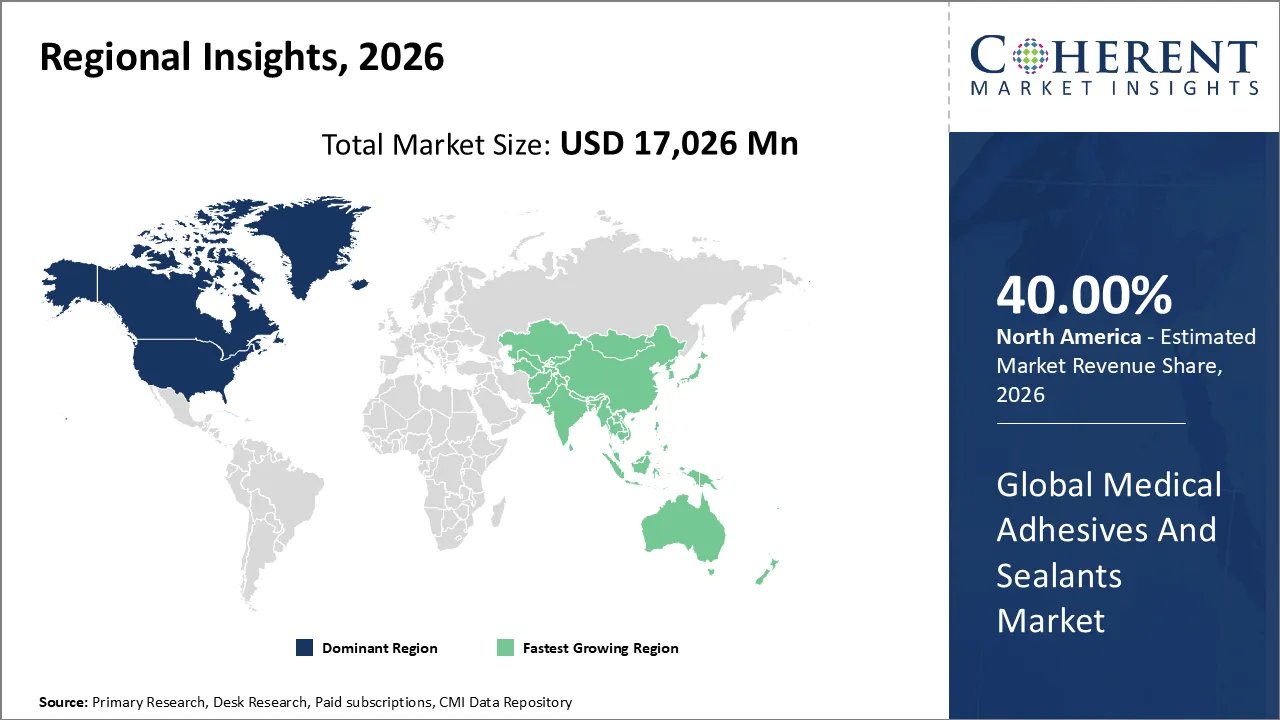
North America is expected to be the leading region in the medical adhesives and sealants market in 2026, with a market share of 40%. The dominance of the region can be attributed to the presence of key players in the market, the advanced healthcare infrastructure, the high adoption rate of innovative surgical technologies, and the high number of surgical procedures being performed in hospitals.
The Asia Pacific market is expected to be the fastest-growing in the medical adhesives and sealants market, driven by the rapidly expanding healthcare infrastructure, number of surgeries, awareness about advanced wound care, and investments in hospitals and surgical centers.
For instance, in January 2024, India’s Ministry of Health and Family Welfare announced an initiative to upgrade 157 district hospitals with advanced surgical care units under the PM‑Ayushman Bharat Health Infrastructure Mission. Such initiatives are propelling the medical adhesives and sealants demand.
Is the U.S. medical adhesives and sealants market growing due to hospital adoption and surgical innovation?
The U.S. medical adhesives and sealants market is expanding owing to the rising number of surgeries being conducted, well-developed infrastructure in hospitals, and adoption of innovative technologies for wound closure. Advanced adhesives and sealants are being increasingly preferred over sutures and staples for internal and external wound closure.
For instance, in March 2024, TELA Bio, Inc. announced the development of a breakthrough bio‑adhesive “Bone‑02” that can repair bone fractures with a single injection in as little as three minutes, potentially transforming orthopedic repair and reducing the need for invasive surgery.
Is China’s hospital modernization driving adhesives and sealants growth?
The increasing healthcare infrastructure in China, the number of surgical procedures, and the government’s initiatives to upgrade hospitals are driving the medical adhesives and sealants market. Hospitals are adopting new technologies for wound closure and hemostasis.
For instance, in September 2025, Chinese scientists announced the development of a breakthrough bio‑adhesive “Bone‑02” that can repair bone fractures with a single injection in as little as three minutes, potentially transforming orthopedic repair and reducing the need for invasive surgery.
| Report Coverage | Details | ||
|---|---|---|---|
| Base Year: | 2025 | Market Size in 2026: | USD 17,026 Mn |
| Historical Data for: | 2020 To 2024 | Forecast Period: | 2026 To 2033 |
| Forecast Period 2026 to 2033 CAGR: | 7.32% | 2033 Value Projection: | USD 27,863 Mn |
| Geographies covered: |
|
||
| Segments covered: |
|
||
| Companies covered: |
3M, Adhesion Biomedical, Bostik Ltd, Henkel AG & Company, B. Braun Melsungen, CryoLife, Inc, Itac Ltd, Ethicon Inc, Chemence Ltd, Covidien Ltd, GluStitch Inc, Cyberbond LLC, Adhezion Biomedical, Cohera Medical, Inc, Baxter International Inc, GEM S.r.l, Meyer-Haake Gmbh, Biocoral, Inc, Scapa Healthcare, Lohmann GmbH, and Mercator Medical. |
||
| Growth Drivers: |
|
||
| Restraints & Challenges: |
|
||
Uncover macros and micros vetted on 75+ parameters: Get instant access to report
The rising demand for medical adhesives and sealants over sutures and staples is propelling the market. Hospitals and surgical centers are adopting these products to reduce surgery time, risk of infection, and patient recovery outcomes. Rising surgical procedures, especially in internal wound management and minimally invasive surgery, are also driving the demand.
The market has strong growth potential with the development of next-generation adhesives and sealants. There are opportunities in the area of bioabsorbable, synthetic, and peptide-based adhesives, which can enhance surgical efficiency and safety. There are also opportunities in the development of temperature-stable and easy-to-use adhesives for operating rooms. Additionally, there are opportunities in emerging markets in the Asia Pacific and Latin America regions, where the healthcare infrastructure is developing rapidly.
The market for medical adhesives and sealants is currently experiencing a rapid paradigm shift due to the increasing trend from conventional sutures and staples to advanced wound closure systems. Clinical evidence indicates that more than 60% of the surgeries performed in North American hospitals currently involve the use of some type of adhesive or sealant, especially in internal wound care and minimally invasive surgery.
Regionally, North America market continues to lead, supported by the presence of advanced hospital infrastructure, a higher number of surgeries, and early adoption of innovative solutions. On the other hand, the Asia Pacific market is emerging as a high-growth market due to large-scale investments in healthcare infrastructure, increased surgical capacity in tier-1 and tier-2 hospitals, and government initiatives to adopt modern standards of wound care.
The market is also seeing a lot of innovation activity. The latest product launches, such as Baxter’s room-temperature Hemopatch and TELA Bio’s LIQUIFIX liquid adhesive for hernia repair, demonstrate how ease of use, storage stability, and operating efficiency are becoming increasingly important differentiators
Share
Share
About Author
Manisha Vibhute is a consultant with over 5 years of experience in market research and consulting. With a strong understanding of market dynamics, Manisha assists clients in developing effective market access strategies. She helps medical device companies navigate pricing, reimbursement, and regulatory pathways to ensure successful product launches.
Missing comfort of reading report in your local language? Find your preferred language :
Transform your Strategy with Exclusive Trending Reports :
Frequently Asked Questions
Joining thousands of companies around the world committed to making the Excellent Business Solutions.
View All Our Clients
 Schedule a meeting with report Author