Liquid Chromatography Mass Spectrometry (LCMS) Market Analysis & Forecast: 2026-2033
Liquid Chromatography Mass Spectrometry (LCMS) market is estimated to be valued at USD 8,169 Mn in 2026 and is expected to reach USD 18,020 Mn in 2033, exhibiting a compound annual growth rate (CAGR) of 12% from 2026 to 2033.
Liquid chromatography mass spectrometry is utilized by pharmaceutical, biotech, cosmetic, food processing, and other sectors for effective analysis of biochemical, as well as organic and inorganic compounds from complex samples.
|
Current Event |
Description and its Impact |
|
Advanced AI Integration and Miniaturization Technologies |
|
|
Global Environmental Monitoring and Regulatory Tightening |
|
Uncover macros and micros vetted on 75+ parameters: Get instant access to report
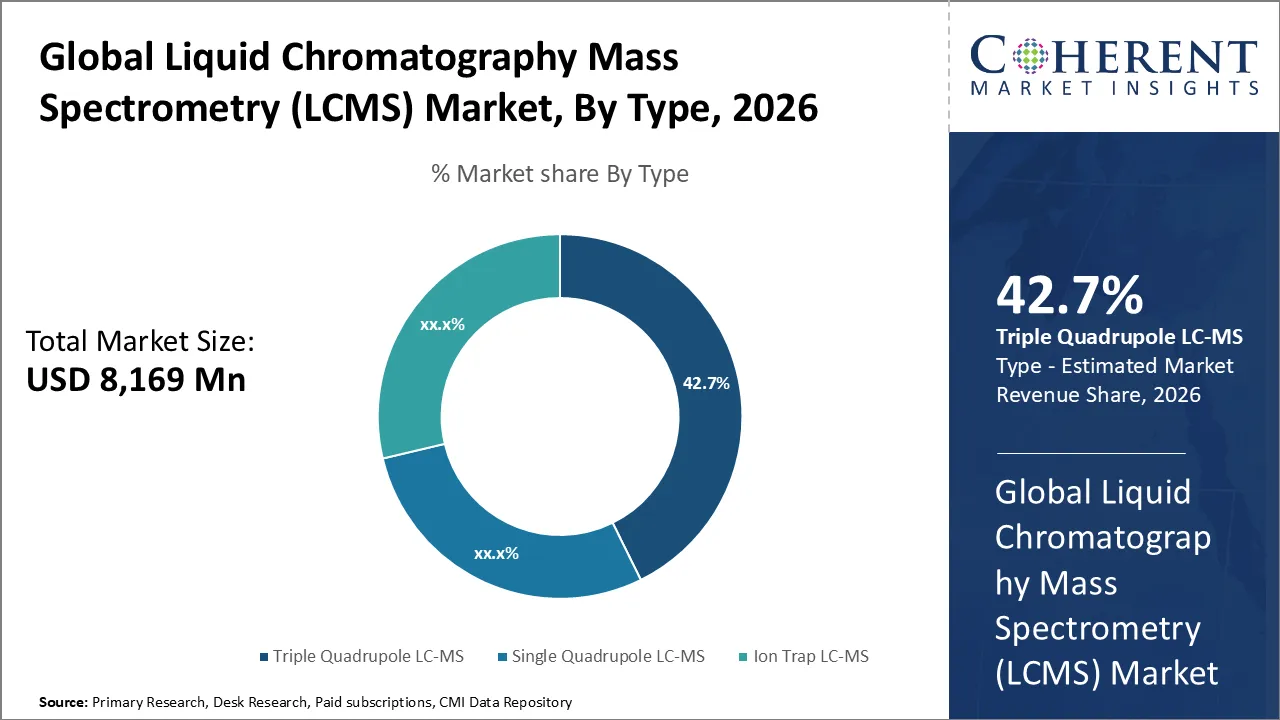
In terms of type, the triple quadrupole LCMS segment is expected to hold 42.7% share of the market in 2026. Triple Quadrupole LC-MS is the best choice for quantitative bioanalysis as it is the most accurate. It meets strict regulatory requirements and is the best way to investigate pharmacokinetics, toxicology, and drug development. It plays a significant role for validated workflows and large-scale clinical trials around the world due to pharmaceutical companies depend on its sensitivity and reproducibility.
For instance, in September 2025, the LCMS-8065XE is a new triple quadrupole mass spectrometer from Shimadzu. It was made for use in pharmaceuticals, clinics, and research, and it has better sensitivity, faster analysis, and more durability. This new technology makes Shimadzu stronger in the field of quantitative bioanalysis, which helps drug development, following rules, and high-throughput workflows in labs all over the world.
In terms of sensitivity, the high flow LCMS segment is expected to lead the market with 53.2% share in 2026, as it can handle a large number of samples and is very reliable. It helps with high-throughput workflows in quality control for drugs and clinical diagnostics. Compared to micro or nano flow systems, it is faster, more reliable, and less complicated, which makes it the best choice for labs that need to work in tough conditions.
For instance, in October 2025, Newomics released the FSK-AM Adjustable Flow Splitter, which lets high-flow LC systems work with LC-MS workflows. It allows split from 300 to 800 µL/min into microflow ranges of 1 to 25 µL/min, which increases sensitivity while keeping throughput the same. This new technology helps with proteomics, metabolomics, and biologics research by combining high-flow scalability with microflow performance.
In terms of end user, the biotechnology & pharmaceutical industry segment is projected to account 57.8% share of the market in 2026. It is commonly used for drug discovery, characterizing biologics, and testing in clinical trials. The growing need for precision medicine and biologics is driving adoption. LC-MS is providing important information for regulatory compliance, therapeutic development, and personalized healthcare solutions around the world.
For instance, in September 2025, Advent Chembio released nitrite-free LC-MS solvents to get rid of the risk of nitrosamine contamination in pharmaceutical analysis. Acetonitrile, methanol, isopropyl alcohol, and water are all part of the premium range. They come in 2.5L amber bottles. This new technology makes sure that detection is accurate, that regulations are followed, and that patients are safe. It makes LC-MS workflows stronger in the biotech and pharmaceutical industries around the world.
To learn more about this report, Download Free Sample
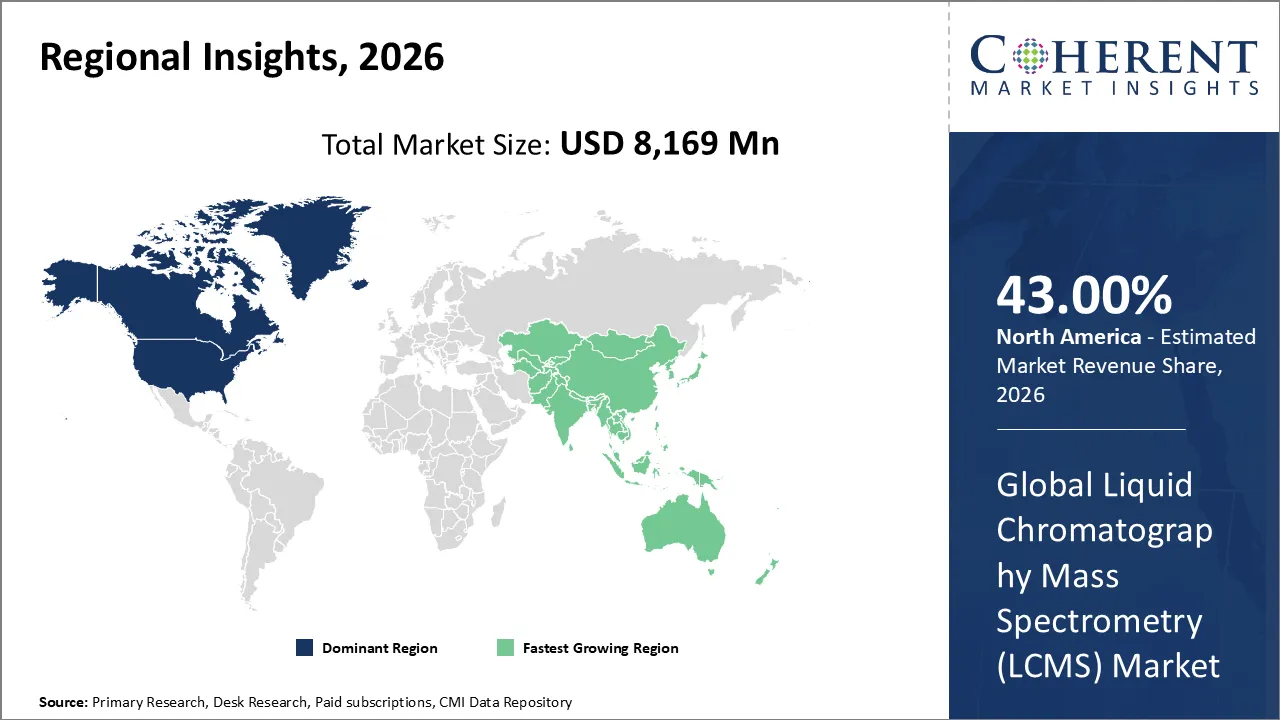
North America is expected to dominate the Liquid Chromatography Mass Spectrometry (LCMS) market with 43% share in 2026, due to advanced pharmaceutical research and development, over 30% of global clinical trials, and strict FDA rules that require precise analytical testing. The region's strong biotech industry and the use of hybrid LCMS systems help growth continue.
For instance, in June 2025, Agilent launched new LC-MS technologies and smaller GC-MS systems at ASMS 2025 in the United States. These new features make pharmaceutical, clinical, and life science applications more sensitive, faster, and compliant. Agilent is based in Santa Clara, California, and it strengthens its position around the world by providing cutting-edge solutions for regulated, high-volume analytical workflows.
Asia Pacific is expected to exhibit the fastest growth, owing to India and China are quickly making more drugs, there are more clinical trials, and the government is investing into healthcare research and development. More testing for food safety and the use of personalized medicine will help the region grow and enter new markets.
For instance, in May 2025, Agilent launched the InfinityLab Pro-IQ Series in Asia-Pacific, which improved LC-MS detection for advanced research, pharmaceuticals, and biotech. The new technology increases sensitivity, reproducibility, and the efficiency of workflows. The focus is on Asia-Pacific's growing role in regulated, high-volume analytical testing and biotechnology innovation, even though it is relevant to the whole world.
The U.S. is going to propel LCMS market demand in 2026, as the U.S. has the most advanced pharmaceutical R&D, leads in biologics, and runs more than 30% of all clinical trials. Strict rules from the FDA and the use of hybrid LCMS systems in labs that test food and diagnose diseases are helping growth even more.
For instance, in June 2025, At ASMS 2025 in Baltimore, USA, Thermo Fisher launched two new Orbitrap mass spectrometers. These tools improve throughput, sensitivity, and multi-omics integration for proteomics, biopharmaceutical development, and research on complex diseases. The launch in the U.S. shows how Thermo Fisher is working to improve regulated, high-volume analytical workflows in life sciences around the world.
China drives strong demand in the LCMS market in 2026 owing to its pharmaceutical manufacturing is growing quickly and it makes almost 20% of the world's drugs. More clinical trials, government-funded healthcare research and development, and stricter food safety rules all help adoption. China is becoming a major growth engine in the Asia-Pacific region due to greater investment is going into advanced LCMS systems.
For instance, in October 2025, Qiming Venture Partners’ highlights diverse biotech, AI, and healthcare investments in China. Bioscience secured approval for two LC‑MS/MS diagnostic kits from Chongqing regulators, advancing clinical diagnostics. The update underscores Asia‑Pacific’s growing biomedical innovation, with Qiming supporting startups driving drug discovery, precision medicine, and next‑generation healthcare technologies.
| Report Coverage | Details | ||
|---|---|---|---|
| Base Year: | 2025 | Market Size in 2026: | USD 8,169 Mn |
| Historical Data for: | 2020 To 2024 | Forecast Period: | 2026 To 2033 |
| Forecast Period 2026 to 2033 CAGR: | 12% | 2033 Value Projection: | USD 18,020 Mn |
| Geographies covered: |
|
||
| Segments covered: |
|
||
| Companies covered: |
Danaher Corporation, PerkinElmer, Inc., Waters Corporation, Bruker Corporation, Thermo Fisher Scientific Inc., Agilent Technologies, Inc., Shimadzu Corporation, JEOL Ltd., and Newomics, Inc. |
||
| Growth Drivers: |
|
||
| Restraints & Challenges: |
|
||
Uncover macros and micros vetted on 75+ parameters: Get instant access to report
The pharmaceutical and biotechnology sectors significantly enhance the growth of the Liquid Chromatography Mass Spectrometry (LCMS) Market share. LCMS is becoming steadily more important for drug discovery because it gives precise molecular characterization, which makes sure that compounds are correctly identified. Clinical trials around the world use LCMS for pharmacokinetics and biomarker research. Personalized medicine and biologics need more advanced LCMS platforms for protein and peptide analysis. This growing use of LCMS at many stages of drug development shows that it is an important technology for modern healthcare innovation.
There is a great deal of Liquid Chromatography Mass Spectrometry (LCMS) market demand owing to strict global rules about food safety and environmental monitoring. LCMS is widely utilized for finding pesticides, additives, and other harmful substances in food. It makes sure that safety standards are met. Environmental agencies use LCMS to monitor on water quality and pollutants, which is important for public health. Governments in the EU, US, and India require exact testing methods, which is why LCMS is so important for laboratories. This push from regulators makes sure that LCMS is used consistently and establishes it as a reliable analytical tool.
The increasing use of LCMS in clinical diagnostics offers a major chance for healthcare innovation. LCMS makes it possible for scientists to perform very precise metabolic profiling, find new biomarkers, and keep an eye on therapeutic drugs, all of which are important for modern medical research. As hospitals and diagnostic labs use LCMS more and more in their daily work, the technology's role is growing beyond research and into direct patient care. This trend is likely to lead to strong growth, which is in line with the positive Liquid Chromatography Mass Spectrometry (LCMS) Market forecast for the next ten years.
The LCMS market continues to be expanding as it is a key part of advanced analytical instrumentation. This is due to there is an excessive amount of demand from the pharmaceutical, biotechnology, environmental, and food safety sectors. LCMS systems are widely used as they can separate, identify, and measure complex mixtures with great sensitivity and accuracy. This makes them essential for drug discovery, clinical research, regulatory testing, and contaminant screening. The pharmaceutical industry is still the leading user, with numerous of installations considering it is so well integrated into workflows for compound validation, pharmacokinetics, and quality control.
North America is the primary market for this product because it has an abundance of research facilities and strict rules. The Asia-Pacific region is growing the fastest because additional laboratories are being built and more industrial and clinical analytical needs are being met.
Technology segmentation shows that triple quadrupole LCMS systems are the best choice for quantitative analysis in that they are very selective and reproducible. Integration of ultra-high pressure liquid chromatography (UHPLC) is also becoming more popular because it improves resolution and speeds up throughput in complex sample matrices.
Ongoing innovation, like automation, miniaturization, AI-enhanced data processing, and hybrid mass spectrometry platforms, is making the market more appealing in research, clinical, and industrial settings. The LCMS market will continue to be important and grow because it can be used in more areas, such as finding environmental contaminants, metabolomics, and proteomics.
Share
Share
About Author
Manisha Vibhute is a consultant with over 5 years of experience in market research and consulting. With a strong understanding of market dynamics, Manisha assists clients in developing effective market access strategies. She helps medical device companies navigate pricing, reimbursement, and regulatory pathways to ensure successful product launches.
Missing comfort of reading report in your local language? Find your preferred language :
Transform your Strategy with Exclusive Trending Reports :
Frequently Asked Questions
Joining thousands of companies around the world committed to making the Excellent Business Solutions.
View All Our Clients
 Schedule a meeting with report Author