Laboratory Glassware And Plasticware Market Analysis & Forecast: 2026-2033

The Laboratory Glassware and Plasticware Market is estimated to be valued at USD 7,200 Mn in 2026 and is expected to reach USD 10,020 Mn by 2033, growing at a compound annual growth rate (CAGR) of 4.8% from 2026 to 2033.
The Laboratory Glassware and Plasticware Market is undergoing a significant transformation driven by a global surge in biotechnology research, genome studies, and personalized medicine. Traditional borosilicate glassware remains essential for precision, heat-intensive, and chemically volatile procedures, yet the market is increasingly shifting toward disposable plasticware. The shift is mainly owing to the rise of laboratory automation and high-throughput screening, where single-use plastics like propylene and polystyrene minimize cross-contamination risks and eliminate the labor costs associated with sterilization. For instance, Eppendorf has launched one of the first laboratory tubes for molecular work made from polypropylene derived from biopolymers.
|
Current Event |
Description and the Impact |
|
Technological Advancements in Materials and Manufacturing |
|
|
Healthcare and Pharmaceutical Industry Growth
|
|
|
Environmental Regulations and Sustainability Trends |
|
Uncover macros and micros vetted on 75+ parameters: Get instant access to report
In terms of product type, the glassware segment contributes the highest share of 45.30% in 2026 of the market. This is owing to its excellent chemical compatibility and proven thermal stability. Glass is indispensable for high-heat applications and reactions involving aggressive solvents that would otherwise degrade or melt synthetic polymers. The growth is also owing to the widespread use of borosilicate glass, which allows researchers to transition vessels directly from high-heat environments to cold storage without risk of shattering. The segment's growth is also attributed its inherent transparency and inert nature.
Glass does not leach organic compounds into sensitive samples, thus ensuring the integrity of analytical results in pharmaceutical and forensic research. Furthermore, the precision offered by glass volumetric instruments remains superior for titration and quantitative analysis. Even as labs move toward automation, manufacturers like DWK Life Sciences and Corning Incorporated continue to refine laboratory glassware with digital tracking features, ensuring it stays at the forefront of the modern scientific infrastructure.
For instance, in December 2025, Scilabware Ltd released entirely novel line of Pyrex® and MBL® pipettes and burettes that provide high quality volumetric glassware at affordable pricing.
In terms of end user, the pharma and biotech industries segment contributes the highest share of 36.70% in the market in 2026 owing to the continual global research and development activities. The increased activity in drug discovery, vaccine development, and genomic research, which rely on high-quality lab equipment, is contributing to this growth in the above-given sectors. The large number of trials and quality checks requires businesses to keep substantial inventories of chemical glassware and sterile plasticware. This demand is particularly strong in emerging markets where pharmaceutical manufacturing is growing quickly to serve global healthcare requirements. The growth in this segment is also due to strict regulatory mandates enforced by agencies like the US Food and Drug Administration (FDA). These rules require laboratory ware to meet high purity and safety standards, thereby minimizing the risk of cross-contamination. The major firms like Thermo Fisher Scientific and Corning Incorporated are providing specialized products tailored for high throughput screening and automated liquid handling to satisfy-throughput screening and these requirements.
To learn more about this report, Download Free Sample
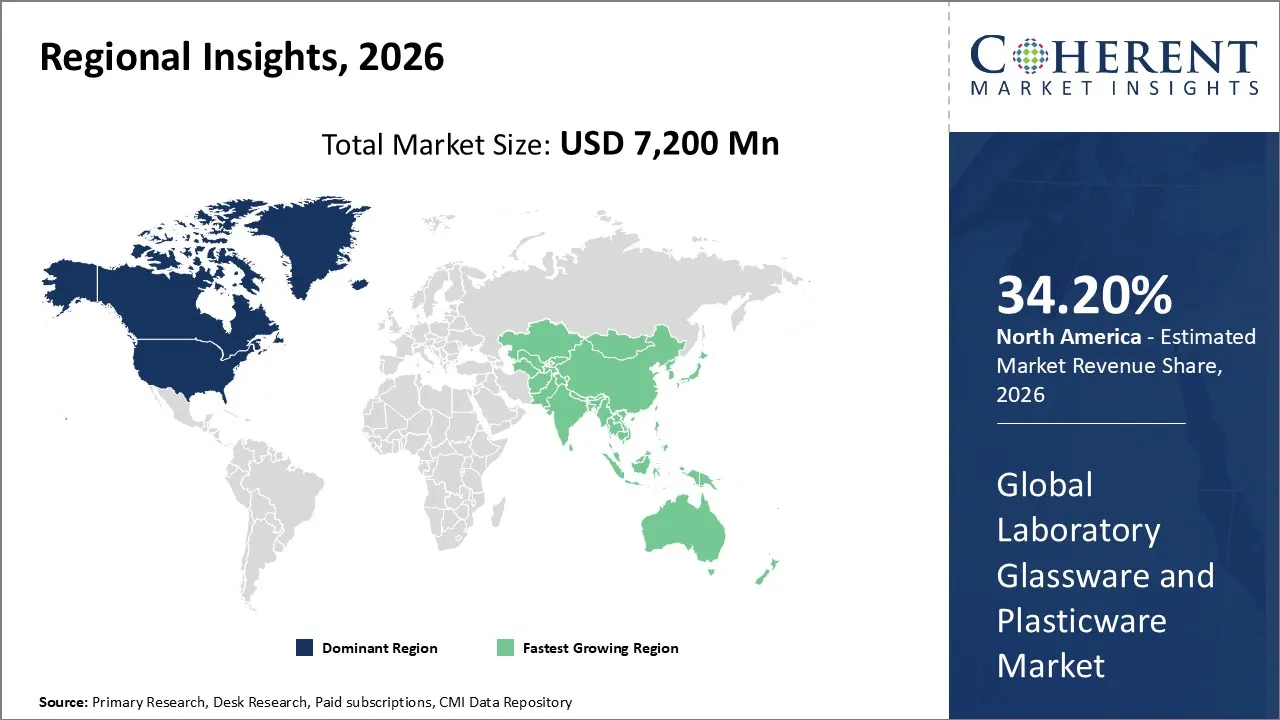
North America has remained the dominant region with 34.20% in 2026 of the global Laboratory Glassware and Plasticware Market over the past decade. The growth is owing to a robust research and development activities in the US and Canada. The substantial federal and private investments in the pharmaceutical and biotechnology sectors, as well as a massive infrastructure of approximately 330,000 active clinical laboratories regulated under the CLIA program are also contributing to the growth in the region. A major trend is the focus on digitalization and sustainability. The laboratories are incorporating automated and IoT-enabled systems. This results in increased demand for smart consumables that feature 1D and 2D barcoding, as well as RFID tagging, for real-time inventory management and traceability.
The traditional glassware is essential for high-temperature and solvent-resistant applications. Although there is a clear trend toward disposable plasticware owing to its cost-effectiveness, shatter resistance, and reduced risk of cross-contamination. The major firms like Thermo Fisher Scientific and Corning Inc. are innovating with plant-based, biodegradable materials and enhanced recycling protocols to address environmental concerns regarding single-use plastics. In addition, recent shifts in U.S. tariffs have altered supply chains, leading laboratories to focus on domestic manufacturing and sources that comply with the USMCA to reduce the impact of increased import duties on glass and plastic components.
For instance, in September 2025, SGD Pharma and Corning Incorporated announced the opening of a new glass tubing factory in Telangana, which would increase pharmaceutical production in the area.
The Asia Pacific region has emerged as the fastest-growing market. The growth is owing to the expansion in pharmaceutical R&D, clinical diagnostics, and academic research, mainly in emerging economies like China and India. The increase in healthcare spending, the growing number of diagnostic laboratories, and the increasing trend toward outsourcing research activities to regional hubs are also contributing to the growth of the market in the region. The trends in the region are focused on automation and digitalization. There is a increasing demand for smart labware integrated with 1D and 2D barcodes to facilitate tracking within Laboratory Information Management Systems (LIMS).
Sustainability has also become a critical focus, thereby leading to the introduction of plant-based and biodegradable consumables like the first sustainable 96-well plates made from polylactic acid (PLA). The top firms like Thermo Fisher Scientific, Corning Incorporated, and regional companies like Borosil Ltd. and Tarsons Products are growing their manufacturing footprints in APAC to meet localized demand from burgeoning biotechnology and clinical trial sectors.
For instance, in May 2023, DWK Life Sciences, a prominent global manufacturer and provider of laboratory glassware, plasticware, and primary packaging solutions, has acquired Assem-Pak, a firm located in Vineland, New Jersey.
The US Market is characterized by a transition toward high-tech automation and a focus on environmental accountability. The growth of the biotechnology and pharmaceutical sectors continues to increase the demand for specialized consumables, mainly those designed for personalized medicine and vaccine development. A major focus of the industry is the transition toward the green laboratory model. Manufacturers are responding to institutional pressure to reduce waste by introducing bio-based plastics derived from renewable sources and establishing comprehensive recycling programs for glass and polymer products. The top entities like Thermo Fisher Scientific, Corning Incorporated, and DWK Life Sciences are at the forefront by blending these sustainability goals with precision engineering.
China is experiencing growth with its massive domestic R&D spending. This growth is due to the development of the pharmaceutical and biotechnology industries, which require high-quality consumables for cell structure and clinical diagnostics. The market is currently undergoing a shift toward automation and digital integration, with increasing adoption of smart labware featuring 1D and 2D barcoding to facilitate seamless tracking within Laboratory Information Management Systems (LIMS). The domestic companies like Shanghai Glassware Co. and Beijing Scientific Instruments play a key role in the market. The international firms like Corning, Thermo fisher, and Schott are the leading contributors in specialized high-value product segments.
| Report Coverage | Details | ||
|---|---|---|---|
| Base Year: | 2025 | Market Size in 2026: | USD 7,200 Mn |
| Historical Data for: | 2020 To 2024 | Forecast Period: | 2026 To 2033 |
| Forecast Period 2026 to 2033 CAGR: | 4.8% | 2033 Value Projection: | USD 10,020 Mn |
| Geographies covered: |
|
||
| Segments covered: |
|
||
| Companies covered: |
Corning, Inc., Duran Group, Vitlab, Thermo Fischer Scientific, Mettler Toledo International, Inc., Gerresheimer AG, Bellco Glass, Inc., Crystalgen, Inc., Sartorius AG, Eppendorf AG, and Technosklo Ltd. |
||
| Growth Drivers: |
|
||
| Restraints & Challenges: |
|
||
Uncover macros and micros vetted on 75+ parameters: Get instant access to report
The increasing number of research initiatives in the biotechnology, pharmaceutical, and healthcare industries is anticipated to drive the demand for glassware and plasticware, thereby fueling growth in the global laboratory glassware and plasticware market in the near future. Additionally, the expanding applications of glassware and plasticware for clinical use in hospitals, forensic laboratories, veterinary science, and agriculture are expected to further enhance the growth of the global market. Furthermore, the rising prevalence of chronic diseases has led to the development of new drugs, which in turn stimulates growth in the global laboratory glassware and plasticware market.
Moreover, advancements in biology and biotechnological research, including studies on diseases, stem cells, and vaccine development, require various laboratory equipment, such as glassware and plasticware, which drives market growth. The ability to diagnose diseases easily and obtain effective results from medical tests has also contributed to the growth of the global laboratory glassware and plasticware market. Additionally, the trend towards automated laboratory processes is significant in this sector. The development of infrastructure expansion in research and laboratories worldwide continues to act as a key driver of sustained market growth for essential consumables.
Definition: The Laboratory Glassware and Plasticware Market is the global industry dedicated to the production and distribution of specialized containers and tools essential for scientific experimentation, medical testing, and industry analysis. This market is primarily categorized into glass products, which are valued for their exceptional chemical resistance and thermal stability, and plastic alternatives, which provide a durable and cost-efficient option for many applications. These products are indispensable across a wide range of sectors, including pharmaceutical research, biotechnology development, and educational science. Currently, the market is experiencing significant growth due to the expansion of healthcare infrastructure and an increased emphasis on precision diagnostics. In addition, the industry is evolving to meet modern demands by developing more sustainable and integrating ergonomic designs for high-efficiency laboratory environments.
Share
Share
About Author
Abhijeet Kale is a results-driven management consultant with five years of specialized experience in the biotech and clinical diagnostics sectors. With a strong background in scientific research and business strategy, Abhijeet helps organizations identify potential revenue pockets, and in turn helping clients with market entry strategies. He assists clients in developing robust strategies for navigating FDA and EMA requirements.
Missing comfort of reading report in your local language? Find your preferred language :
Transform your Strategy with Exclusive Trending Reports :
Frequently Asked Questions
Joining thousands of companies around the world committed to making the Excellent Business Solutions.
View All Our Clients
 Schedule a meeting with report Author