Italy Peptide Receptor Radionuclide Therapy (PRRT) Market Analysis & Forecast: 2026-2033
The Italy Peptide Receptor Radionuclide Therapy (PRRT) Market is estimated to be valued at USD 42 Mn in 2026 and is expected to reach USD 86.1 Mn by 2033, growing at a compound annual growth The rate (CAGR) of 10.8% from 2026 to 2033.
The Italy Peptide Receptor Radionuclide Therapy (PRRT) Market is advancing significantly, driven by its critical role in the targeted treatment of neuroendocrine tumors (NETS) and the expansion of specialized nuclear medicine facilities. The increasing demand for precision oncology and the adoption of standardized clinical guidelines, such as those from the Italian Association of nuclear medicine (AIMN), are expected to drive market growth over the forecast period.
Italy’s PRRT solutions are high-precision molecular therapies mainly categorized as Lutetium (Lu-177) or Yttrium-90 systems that deliver concentrated, cytotoxic radiation directly to the tumor site, allowing clinicians to treat complex malignancies with superior efficacy and clarity. These treatments play a crucial role in modern healthcare for managing inoperable or metastatic Gastroenteropancreatic neoplasms. This is due to their ability to provide localized therapy that spares healthy tissue and improves patient survival with prolonged interventions.
The ongoing innovation in radiolabeled peptides and integrated diagnostic imaging technology like Ga-68 PET/CT scans is reshaping the nuclear medicine industry. The demand for flexible, high-performance theranostic systems is increasing across major Italian hospitals and oncology research centers. These advancements have expanded the functional scope of PRRT by enhancing tumor visualization, ensuring compatibility with personalized dosimetry, and enabling precise adjustment of treatment protocols. The top players operating in the industry are focused on forming strategic acquisitions and launching isotope-integrated platforms designed mainly for streamlined digital workflows and personalized cancer interventions.
|
Current Event |
Description and the Impact |
|
Regulatory and Healthcare Policy Developments in Italy |
|
|
Advancements in Radiopharmaceutical Technology
|
|
|
Research Collaborations and Clinical Trials |
|
Uncover macros and micros vetted on 75+ parameters: Get instant access to report
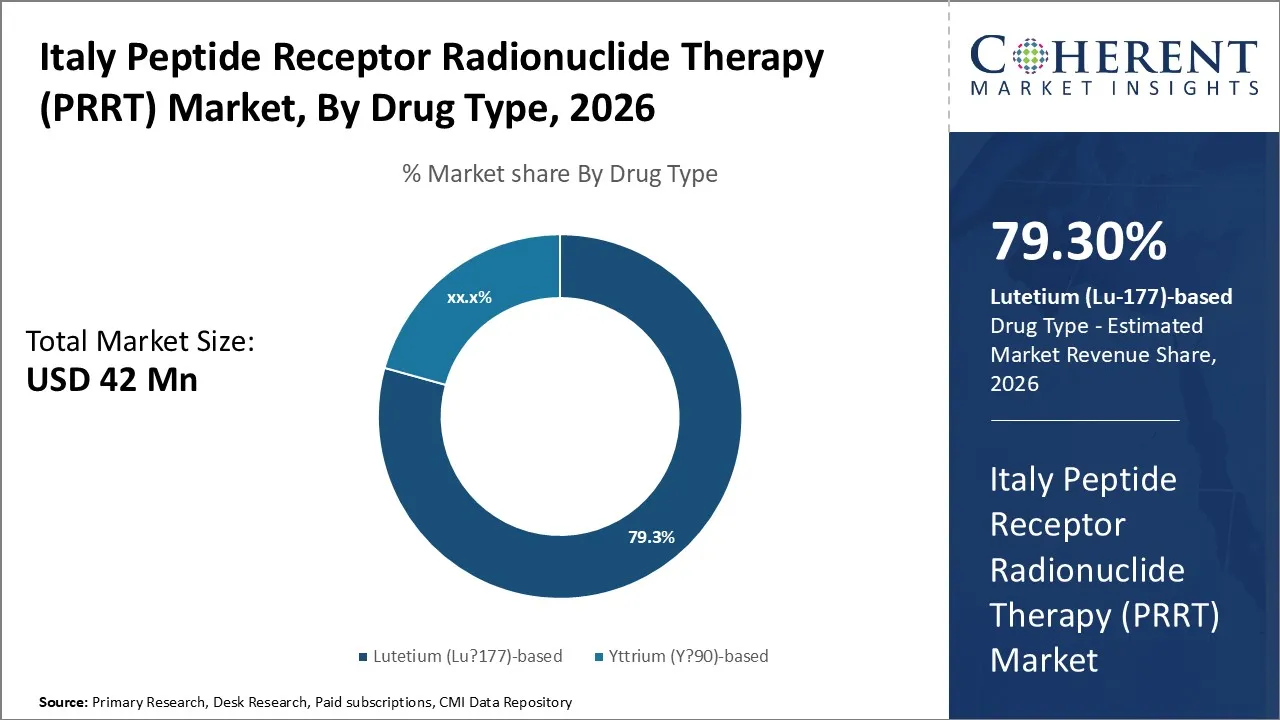
In terms of drug type, the Lutetium (Lu-177)-based segment contributes the highest share of 79.30% in 2026 of the Italy Peptide Receptor Radionuclide Therapy (PRRT) Market. This leadership is sustained by the clinical maturity of 177Lu DOTATATE which has become the primary therapeutic choice due to its favorable safety profile and precise beta particle emission. The ongoing investments in Italian nuclear medicine facilities have streamlined the handling of this isotope, thus ensuring it remains the preferred option over older alternatives. In addition, the development of no-carrier-added Lutetium-177 has improved the specific activity of these drugs. This has allowed for more effective targeting of small tumor lesions. Consequently, the Italian healthcare system continues to favor Lutetium (Lu-177)-based protocols due to their strong therapeutic efficacy and reduced risk of renal toxicity.
In terms of indication, the gastroenteropancreatic neuroendocrine tumor segment contributes the highest share of 64.20% in the Italy Peptide Receptor Radionuclide Therapy (PRRT) Market in 2026. This is owing to the increasing incidence of gastroenteropancreatic neuroendocrine tumors in Italy. This compliance is reinforced by the Italian Association of Medical Oncology (AIOM) guidelines, which recommend PRRT for patients with advanced, well-differentiated GEP NETs that have progressed on standard somatostatin analogs. The segment's growth is further accelerated by the introduction of PRRT for Grade 3 (G3) neuroendocrine neoplasms, widening the eligible patient pool. In addition, Italy's specialized network of NET Centers of Excellence ensures that patients receive early access to these targeted radioligand therapies. Because GEP-NETs consistently overexpress the somatostatin receptors targeted by these drugs, this indication remains the cornerstone of the PRRT effect.
In terms of distribution channel, the hospital pharmacies contributes the highest share of 71.80% in the Italy Peptide Receptor Radionuclide Therapy (PRRT) Market in 2026. This is because the administration of PRRT is strictly limited to specialized clinical settings. These facilities are equipped with the radioprotection infrastructure and hot labs that are required to store and prepare radioactive substances safely. The Italian National Health Service (SSN) manages the procurement of these high-cost therapies via hospital-based central purchasing, which ensures strict regulatory compliance and patient safety. Hospital pharmacists play a key operational role in aligning just-in-time delivery schedules with the short physical half-life of the radioisotopes, ensuring clinical and logistical efficiency. As a result, the centralized nature of nuclear medicine in Italy reinforces the hospital pharmacy as the indispensable hub for PRRT logistics and dispensing.
| Report Coverage | Details | ||
|---|---|---|---|
| Base Year: | 2025 | Market Size in 2026: | USD 42 Mn |
| Historical Data for: | 2020 To 2024 | Forecast Period: | 2026 To 2033 |
| Forecast Period 2026 to 2033 CAGR: | 10.8% | 2033 Value Projection: | USD 86.1 Mn |
| Segments covered: |
|
||
| Companies covered: |
Novartis International AG, Curium Pharma, ITM Isotope Technologies Munich SE, Eckert & Ziegler AG, and others |
||
| Growth Drivers: |
|
||
| Restraints & Challenges: |
|
||
Uncover macros and micros vetted on 75+ parameters: Get instant access to report
The increasing incidence of neuroendocrine tumors (NETs) is a primary catalyst for the growth of the Italy Peptide Receptor Radionuclide Therapy (PRRT) market. NETs have seen a substantial rise in documented cases across Italy, with recent epidemiological data suggesting nearly a sevenfold increase in detection over the last few decades. The rise is attributable to the growing availability and utilization of high-resolution diagnostic imaging like Gallium 68 PET/CT, thus enabling the identification of subclinical lesions. As more patients are diagnosed with advanced or metastatic gastroenteropancreatic tumors, the clinical demand for targeted interventions like PRRT has intensified. It has become an essential second-line treatment because PRRT offers a precise mechanism for delivering cytotoxic radiation directly to tumor cells expressing somatostatin receptors
Definition: The Peptide Receptor Radionuclide Therapy (PRRT) market is a specialized sector of the biopharmaceutical industry that focuses on the development, manufacturing, and distribution of targeted radiopharmaceuticals used to treat specific cancers. This market operates on a theranostic framework, which utilizes radiolabeled peptides to identify and destroy tumor cells that overexpress specific receptors. The primary application of these therapies is for neuroendocrine tumors, where isotopes such as Lutetium-177 deliver localized radiation to malignancy while sparing healthy surrounding tissue. The significant growth in these sectors is currently driven by the increasing global prevalence of rare cancers and the expansion of specialized nuclear medicine facilities. Furthermore, ongoing research into new radioligands and a shift toward personalized oncology are expected to broaden the market’s reach into various solid tumor types.
Share
Share
About Author
Vipul Patil is a dynamic management consultant with 6 years of dedicated experience in the pharmaceutical industry. Known for his analytical acumen and strategic insight, Vipul has successfully partnered with pharmaceutical companies to enhance operational efficiency, cross broader expansion, and navigate the complexities of distribution in markets with high revenue potential.
Missing comfort of reading report in your local language? Find your preferred language :
Transform your Strategy with Exclusive Trending Reports :
Frequently Asked Questions
Joining thousands of companies around the world committed to making the Excellent Business Solutions.
View All Our Clients
 Schedule a meeting with report Author