Immune Repertoire Sequencing Market Analysis & Forecast: 2026-2033
Immune repertoire sequencing market is estimated to be valued at USD 181.1 Mn in 2026 and is expected to reach USD 263.0 Mn in 2033, exhibiting a compound annual growth rate (CAGR) of 5.6% from 2026 to 2033.
The immune repertoire sequencing market is gaining momentum as a vital technology for understanding adaptive immunity. It enables comprehensive profiling of B-cell and T-cell receptors, supporting applications in oncology, autoimmune disorders, infectious disease monitoring, and vaccine development. Advances in next-generation sequencing and bioinformatics are driving innovation, while growing demand for precision medicine and personalized therapies continues to expand adoption. Increasing collaborations between research institutions and industry players are further accelerating progress, positioning immune repertoire sequencing as a cornerstone in modern biomedical research.
|
Current Event |
Description and its Impact |
|
AI and Machine Learning Integration in Genomics |
|
|
Precision Medicine Regulatory Evolution |
|
Uncover macros and micros vetted on 75+ parameters: Get instant access to report
|
Company / Institution |
Country / Region |
Funding Round |
Amount Raised |
Purpose / Focus |
|
Infinity Bio |
U.S. (Baltimore) |
Series A |
USD 8M |
Expand immune profiling platform; decoding TCR/BCR repertoires for autoimmune and oncology research |
|
Adaptive Biotechnologies |
U.S. (Seattle) |
Strategic Investment |
Undisclosed (multi-million) |
Enhance immune medicine platform; expand clinical applications of immune repertoire sequencing |
|
Repertoire Immune Medicines |
U.S. (Cambridge, MA) |
Collaboration & Licensing (with Genentech) |
Deal value undisclosed |
Develop T-cell targeted therapies for autoimmune disease, leveraging immune repertoire sequencing |
|
St. Jude Children’s Research Hospital |
U.S. (Memphis) |
Research Grant |
NIH-backed funding (multi-million) |
Democratize access to T-cell receptor analysis; expand IRS accessibility globally |
|
Fred Hutchinson Cancer Center |
U.S. (Seattle) |
Research Consortium Funding |
Consortium-backed (multi-million) |
Develop computational IRS methods (e.g., TIRTL-seq) for cancer and infectious disease immunology |
Uncover macros and micros vetted on 75+ parameters: Get instant access to report
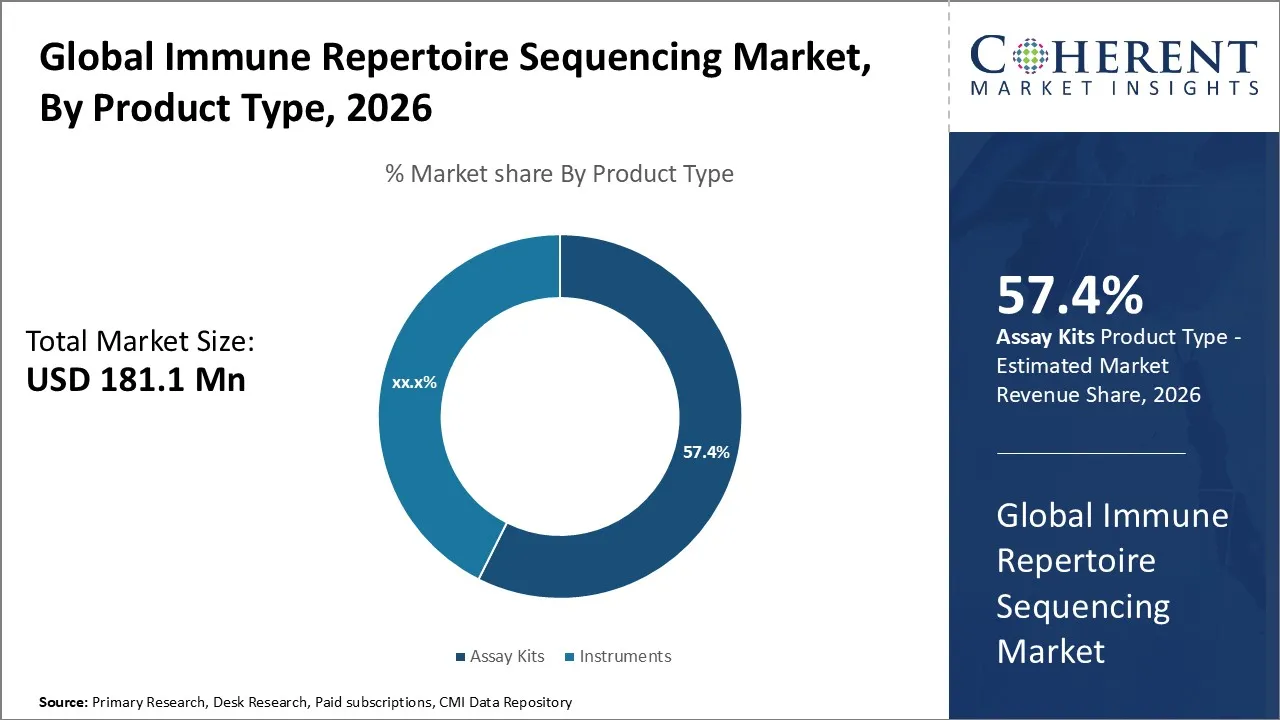
In terms of product type, the Assay kits segment is expected to lead the market with 57.4% share in 2026, due to their standardized protocols, reproducibility, and ease of use in profiling T-cell and B-cell receptors. They are essential for oncology, autoimmune, and infectious disease research, enabling rapid immune repertoire analysis. Their widespread adoption across clinical and research settings ensures they remain the leading product category.
For instance, in July 2025, Cellecta, Inc. launched its new DriverMap™ Single-Cell Adaptive Immune Receptor (scAIR) Kits, designed to deliver affordable, high-resolution chain-pairing data for T-cell and B-cell receptors without requiring specialized instruments. These kits expand immune profiling capabilities and are optimized for Illumina NGS platforms.
In terms of application, the cancer immunotherapy segment is expected to hold 47% share of the market in 2026, as immune repertoire sequencing provides critical insights into tumor-immune interactions. It supports CAR-T therapy development, checkpoint inhibitor optimization, and personalized oncology strategies. By enabling precise profiling of immune responses, sequencing drives breakthroughs in cancer treatment, making immunotherapy the most significant application segment in 2026.
For instance, in November 2025, A new study introduced a cost‑effective method to analyze the entire T‑cell repertoire, enhancing immune profiling accessibility. This innovation supports diverse applications, including oncology, autoimmune disorders, and infectious disease research. By lowering sequencing costs, it strengthens immune repertoire sequencing’s role in advancing cancer immunotherapy and personalized medicine development.
In terms of end user, the biotechnology & pharmaceutical companies’ segment is projected to capture 47.8% share in 2026, leveraging immune repertoire sequencing for drug discovery, biomarker validation, and clinical trial support. Their investment in precision medicine pipelines and immunotherapy development ensures high demand. With strong funding and translational focus, these companies remain the largest contributors to market growth in 2026.
For instance, in May 2025, Imprint Labs launched with a focus on forensic immunology for chronic disease, combining immune repertoire sequencing and AI to decode immune signatures. The company raised $15 million in funding to accelerate development. This reinforces their dominance in advancing immune profiling and therapeutic innovation.
To learn more about this report, Download Free Sample
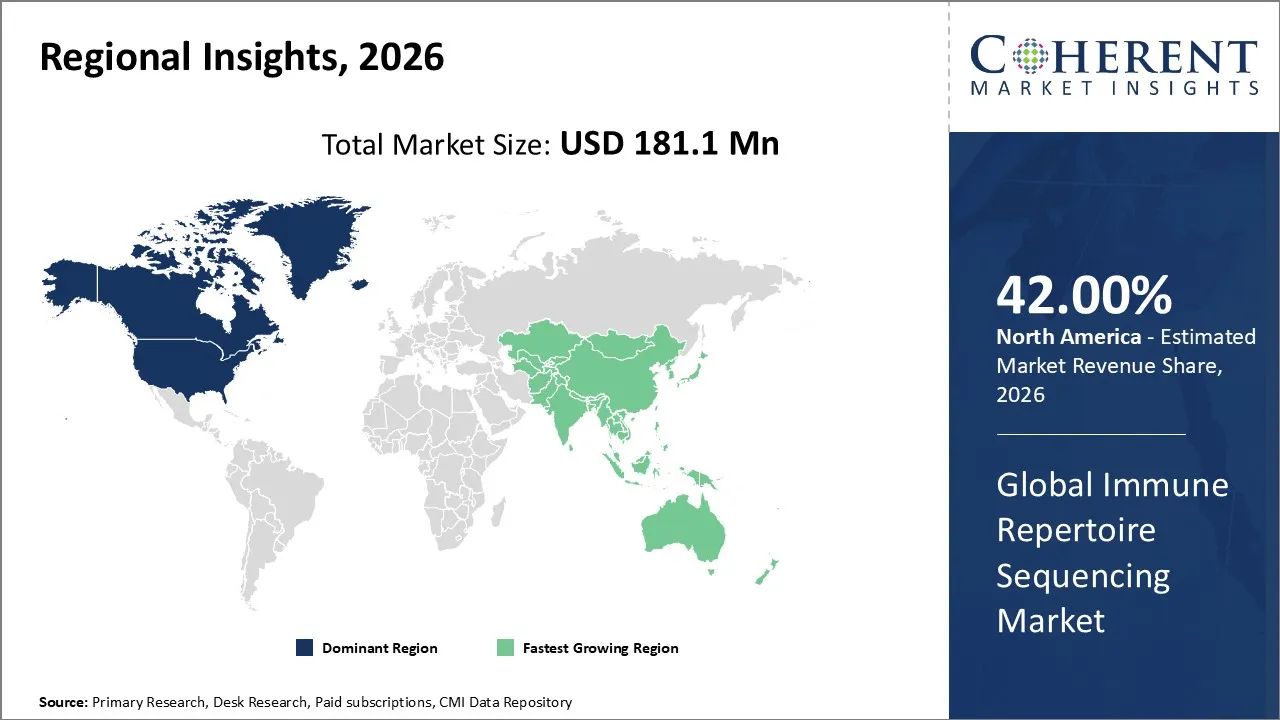
North America is expected to dominate the immune repertoire sequencing market with 42% share in 2026, due to strong biotechnology and pharmaceutical presence, advanced research infrastructure, and high adoption of precision medicine. Significant investment in cancer immunotherapy, autoimmune disease studies, and clinical trials ensures the region maintains dominance, fostering innovation and accelerating therapeutic development.
For instance, in April 2025, Repertoire Immune Medicines announced a collaboration and license agreement with Genentech to develop T‑cell targeted therapies for autoimmune disease. Leveraging Repertoire’s expertise in decoding immune repertoires, the partnership aims to advance precision treatments. Based in North America, this alliance highlights biotech and pharma leadership in immune‑driven therapeutic innovation.
Asia Pacific is anticipated to be the fastest growing region, due to rising investments in genomic medicine, expanding healthcare infrastructure, and declining sequencing costs. Countries like China, Japan, and India adopt advanced single-cell analysis and bioinformatics tools, fueling rapid growth in oncology, infectious disease monitoring, and vaccine development across the region.
For instance, in November 2025, SA Genomics’ installation of the MiSeq i100 Plus in Australia strengthens Asia-Pacific’s immune repertoire sequencing capacity. The advanced Illumina platform supports TCR and BCR profiling, oncology, and translational research. This investment highlights APAC’s rapid growth, driven by genomic medicine adoption, declining sequencing costs, and expanding regional healthcare infrastructure.
In 2026, the U.S. immune repertoire sequencing market is driven by advanced research infrastructure, strong biotech and pharmaceutical presence, and rising adoption of cancer immunotherapies. Government investments in genomics, high prevalence of autoimmune and infectious diseases, and extensive clinical trials fuel demand, reinforcing North America’s leadership in precision medicine.
In 2026, Japan’s immune repertoire sequencing market grows due to advanced healthcare infrastructure, strong government support for genomics, and rising demand for personalized immunotherapy. Increasing cancer and autoimmune disease prevalence, coupled with adoption of next-generation sequencing technologies, drives research and clinical applications, reinforcing Japan’s leadership in precision medicine innovation.
For instance, in December 2025, Takara Bio’s TCR and BCR immune profiling of FFPE samples highlights Asia-Pacific’s strength in immune repertoire sequencing. Headquartered in Japan, the company enables accurate profiling from degraded RNA, supporting cancer immunotherapy and translational research. This innovation reinforces APAC’s rapid growth, driven by genomic investments and advanced sequencing adoption.
| Report Coverage | Details | ||
|---|---|---|---|
| Base Year: | 2025 | Market Size in 2026: | USD 181.1 Mn |
| Historical Data for: | 2020 To 2024 | Forecast Period: | 2026 To 2033 |
| Forecast Period 2026 to 2033 CAGR: | 5.6% | 2033 Value Projection: | USD 263.0 Mn |
| Geographies covered: |
|
||
| Segments covered: |
|
||
| Companies covered: |
Thermo Fisher Scientific, Inc., Illumina Inc., ArcherDX, Inc., Roche Holding AG, Pacific Biosciences, CD Genomics, Atreca, Inc., Adaptive Biotechnologies, Oxford Nanopore Technologies, Ltd., Qiagen N.V., Agilent Technologies, Inc., and Takara Bio, Inc. |
||
| Growth Drivers: |
|
||
| Restraints & Challenges: |
|
||
Uncover macros and micros vetted on 75+ parameters: Get instant access to report
The growing emphasis on personalized medicine is a major catalyst for the immune repertoire sequencing market share. By enabling patient-specific immune profiling, this technology supports tailored therapies in cancer immunotherapy, autoimmune disorders, and transplant medicine. Physicians can design more effective treatment strategies by understanding individual immune responses. As global healthcare systems increasingly adopt precision medicine initiatives, the reliance on immune repertoire sequencing expands, strengthening its role in diagnostics, therapeutics, and long-term patient management.
Rapid advancements in next-generation sequencing (NGS) platforms are significantly boosting immune repertoire sequencing market demand. Modern NGS systems are faster, more affordable, and highly accurate, making large-scale immune repertoire analysis practical. Coupled with bioinformatics and AI-driven tools, researchers can interpret complex immune data with greater precision, unlocking new insights into disease mechanisms. These technological improvements not only accelerate research but also broaden clinical applications, ensuring immune repertoire sequencing becomes a cornerstone in modern healthcare innovation.
Clinical integration of immune repertoire sequencing is poised to reshape hospital and diagnostic lab workflows. By offering precise immune profiling, it supports personalized treatment strategies and enhances diagnostic accuracy. As sequencing costs decline and bioinformatics tools advance, adoption in routine clinical settings will accelerate. This expansion will significantly increase demand across healthcare institutions. The immune repertoire sequencing market forecast projects strong growth in hospital and lab applications, positioning them as key end-users driving market expansion globally.
Share
Share
About Author
Abhijeet Kale is a results-driven management consultant with five years of specialized experience in the biotech and clinical diagnostics sectors. With a strong background in scientific research and business strategy, Abhijeet helps organizations identify potential revenue pockets, and in turn helping clients with market entry strategies. He assists clients in developing robust strategies for navigating FDA and EMA requirements.
Missing comfort of reading report in your local language? Find your preferred language :
Transform your Strategy with Exclusive Trending Reports :
Frequently Asked Questions
Joining thousands of companies around the world committed to making the Excellent Business Solutions.
View All Our Clients
 Schedule a meeting with report Author