
Healthcare Revenue Cycle Management Market Analysis & Forecast: 2026-2033

Healthcare Revenue Cycle Management Market Size and Forecast – 2026 – 2033
The Healthcare Revenue Cycle Management market is projected to grow significantly from around USD 178 billion in 2026 to USD 517 billion by 2033, expanding at a 12.6 % CAGR through 2033, driven by digitization of billing and claims, automation, and rising healthcare IT adoption.
Global Healthcare Revenue Cycle Management Market Overview
Healthcare Revenue Cycle Management (RCM) refers to the financial process that healthcare providers use to track patient care episodes from registration and appointment scheduling through billing, claims submission, payment, and revenue collection. It integrates administrative, clinical, and financial functions to ensure accurate reimbursement and reduce revenue leakage. RCM includes coding, charge capture, claims management, denial management, and accounts receivable follow-up. With rising healthcare costs, complex payer rules, and value-based care models, efficient RCM is critical for provider sustainability. Increasing adoption of automation, artificial intelligence, and cloud-based solutions is transforming RCM by improving accuracy, compliance, operational efficiency, and overall financial performance.
Key Takeaways
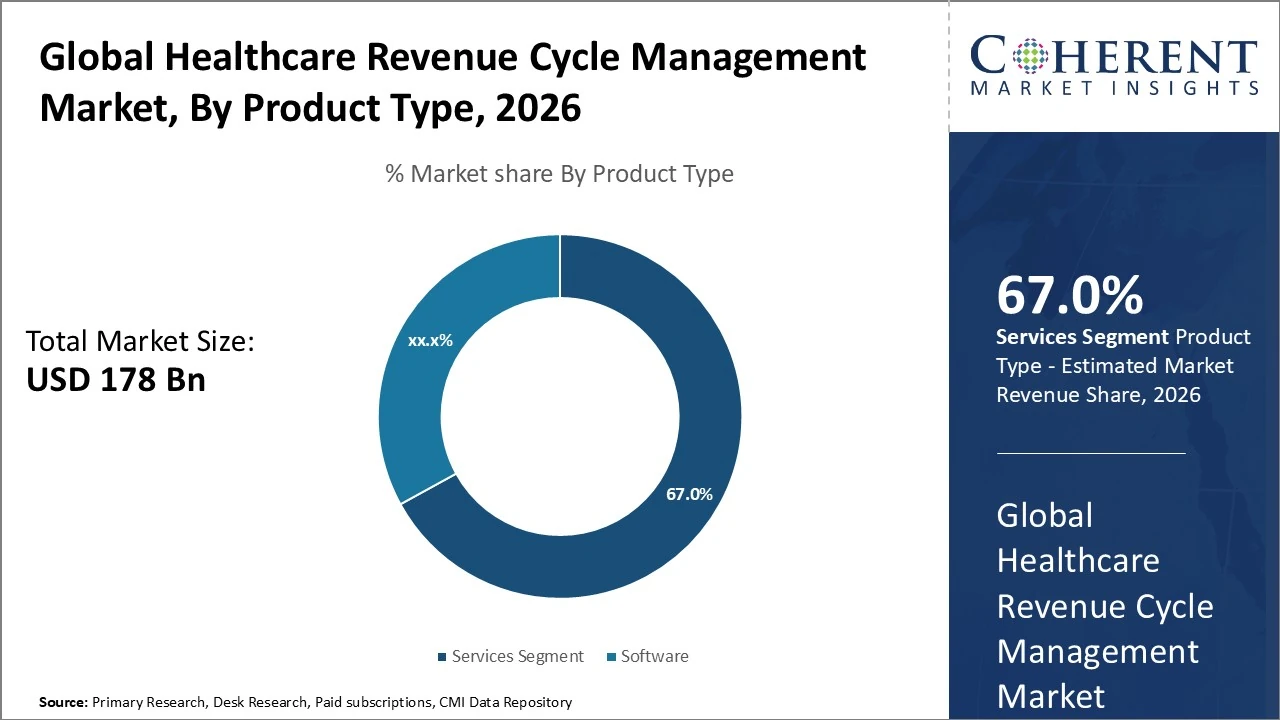
Product Type- The services segment accounts for about 67 % of the overall RCM market revenue.
By Technology type, integrated RCM solutions hold the largest share, with about 65 % of the market.
End-user segmentation shows hospitals as the dominant segment, holding about ~62% of market share globally.
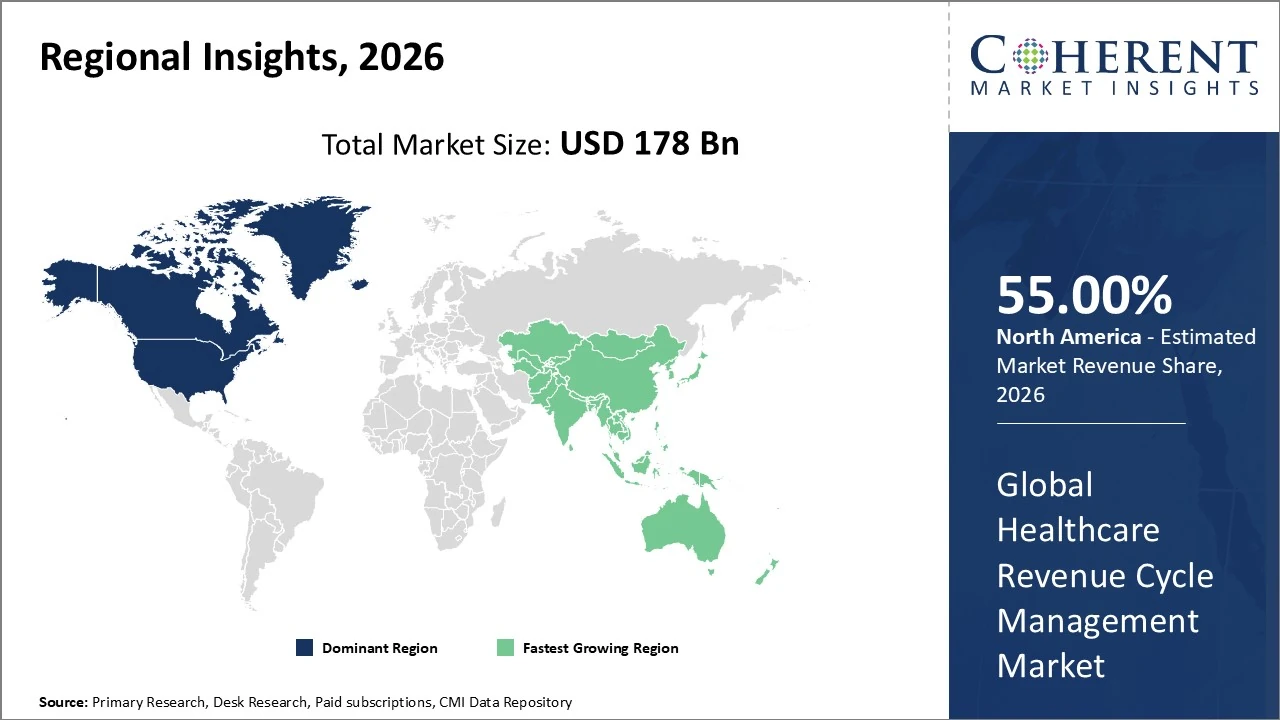
North America dominates the healthcare Revenue Cycle Management (RCM) market, holding roughly 55% of global share.
The Asia Pacific Healthcare Revenue Cycle Management (RCM) market is one of the fastest-growing globally, accounting for roughly ~19% of the global RCM market share.
The U.S. healthcare Revenue Cycle Management (RCM) market is rapidly expanding, valued at around USD 57 billion in 2026.
The Germany Healthcare Revenue Cycle Management (RCM) market is expected to grow strongly with ~11 % CAGR
Healthcare Revenue Cycle Management Market Segmentation Analysis
To learn more about this report, Download Free Sample
Healthcare Revenue Cycle Management Market Insights, By Product Type
In the Healthcare Revenue Cycle Management (RCM) market, product type segmentation typically includes software and services, with some reports also highlighting integrated versus standalone offerings. According to industry data, the services segment accounts for about 67 % of the overall RCM market revenue due to widespread outsourcing of implementation and support functions, while software represents around 33 % of the share.
Healthcare Revenue Cycle Management Market Insights, By Technology
In the Healthcare Revenue Cycle Management market by technology type, integrated RCM solutions hold the largest share, with about 65 % of the market, reflecting strong preference for unified platforms that streamline billing, claims, coding, and financial workflows. Standalone systems account for the remaining ~35%, offering focused tools for specific tasks like coding or billing. Adoption of AI and automation technologies is rising rapidly—over 50 % of providers incorporate AI for claims analytics and predictive denial management, boosting efficiency and accuracy across the revenue cycle. Traditional non-AI systems still comprise a significant portion but are being progressively enhanced by intelligent features.
Healthcare Revenue Cycle Management Market Insights, By End-User
In the Healthcare Revenue Cycle Management market, end-user segmentation shows hospitals as the dominant segment due to high patient volumes and complex billing needs, holding about 62% of market share globally. Physician offices/clinics follow with approximately 24% share, driven by rising adoption of RCM tools to streamline outpatient billing and improve cash flow. Diagnostic labs and other outpatient providers represent a smaller portion, around ~14% of the market, as they increasingly adopt specialized RCM solutions for claims and eligibility verification. This distribution reflects the varying revenue cycle complexity across healthcare settings.
Healthcare Revenue Cycle Management Market Trends
Rising use of artificial intelligence, machine learning, and robotic process automation to improve claims accuracy, reduce denials, and accelerate revenue collection.
Increasing shift toward cloud-hosted RCM platforms for scalability, lower IT costs, and enhanced interoperability with EHR/EMR systems.
Greater adoption of outsourced RCM services and analytics to support complex value-based care models and optimize financial performance.
Healthcare Revenue Cycle Management Market Insights, By Geography
To learn more about this report, Download Free Sample
North America Healthcare Revenue Cycle Management Market Analysis and Trends
North America dominates the healthcare Revenue Cycle Management (RCM) market, holding roughly 55% of global share due to advanced healthcare infrastructure, high EHR/RCM adoption, and complex payer systems. The U.S. leads with the largest regional share, supported by widespread cloud-based and automated RCM deployments. Cloud solutions account for a significant portion of regional installations, enhancing billing accuracy and interoperability. Integration of AI and automation is accelerating, improving denial management and efficiency. The market is expected to sustain robust growth driven by technological innovation and regulatory compliance requirements. Canada and Mexico also show rising RCM adoption, contributing to regional expansion.
Asia Pacific Healthcare Revenue Cycle Management Market Analysis and Trends
The Asia Pacific Healthcare Revenue Cycle Management (RCM) market is one of the fastest-growing globally, accounting for roughly 19% of the global RCM market share due to rapid digital healthcare adoption and expanding private hospital networks. Integrated RCM solutions and cloud-based deployments are driving regional uptake, particularly in China, India, and Japan, where modernization of billing, coding, and claims processes is accelerating. The market is expected to grow at ~14 % CAGR, supported by government health IT initiatives, automation integration, and enhanced reimbursement systems that improve operational efficiency and reduce revenue leakage.
Healthcare Revenue Cycle Management Market Outlook for Key Countries
USA Healthcare Revenue Cycle Management Market Analysis and Trends
The U.S. healthcare Revenue Cycle Management (RCM) market is rapidly expanding. AI and automation technologies are increasingly adopted to reduce claim denials and improve billing efficiency. Cloud-based deployments lead with strong uptake for scalability and remote access, while integrated solutions dominate over standalone systems. Hospitals and physician practices are primary end-users, driven by complex reimbursement processes and administrative cost pressures. Value-based care and outsourced RCM services continue to shape market dynamics.
Germany Healthcare Revenue Cycle Management Market Analysis and Trends
The Germany Healthcare Revenue Cycle Management (RCM) market is growing steadily, driven by digital transformation and regulatory compliance within the highly regulated German healthcare system. Patient‑centric billing and transparency are emerging priorities. Hospitals and outpatient providers are investing in integrated RCM platforms that align with coding and reimbursement standards, supporting real‑time DRG and claims processes. The market is expected to grow strongly with ~11 % CAGR, supported by cloud‑based solutions and national eHealth initiatives boosting RCM digitization.
Analyst Opinion
Experts believe AI, machine learning, and robotic process automation are reshaping RCM by reducing claim denials, improving accuracy, and accelerating reimbursements.
Analysts see cloud‑based RCM solutions as key drivers due to scalability, lower IT costs, and easier integration with EHR/EMR systems.
Outsourced RCM services are increasingly preferred by providers to cut overhead and access specialized expertise.
Ongoing payer and compliance changes push providers toward advanced RCM technologies.
Shift to value‑based care increases demand for analytics‑driven RCM that supports performance and financial outcomes.
Market Scope
| Report Coverage | Details | ||
|---|---|---|---|
| Base Year: | 2025 | Market Size in 2026: | USD 178 Billion |
| Historical Data for: | 2020 To 2024 | Forecast Period: | 2026 To 2033 |
| Forecast Period 2026 to 2033 CAGR: | 12.6% | 2033 Value Projection: | USD 517 Billion |
| Geographies covered: |
|
||
| Segments covered: |
|
||
| Companies covered: | Optum, Cerner, Epic Systems, R1 RCM, Athenahealth, Allscripts, McKesson, and Change Healthcare | ||
| Growth Drivers: |
|
||
Uncover macros and micros vetted on 75+ parameters: Get instant access to report
Healthcare Revenue Cycle Management Market Growth Factors
The Healthcare Revenue Cycle Management (RCM) market is driven by several growth factors. Rising complexity in healthcare billing and reimbursements pushes providers to adopt automated RCM solutions. Increasing EHR/EMR integration and digital transformation initiatives enhance operational efficiency and reduce revenue leakage. The shift toward value-based care necessitates accurate claims processing and financial analytics. AI, machine learning, and cloud-based RCM platforms are accelerating adoption by improving denial management and workflow optimization. Additionally, outsourcing RCM services is growing as providers seek cost efficiency and specialized expertise, while government regulations and compliance requirements further propel market demand.
Healthcare Revenue Cycle Management Market Development
In February 2026, Cosentus, a leader in healthcare revenue cycle management, unveiled Cosentus.ai, a new platform highlighting the company’s in-house AI capabilities purpose-built for healthcare operations.
Key Players
Leading Companies of the Market
Optum
Cerner
Epic Systems
R1 RCM
Athenahealth
Allscripts
McKesson
Change Healthcare
Leading players include Optum, Cerner, Epic Systems, R1 RCM, athenahealth, Allscripts, McKesson, and Change Healthcare, known for comprehensive RCM solutions and services. These firms dominate through advanced automation, cloud integration, and broad healthcare provider adoption worldwide.
Healthcare Revenue Cycle Management Market Future Outlook
The future of the Healthcare Revenue Cycle Management (RCM) market is poised for strong growth, driven by increasing digitalization, AI, and automation integration. Providers will continue adopting cloud-based and integrated RCM platforms to improve billing accuracy, reduce claim denials, and optimize revenue cycles. The shift toward value-based care and patient-centric models will create demand for advanced analytics and predictive financial tools. Outsourcing RCM services is expected to rise as healthcare organizations seek efficiency and cost reduction. Regulatory changes and interoperability requirements will further accelerate innovation, making RCM a critical component of sustainable healthcare financial management globally.
Healthcare Revenue Cycle Management Market Historical Analysis
Historically, the Healthcare Revenue Cycle Management (RCM) market grew steadily as healthcare providers faced increasing billing complexity and regulatory demands. Initially dominated by manual and standalone systems, adoption of EHR/EMR-integrated RCM solutions began accelerating in the early 2010s, improving claim processing and revenue tracking. Outsourcing of RCM services gained traction as hospitals and clinics sought cost efficiency and specialized expertise. Over time, automation and cloud-based platforms emerged, enhancing workflow efficiency and accuracy. Between 2010 and 2020, the market witnessed consistent growth, driven by rising healthcare expenditures, digitization initiatives, and the need to reduce revenue leakage and denials across providers globally.
Sources
Primary Research Interviews:
Healthcare Providers
RCM Solution Vendors
IT and Health Tech Professionals
Payers and Insurance Companies
Databases:
PubMed / Medline
Scopus
IEEE Xplore
Journals:
Journal of Healthcare Management (JHM)
Healthcare Financial Management
Journal of Health Care Finance
Health Services Research
Newspapers:
The Wall Street Journal
Financial Times
The Guardian
The New York Times
Associations:
European Health Management Association (EHMA)
International Hospital Federation (IHF)
Asia Pacific Hospital Federation (APHF)
Share
Share
About Author
Komal Dighe is a Management Consultant with over 8 years of experience in market research and consulting. She excels in managing and delivering high-quality insights and solutions in Health-tech Consulting reports. Her expertise encompasses conducting both primary and secondary research, effectively addressing client requirements, and excelling in market estimation and forecast. Her comprehensive approach ensures that clients receive thorough and accurate analyses, enabling them to make informed decisions and capitalize on market opportunities.
Missing comfort of reading report in your local language? Find your preferred language :
Transform your Strategy with Exclusive Trending Reports :
Frequently Asked Questions

Credibility and Certifications

860519526

9001:2015

27001:2022


Need a Custom Report?
We can customize every report - free of charge - including purchasing stand-alone sections or country-level reports
Customize NowSelect a License Type
Joining thousands of companies around the world committed to making the Excellent Business Solutions.
View All Our Clients
 Schedule a meeting with report Author