Genetic Testing Market Analysis & Forecast: 2026-2033

The Genetic Testing Market is estimated to be valued at USD 25.91 Bn in 2026 and is expected to reach USD 58.71 Bn by 2033, growing at a compound annual growth rate (CAGR) of 12.4% from 2026 to 2033.
This sector encompasses genetic tests ordered by healthcare providers, laboratories, and direct-to-consumer companies as well as tests conducted for research institutions and pharmaceutical partners. The growing awareness of personalized medicine and increased adoption of advanced genomic technologies are driving the market value in this sector.
The genetic testing market is trending towards the greater accessibility and automation of testing processes. Healthcare systems are embracing genetic solutions that integrate with their Electronic Health Records and laboratory information systems for enhanced data management and clinical decision-making capabilities. Next generation sequencing and at home testing kits are also growing in popularity over traditional laboratory only methods, as they offer improved accuracy, faster results, and better insight into patient health conditions and disease risks. This technological advancement will continue driving testing volumes higher over the forecast period.
|
Current Event |
Description and the Impact |
|
Geopolitical Developments |
|
|
Technological Advancements |
|
|
Societal and Ethical Dynamics |
|
Uncover macros and micros vetted on 75+ parameters: Get instant access to report
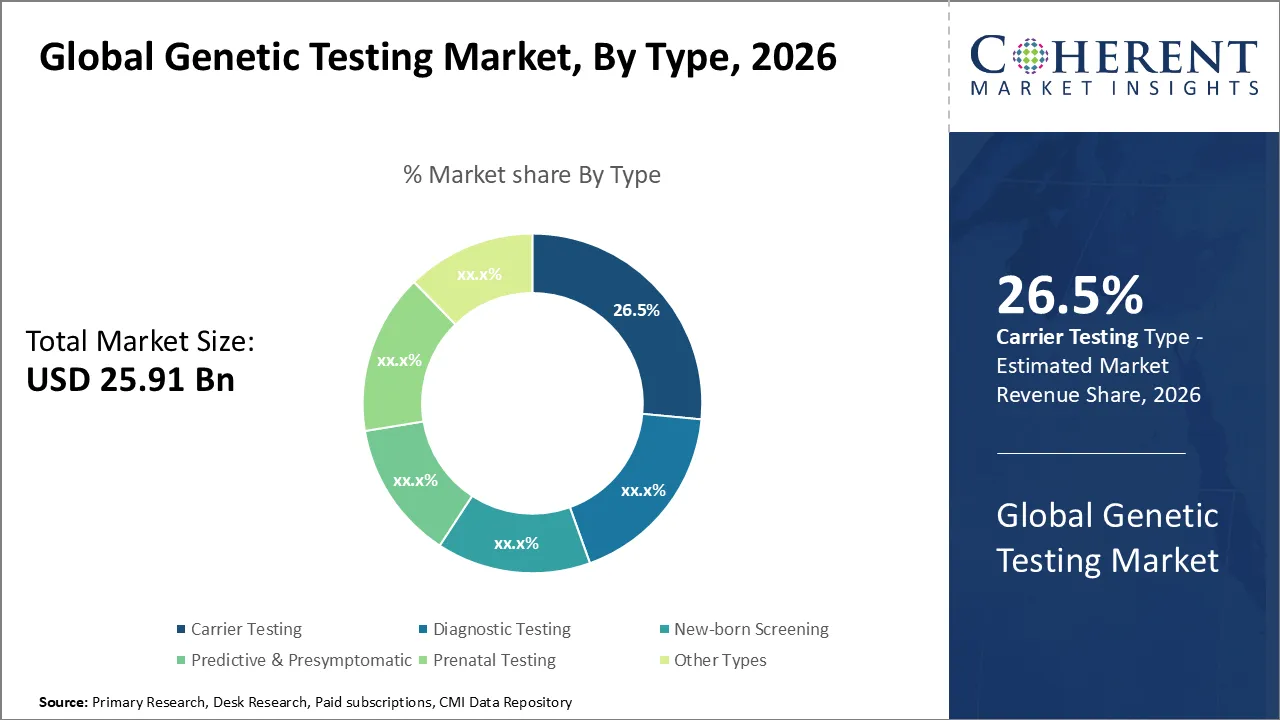
In terms of type, carrier testing segment contributes the highest share of 26.5% in 2026 of the genetic testing market owing to the widespread demand from couples planning families and established clinical protocols for common genetic conditions. Carrier screening allows the healthcare providers to leverage existing screening guidelines and well understood genetic markers that require minimal specialized training and streamline counselling processes. This preexisting knowledge base established through years of clinical practice makes carrier testing straightforward compared to interpreting results for rare or complex genetic disorders in emerging testing categories.
For instance, in October 2025, Myriad Genetics, Inc., a leading provider of molecular diagnostic testing and precision medicine, announced the addition of two genes named F8 and FXN to the Foresight® Carrier Screen Universal Plus Panel.
In terms of disease, Alzheimer's disease segment contributes the highest share in 2026 of the market owing to the growing aging population and increasing awareness about early detection of dementia risks. Alzheimer's genetic testing allows doctors to identify patients at higher risk using well known genetic markers like APOE-e4 that have been studied extensively over decades. This established research base and clear testing protocols make Alzheimer's screening more accessible compared to genetic tests for less common neurological conditions where the genetic links are still being discovered.
According to a report by the Alzheimer's Association, around 7.2 million of American population with age 65 and older live with Alzheimer's dementia in 2025.
In terms of technology, cytogenetic testing contributes the highest share in 2026 of the genetic testing market owing to long established use in clinic practice and proven reliability. Cytogenetic testing allows laboratories to identify conditions like Down syndrome and other chromosomal disorders. It uses microscopy techniques that doctors have trusted for decades. This methodology has widespread availability of trained technicians. This makes cytogenetic testing more commonly used than newer molecular technologies.
To learn more about this report, Download Free Sample
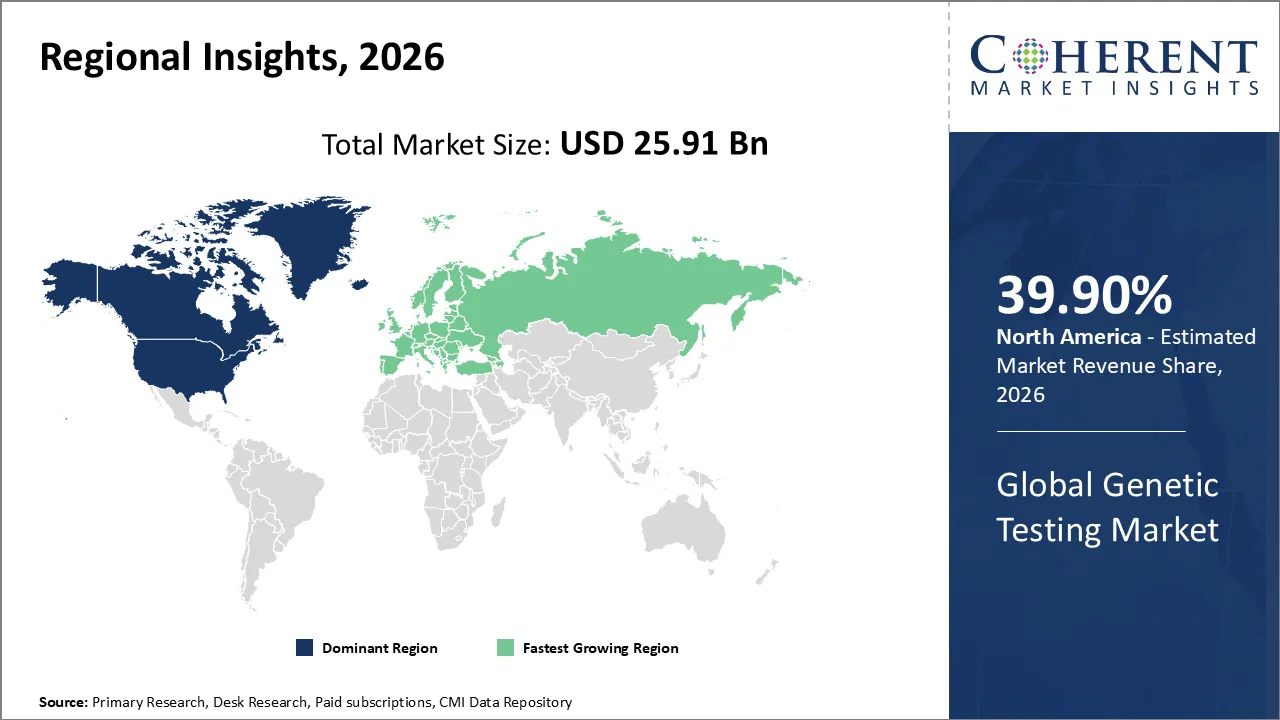
North America has remained the dominant region with 39.9% in 2026 of the global genetic testing market over the past decade. The region is home to several genetic testing laboratories and biotech companies thar provide different types of tests for doctors, hospitals, and everyday consumers. Major companies like Abott Laboratories, 23andMe Inc., and Danaher Corporation have strong operations across North America. The medical testing infrastructure and genomic technologies are advanced in this region. This makes it easier to access genetic testing services for medical diagnosis and personal health screening. Supportive government policies have created positive environment for the industry to grow. The increasing number of genetic disorders, government health programs, and growing demand for personalized medicine have steadily increased the need for genetic testing.
For instance, in February 2025, Seonix Bio, a pioneer in genetic testing for glaucoma, launched SightScore in the U.S. This marked the debut of the first commercial polygenic risk score testing service for primary open angle glaucoma. The saliva-based test helps identify high risk individuals, supporting earlier detection, interventions, and provide better personalized treatment.
Europe region has emerged as the fastest growing market globally in recent years. The region has a strong presence of established genetic testing companies and biotech firms that provide various solutions for healthcare providers. Advances in technologies such as next generation sequencing have considerably improved test accuracy, reduced costs, and increased accessibility for widespread use. These upgrades enable doctors and researchers to apply them more frequently in hospitals and laboratories, leading to faster and more reliable disease diagnoses for patients. Governments across the region are actively providing funding for genetic research initiatives and healthcare infrastructure improvements to improve public health outcomes. There is a rising emphasis on preventive medicine and early disease detection which allows individuals to receive timely treatments and lead healthier lives. All of these combined factors are speeding up the market growth.
For instance, in June 2025, Gene Matrix marked its entry into the European market by introducing cutting-edge diagnostic services in Slovenia. The company introduced its innovative GeneCancer™ hereditary cancer screening and the leading GenePGx™ pharmacogenomic test. This delivers Slovenian patients and healthcare providers with valuable insights into their unique genetic makeup.
In 2026, the genetic testing market in the U.S. is expected to be strong due to several interconnected drivers. The rising awareness about the advantages detecting diseases early has encouraged more people to seek testing, while breakthroughs in more molecular biology technologies continue to make processes faster and more precise. At the same time, healthcare providers and pharmaceutical companies are placing greater emphasis on personalized medicine approaches, tailoring treatments based on individual genetic profiles to improve patient outcomes and efficiency.
For instance, in May 2025, Targeted Genomics LLC, the creator of GlutenID, the sole FDA cleared direct to consumer test for celiac disease genetics, partnered with OraSure Technologies, Inc. OraSure produces ORAcollect®·Dx, the only FDA approved saliva collection device for over the counter use. The alliance broadens access to convenient at home celiac genetic testing for consumers.
In 2026, the genetic testing market in U.K. is booming owing to proactive government support. Authorities have demonstrated strong commitment to healthcare innovation by allocating substantial funding for genomic research programs and initiatives that speed up the development and integration of genetic testing into routine care. The rising incidence of genetic disorders across the population combined with increasing popularity of direct-to-consumer testing devices is steadily broadening the market reach.
For instance, in June 2024, the Royal Marsden NHS Foundation Trust introduced the UK’s first genome testing center. This cutting edge setup will double the Trust’s genomics testing capabilities and broaden the scope of available tests all without requiring additional lab space. The initiative focuses on boosting cancer genomic testing through advanced robotic automation.
| Report Coverage | Details | ||
|---|---|---|---|
| Base Year: | 2025 | Market Size in 2025: | USD 25.91 Bn |
| Historical Data for: | 2020 To 2024 | Forecast Period: | 2025 To 2032 |
| Forecast Period 2025 to 2032 CAGR: | 12.4% | 2032 Value Projection: | USD 58.71 Bn |
| Geographies covered: |
|
||
| Segments covered: |
|
||
| Companies covered: |
23&Me Inc., Qiagen NV, Eurofins Scientific, PerkinElmer Inc., Illumina Inc., Danaher Corporation, Myriad Genetics Inc., Abbott Laboratories, F. Hoffmann-La Roche Ltd., Quest Diagnostics Incorporated, BioRad Laboratories Inc., and DiaSorin S.p.A. (Luminex Corporation), among others. |
||
| Growth Drivers: |
|
||
| Restraints & Challenges: |
|
||
Uncover macros and micros vetted on 75+ parameters: Get instant access to report
The genetic testing market is witnessing substantial growth owing to the increasing occurrence of inherited conditions and long term health problems across global populations. Rare diseases often stem from genetic changes while birth defects continue to affect newborns worldwide. Healthcare systems are witnessing rising cases of conditions like cystic fibrosis, sickle cell anemia, and Huntington’s disease which require accurate genetic testing. The growing burden of chronic illnesses combined with aging populations in developed nations has created high demand for cutting-edge testing solutions. Genetic testing has become essential for early disease detection, enabling healthcare providers to take timely action and develop personalized treatment plans that improve patient outcomes and quality of life.
Personalized medicine represents a major opportunity for the genetic testing industry as healthcare shifts toward individual treatment approaches. Medical professionals increasingly use genetic information to create custom care plans for patients with cancer, heart diseases, and rare genetic disorders. Advanced genetic testing panels enable doctors to identify important markers that guide treatment selection and help with entry in targeted clinical trials. This precise approach reduces bad reactions by matching treatments to individual genetic profiles, thus improving treatment results. The use of genetic profiling in routine clinical decision making is changing healthcare delivery, creating substantial opportunities for testing providers, drug companies, and genetic medicine developers tow ork together in delivering patient centered care.
For instance, in March 2025, Apollo Hospitals has launched the Apollo Genomics Institute in Karnataka. This advanced facility aims to embed genetic diagnostics into everyday healthcare practices. It represents a significant step forward for personalized medicine in India by improving early detection, treatment accuracy, and risk evaluation.
Public awareness about genetic testing has increased considerably in recent years owing to educational campaigns, media coverage, and direct-to-consumer testing availability. People are becoming more knowledgeable about various testing types like ancestry analysis, disease susceptibility screening, prenatal carrier testing, and personal trait assessment. The growing healthcare expenditure, expanding middle class population and favorable government initiatives for precision medicine are increasing the awareness in emerging markets. States-sponsored educational programs and partnerships between healthcare systems and technology companies have normalized the use of genetic insights for personal heath decisions. Younger urban population are embracing genetic testing as a proactive heath management tool.
The genetic testing market has developed into a core component of modern diagnostics and personalized healthcare, supported by increasing test volumes and broadening clinical applications. Industry data indicate that tens of millions of genetic tests are conducted globally each year, with demand concentrated in disease risk assessment, prenatal screening, and therapy selection. North America accounts for a substantial proportion of total testing activity, supported by advanced laboratory infrastructure, high physician adoption, and strong reimbursement coverage. Asia Pacific is emerging as a high-growth region, driven by expanding healthcare access, rising awareness of inherited disorders, and increased investment in genomic research.
Technology adoption trends show next-generation sequencing as the dominant platform, enabling comprehensive multi-gene analysis and whole-genome testing at scale. The cost per sample for sequencing has declined sharply over the past decade, allowing broader clinical and research use. PCR-based and array-based assays continue to support high-throughput screening and targeted mutation detection, particularly in hospital and reference laboratory settings.
By application, predictive and risk assessment testing represents a significant share of total test volumes, reflecting growing emphasis on preventive care and early disease identification. Prenatal, newborn, and carrier screening programs also contribute materially to market demand. In parallel, direct-to-consumer genetic testing has expanded, with millions of users globally seeking insights into ancestry, health traits, and inherited risks. Overall, the genetic testing market is characterized by expanding clinical relevance, technological maturity, and increasing integration into routine healthcare decision-making.
Definition: The Genetic Testing Market provides laboratory services that examine a person’s DNA and genes to check for health conditions and disease risks. These tests help doctors, patients, and researchers find genetic problems, understand disease risks, and make better medical decisions quickly and accurately. Common testing methods include DNA sequencing, gene analysis, and newer technologies like liquid biopsies that detect diseases from blood samples.
Share
Share
About Author
Nikhilesh Ravindra Patel is a Senior Consultant with over 8 years of consulting experience. He excels in market estimations, market insights, and identifying trends and opportunities. His deep understanding of the market dynamics and ability to pinpoint growth areas make him an invaluable asset in guiding clients toward informed business decisions. He plays a instrumental role in providing market intelligence, business intelligence, and competitive intelligence services through the reports.
Missing comfort of reading report in your local language? Find your preferred language :
Transform your Strategy with Exclusive Trending Reports :
Frequently Asked Questions
Joining thousands of companies around the world committed to making the Excellent Business Solutions.
View All Our Clients
 Schedule a meeting with report Author