Fish Products Market Analysis & Forecast: 2026-2033

Fish products market is estimated to be valued at USD 221.30 Mn in 2026 and is expected to reach USD 275.9 Mn in 2033, exhibiting a compound annual growth rate (CAGR) of 3.2% from 2026 to 2033.
Fish products are consumed all over the world as it is one of the major sources of high-quality proteins. According to the World Health Organization (WHO), more than one billion people depend on fish and fish products as their primary source of proteins. Fish is processed into various food and non-food products. Fish products are segmented into fish oil, fish meal, and others. The consumption of fish products is increasing globally owing to various benefits of these products. In addition to being a rich source of proteins, fish products also contain iodine and zinc, which has led to an increase in consumption of these product. Countries such as Portugal and Japan are witnessing an increase in the consumption of ready-to-eat and processed fish products. The main application of fish products are food, feed, pharmaceuticals and others.
|
Current Event |
Description and its Impact |
|
Climate Change and Ocean Warming |
|
|
Technological Advancements in Aquaculture |
|
Uncover macros and micros vetted on 75+ parameters: Get instant access to report
|
Region |
Production (2025–2026) |
Consumption (2025–2026) |
Key Drivers |
|
Asia-Pacific |
>110 million tonnes; aquaculture accounts for over 50% of global output. China leads with inland and coastal farming expansion. |
>100 million tonnes; highest global consumption, driven by urbanization and middle-class growth. |
Protein-rich diets, aquaculture investment, processed seafood demand. |
|
Europe |
~20 million tonnes; Norway and Iceland dominate salmon farming. Strong focus on sustainable fisheries. |
~22 million tonnes; demand for processed, premium, and traceable seafood. |
Sustainability regulations, premium seafood preference. |
|
North America |
~10 million tonnes; moderate aquaculture growth plus plant-based and lab-grown seafood innovation. |
~12 million tonnes; rising demand for substitutes and premium fish products. |
Innovation, health-conscious consumers, alternative proteins. |
|
Latin America |
~15 million tonnes; Chile and Brazil expand salmon and tilapia farming. |
~14 million tonnes; growing domestic consumption and exports to Asia/Europe. |
Export-driven growth, affordable fish supply. |
|
Africa |
~12 million tonnes; fishmeal and fish oil production expanding (e.g., South Africa). |
~11 million tonnes; demand for affordable fish products in urban centers. |
Feed applications, affordability, food security. |
|
Middle East |
<5 million tonnes; limited production but premium aquaculture projects emerging. |
~6 million tonnes; imports dominate, with UAE leading premium seafood demand. |
Rising affluence, preference for sustainable imports. |
Uncover macros and micros vetted on 75+ parameters: Get instant access to report
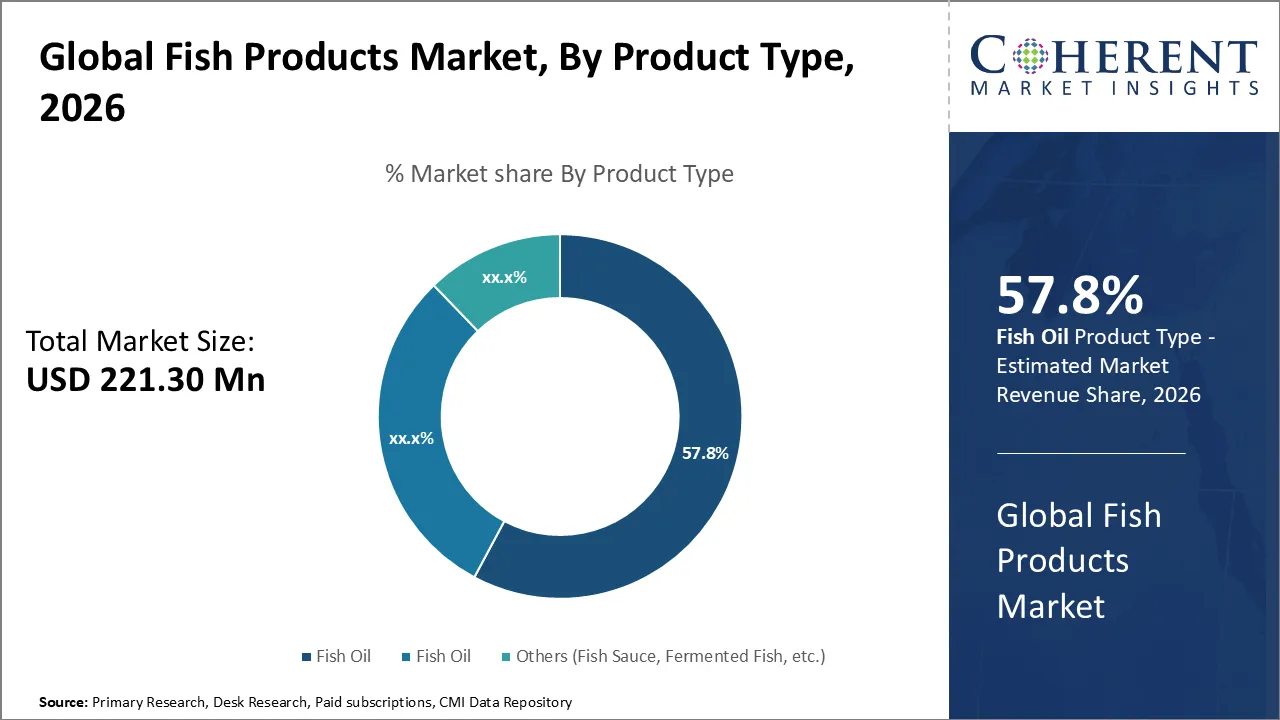
In terms of product type, the fish oil segment is expected to lead the market with 57.8% share in 2026, as it is used in so many nutraceuticals, pharmaceuticals, and functional foods. It is high in omega-3 fatty acids and is widely consumed for its heart, brain, and anti-inflammatory benefits. The demand for it around the world is growing as consumers are becoming more aware of their health and are more likely to get preventive care.
For instance, in January 2026, Samherji now owns 49% of Berg LipidTech, a Norwegian company that makes fish oil from cod, saithe, salmon, tuna, and anchovies that is high in omega-3s. The deal makes Samherji's seafood business stronger, increases the processing of byproducts, and shows how important fish oil is becoming in the nutraceuticals, pharmaceuticals, and functional food markets.
In terms of application, the food segment is expected to hold 52.6% share of the market in 2026, due to larger populations around the world are eating seafood and wanting diets high in protein. Increasingly, functional foods, supplements, and everyday foods are using fish oil and fishmeal. The growing demand for natural, nutrient-rich foods means that food will always be the largest application area.
For instance, in September 2025, Young's Seafood launched with a Jumbo Fish Special that is aimed at people who want to save money in both retail and foodservice. The launch indicates that seafood continues to grow more prevalent in the food industry because it is affordable and high in protein. This move makes the company more appealing to customers and shows that there is a growing demand for fish-based products that are easy to find and use around the world.
To learn more about this report, Download Free Sample
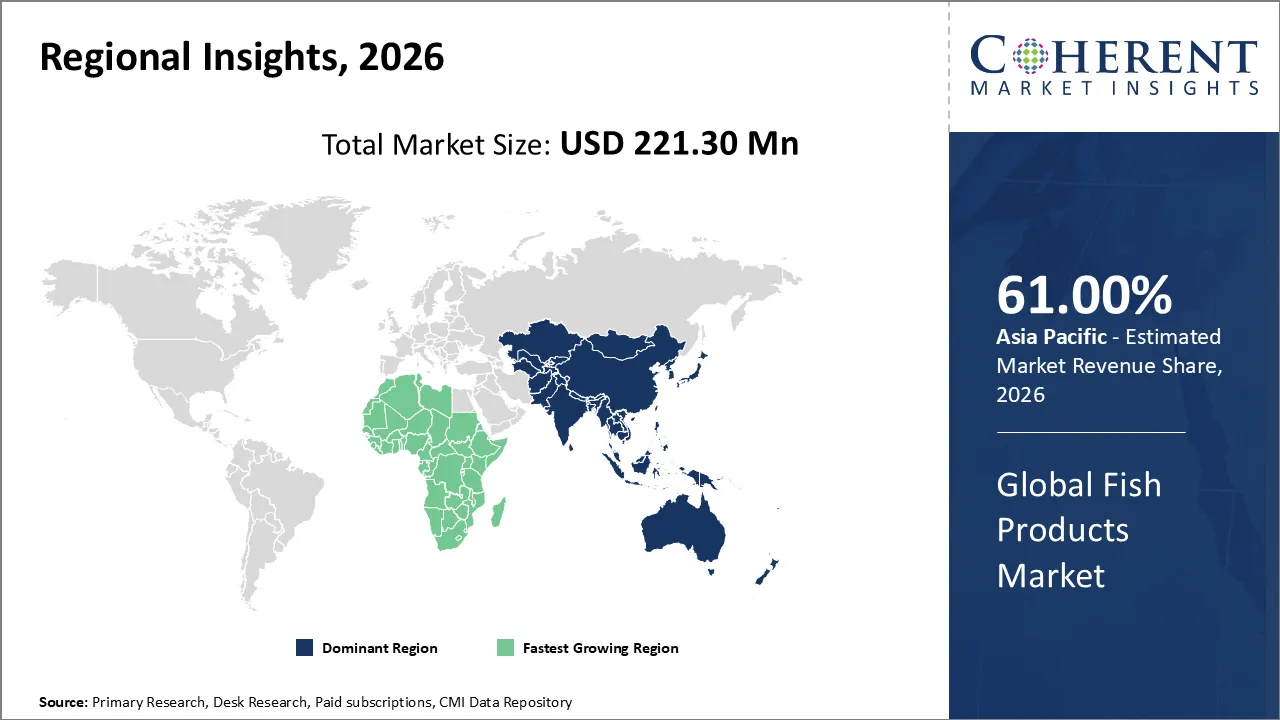
Asia Pacific is expected to dominate the fish product market with 61% share in 2026, driven by China's, India's, and Southeast Asia's large aquaculture base, rising disposable incomes, and strong seafood consumption habits. The region is the world leader in fish products as more people are moving to cities and prefer processed seafood.
For instance, in February 2026, the Seafood Expo Asia and Seafood Processing Asia event in Singapore from September 2 to 4, 2026, is expected to bring together everyone in the seafood supply chain around the world. It connects directly to fish products by showcasing new ideas, processing methods, and seafood products that are made with the consumer in mind in food, feed, and other areas.
Africa is expected to exhibit the fastest growth, due to rapid urbanization, the population is rising, and the middle class prefer affordable protein. Aquaculture growth, new technologies like automated feeding, and environmentally friendly methods like aquaponics are all increasing supply. This makes Africa the fastest-growing market for fish products in the world.
For instance, in January 2026, South Africa’s Pioneer has opened a new $10 million fishmeal plant that is directly related to the fish products market. Fishmeal is an important product made from fish that is used in aquaculture feed, livestock feed, and other things. This investment increases production capacity and meets global demand.
The UAE's fish products market is extremely competitive in 2026 as more people choose to consume seafood, they want high-quality products, and the UAE is a major trading hub. The market is expected to grow quickly, partly due to imports, aquaculture projects, and consumer preference for fresh, frozen, and processed fish.
For instance, in September 2025, Finnforel introduced its Lohi brand of land-based farmed rainbow trout to the UAE. This is directly related to the fish products market as it adds a seafood product for consumers in the food application segment. It also promotes sustainable aquaculture, protein-rich diets, and the growing global demand for high-quality fish products.
Thailand's fish products market will be highly robust in 2026 due to the country is a major seafood hub, has a strong aquaculture base, and is a part of traditional cuisine. Thailand is becoming a major player in the Asia-Pacific region because of growing tourism, exports of processed seafood, and the use of environmentally friendly aquaculture methods.
For instance, in January 2026, Mowi has opened a new salmon processing plant in Thailand to meet the growing demand for seafood in Asia and make its presence stronger there. The facility makes the supply chain more efficient, helps with local distribution, and puts Mowi in a good position to grow in one of the world's fastest-growing fish product markets.
| Report Coverage | Details | ||
|---|---|---|---|
| Base Year: | 2025 | Market Size in 2025: | USD 221.30 Mn |
| Historical Data for: | 2020 To 2024 | Forecast Period: | 2025 To 2032 |
| Forecast Period 2025 to 2032 CAGR: | 3.2% | 2032 Value Projection: | USD 275.9 Mn |
| Geographies covered: |
|
||
| Segments covered: |
|
||
| Companies covered: |
Omega Protein Corporation, FMC Corporation, Corpesca S.A., TripleNine Group A/S, Colpex International, FF Skagen A/S, Pesquera Diamante S.A., Marvesa Holding N.V, TASA, American Marine Ingredients, Croda Inc., GC Rieber Oils, and Pelagia. |
||
| Growth Drivers: |
|
||
| Restraints & Challenges: |
|
||
Uncover macros and micros vetted on 75+ parameters: Get instant access to report
Increasingly, individuals are realizing that fish is an important part of a healthy diet. It has lean protein, omega-3 fatty acids, and vitamins that are good for your heart, brain, and overall health. People are becoming more health-conscious and actively seeking for foods that are high in nutrients and fit with trends in preventive healthcare. This change is driving up the Fish Products Market demand, especially for fresh, frozen, and processed fish, as people make healthier food choices and eat more functional foods every day.
Aquaculture is a long-term way to meet the growing demand for seafood. It provides a steady supply of fish while taking some of the pressure off of wild stocks. Improvements in breeding, feed optimization, and water management have greatly increased productivity and reduced harm to the environment. These improvements are increasing the Fish Products Market share due to farmed fish is becoming more affordable and easier to find. Aquaculture is making fish products a key driver of global market growth by supporting food security and allowing exports to grow.
Beyond supplements, fish-derived ingredients are finding applications in nutraceuticals, skincare, and infant nutrition. Omega-3 enriched formulas are being incorporated into fortified foods, anti-aging cosmetics, and baby products, creating diverse revenue streams. This diversification reduces reliance on traditional seafood consumption and opens premium market segments. According to the Fish Products Market forecast, these innovative applications will accelerate growth, as companies leverage fish-based bioactive compounds to meet consumer demand for functional, science-backed, and lifestyle-oriented products.
The fish products market is supported by the growing global demand for seafood as a main source of high-quality protein and nutrition. In recent years, global fish production has reached record levels. Aquaculture and capture fisheries have both contributed almost the same amount, showing that people rely on both farmed and wild-caught sources to meet their needs. Fish, like salmon, tuna, cod, and tilapia, are still the most popular type of seafood since they can be used in so many different ways and have well-established distribution systems.
Regional trends show that the Asia Pacific region is still the greatest contributor to fish product volumes. This is because there are an increasing number of people living on the coast and a long history of eating seafood. Europe and North America are also important markets, with strong retail and foodservice channels driving the sale of processed and value-added goods.
Trends in consumption show that people are increasingly choosing convenient formats like fresh, frozen, and ready-to-eat fish products. These products are becoming more widely available through organized retail and online platforms. Improvements in processing, cold-chain logistics, and packaging have made products last longer and be of higher quality, which helps them reach more people and be easier to find.
Rising consumer awareness of the health benefits of omega-3 fatty acids and protein-rich diets, as well as industry investment in sustainable fishing practices and aquaculture technologies, are all factors that drive demand. All of these things together make the fish products market dynamic, with a wide range of products available and changing consumption patterns in different parts of the world.
Share
Share
Missing comfort of reading report in your local language? Find your preferred language :
Transform your Strategy with Exclusive Trending Reports :
Frequently Asked Questions
Joining thousands of companies around the world committed to making the Excellent Business Solutions.
View All Our Clients
 Schedule a meeting with report Author