Electric Truck Market Analysis & Forecast: 2026-2033

Electric Truck Market is estimated to be valued at USD 5.45 Bn in 2026 and is expected to reach USD 16.01 Bn in 2033, exhibiting a compound annual growth rate (CAGR) of 19.2% from 2026 to 2033.
The electric truck market is actively transforming the commercial vehicle industry as companies and fleets increasingly adopt sustainable, zero-emission transportation solutions. Advancements in battery technology, the expansion of charging infrastructure, and government policies promoting electrification are driving this growth. Businesses rely on electric trucks for urban logistics, e-commerce deliveries, and short-haul transportation because they lower operating costs and reduce environmental impact. Leading manufacturers are launching a wide range of light, medium, and heavy-duty models, accelerating global adoption and enhancing fleet efficiency and sustainability.
|
Current Events |
Description and its impact |
|
Geopolitical and Regulatory Developments |
|
|
Supply Chain and Raw Material Constraints |
|
|
Economic and Market Dynamics |
|
Uncover macros and micros vetted on 75+ parameters: Get instant access to report
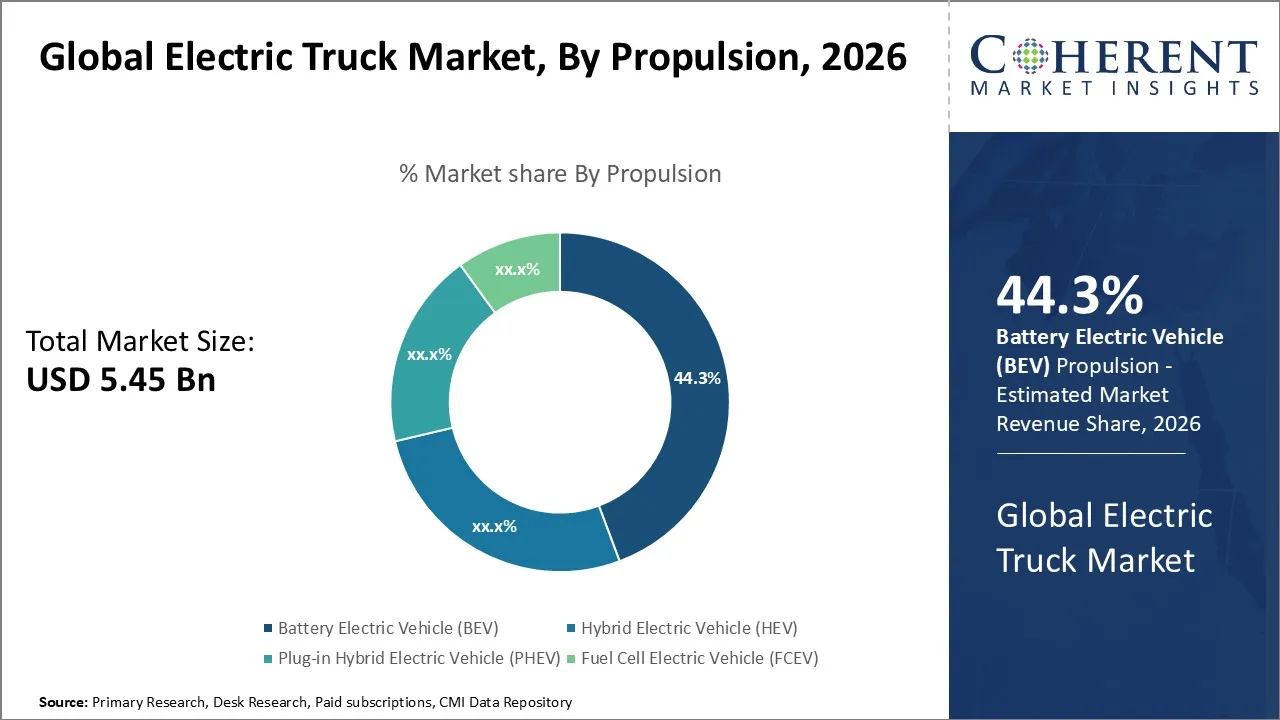
Battery electric Vehicle hold the largest market share of 44.3% in 2026. Multiple factors are actively driving the adoption of battery electric vehicles in the electric truck market, reshaping commercial transportation. Stricter emission regulations and rising environmental concerns are pushing fleets to adopt zero-emission solutions. Advances in battery technology are improving range, efficiency, and reliability, while expanding charging networks enable smooth daily operations. Companies favor electric trucks for their lower operating and maintenance costs, and growing demand for urban deliveries, short-haul logistics, and corporate sustainability goals is prompting manufacturers to produce diverse battery electric truck models for various applications. For instance, in October 2025, Blue Energy Motors (BEM), India’s leading green truck manufacturer, launched its electric heavy-duty truck with battery swapping technology at its state-of-the-art Chakan facility in Pune, unveiled by Maharashtra Chief Minister Shri Devendra Fadnavis.
Increasing demand for efficient, eco-friendly urban transportation is actively driving the growth of light-duty electric trucks. Fleets rely on these vehicles for short-haul deliveries, last-mile logistics, and municipal services because they produce lower emissions and handle predictable daily routes effectively. Advances in battery technology are improving range and performance, while expanding charging infrastructure enables smooth fleet operations. Businesses choose electric trucks for their lower operating and maintenance costs, and government incentives further encourage adoption. Rising e-commerce and sustainability goals push manufacturers to produce versatile light-duty electric truck models. For instance, in April 2025, Stellantis Pro One, the commercial vehicle unit of Stellantis, confirmed its collaboration with French high-tech firm Qinomic to launch a retrofit system that converts combustion-engine light commercial vehicles into electric vehicles.
Businesses are actively driving demand for electric trucks with a 0–150 mile range because they perfectly suit urban and short-haul operations. Fleets use these vehicles for last-mile deliveries, city logistics, and local distribution, where daily travel stays within this range. Smaller batteries lower vehicle costs and reduce weight, while expanding depot and urban charging networks enable efficient operations. Companies benefit from reduced maintenance and energy expenses, and stricter environmental regulations push fleets to adopt zero-emission solutions, promoting wider use of short-range electric trucks.
To learn more about this report, Download Free Sample
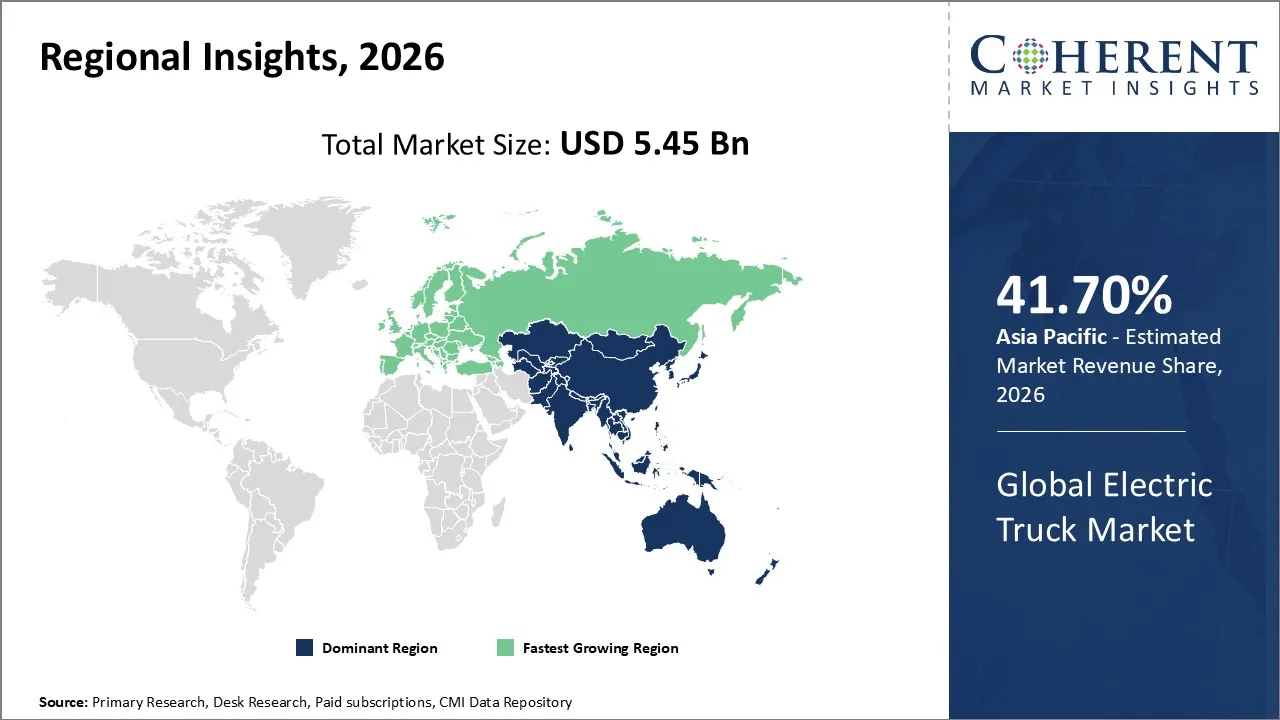
Asia Pacific dominates the overall market with an estimated share of 41.7% in 2026. Strong government support, growing environmental awareness, and increasing urban logistics demand are actively transforming the Asia Pacific electric truck market. China leads the region with extensive manufacturing capabilities and robust policies, while India, Japan, and South Korea expand infrastructure and accelerate fleet adoption. Advances in battery technology and the introduction of diverse truck models improve operational efficiency and lower costs. Rising e-commerce, rapid urbanization, and corporate sustainability initiatives are further driving the transition to electric trucks across light, medium, and heavy-duty segments throughout the region. For instance, in May 2025, China deployed the world’s largest fleet of driverless electric mining trucks in Inner Mongolia, with 100 vehicles powered by autonomous driving technology from Huawei Technologies.
European governments are actively shaping the electric truck market by enforcing strict emission regulations and promoting fleet electrification through incentives. Automotive manufacturers are responding by launching advanced electric truck models to meet rising demand in urban logistics, last-mile delivery, and regional freight operations. Expanding charging infrastructure and improvements in battery technology are boosting operational efficiency and reliability. Increasing environmental awareness, corporate sustainability initiatives, and the drive for cleaner transportation are accelerating adoption, transforming fleet strategies, and positioning Europe as a leading region in the electric truck sector. For instance, in May 2025, MAN launched Charge&Go, a new charging service for electric truck operators that provides access to charging points across Europe and supports automated payments for all truck brands.
Government policies, subsidies, and incentives are actively driving India’s electric truck market by promoting fleet electrification and the adoption of zero-emission vehicles. Businesses are increasingly integrating electric trucks for short-haul and last-mile deliveries to meet growing e-commerce and urban logistics demand. Advances in battery technology and expanding charging infrastructure are improving operational efficiency and reliability. Rising environmental awareness, corporate sustainability initiatives, and the push for cleaner transportation are prompting manufacturers to launch diverse electric truck models, transforming commercial transport and accelerating the shift toward sustainable freight in India. For instance, in October 2025, Blue Energy Motors (BEM) launched its electric heavy-duty truck with battery swapping technology at its Chakan facility in Pune, unveiled by Maharashtra Chief Minister Devendra Fadnavis, who also inaugurated India’s first Mumbai–Pune electric corridor.
Government regulations and incentives are actively driving the expansion of the United Kingdom’s electric truck market by promoting the adoption of zero-emission commercial vehicles. Businesses are increasing demand for efficient electric trucks to support urban delivery, last-mile logistics, and regional freight operations. Advances in battery technology and the expansion of charging infrastructure are enhancing range, reliability, and fleet productivity. Growing environmental awareness, corporate sustainability goals, and the push for cleaner transportation are prompting manufacturers to launch diverse electric truck models, transforming fleet operations and advancing the UK’s shift to sustainable, low-emission freight. For instance, in February 2025, Yutong announced plans to launch a new electric truck for the UK market, the T57e, featuring either a 100kW or 132kW battery, with the higher-capacity version offering a range of over 180 miles per charge.
The electric truck market is increasingly focusing on urban logistics and short-haul deliveries, as electric drivetrains are well-suited for predictable routes with frequent stops. Companies are integrating electric trucks into last-mile operations to reduce emissions and operating costs. Rising e-commerce demand, combined with city emission regulations, is accelerating the deployment of light- and medium-duty electric trucks, reshaping delivery networks and promoting cleaner, quieter urban freight solutions.
Battery improvements are driving market trends, enabling longer ranges, faster charging, and higher energy efficiency. Manufacturers are investing in high-density, lightweight batteries that reduce vehicle weight and improve payload capacity. Enhanced battery management systems optimize performance under various operational conditions, making electric trucks more reliable and economically viable. These technological developments are key to expanding adoption across urban, regional, and heavy-duty applications, ensuring electric trucks meet diverse fleet requirements.
Electric trucks present a significant opportunity in urban logistics and last-mile delivery, where predictable short routes match current battery ranges. As e-commerce continues to grow, companies can deploy electric trucks to reduce operational costs, minimize emissions, and comply with city regulations. This trend opens opportunities for fleet operators to optimize route planning, adopt green transportation solutions, and enhance service efficiency while contributing to cleaner, quieter urban environments.
| Report Coverage | Details | ||
|---|---|---|---|
| Base Year: | 2025 | Market Size in 2026: | USD 5.45 Bn |
| Historical Data for: | 2020 To 2024 | Forecast Period: | 2025 To 2032 |
| Forecast Period 2026 to 2033 CAGR: | 19.2% | 2033 Value Projection: | USD 16.01 Bn |
| Geographies covered: |
|
||
| Segments covered: |
|
||
| Companies covered: |
AB Volvo, Workhorse, BYD Company Ltd., Tesla, Daimler AG, Scania AB, Tata Motors, Rivian, Dongfeng Motor Group Co., Ltd., Man SE |
||
| Growth Drivers: |
|
||
| Restraints & Challenges: |
|
||
Uncover macros and micros vetted on 75+ parameters: Get instant access to report
Share
Share
About Author
Ameya Thakkar is a seasoned management consultant with 9+ years of experience optimizing operations and driving growth for companies in the automotive and transportation sector. As a senior consultant at CMI, Ameya has led strategic initiatives that have delivered over $50M in cost savings and revenue gains for clients. Ameya specializes in supply chain optimization, process re-engineering, and identification of deep revenue pockets. He has deep expertise in the automotive industry, having worked with major OEMs and suppliers on complex challenges such as supplier analysis, demand analysis, competitive analysis, and Industry 4.0 implementation.
Missing comfort of reading report in your local language? Find your preferred language :
Transform your Strategy with Exclusive Trending Reports :
Frequently Asked Questions
Joining thousands of companies around the world committed to making the Excellent Business Solutions.
View All Our Clients
 Schedule a meeting with report Author