Di Methyl Ether Market Analysis & Forecast: 2025-2032

Di Methyl Ether Market is estimated to be valued at USD 10.44 Bn in 2025 and is expected to reach USD 19.21 Bn in 2032, exhibiting a compound annual growth rate (CAGR) of 9.1% from 2025 to 2032.
The Dimethyl Ether (DME) market is rapidly expanding as industries adopt it as a versatile alternative fuel and chemical feedstock. Companies use DME mainly for LPG blending, transportation fuels, aerosol propellants, and industrial processes because of its clean-burning properties and compatibility with existing infrastructure. Rising demand for low-emission fuels, government initiatives promoting cleaner energy, and accelerating industrialization in regions like Asia-Pacific are driving the market. Ongoing advancements in production technologies and the growth of new applications continue to boost global DME adoption.
|
Current Events |
Description and its impact |
|
Geopolitical Developments |
|
|
Technological Advancements |
|
|
Environmental and Regulatory Factors |
|
Uncover macros and micros vetted on 75+ parameters: Get instant access to report
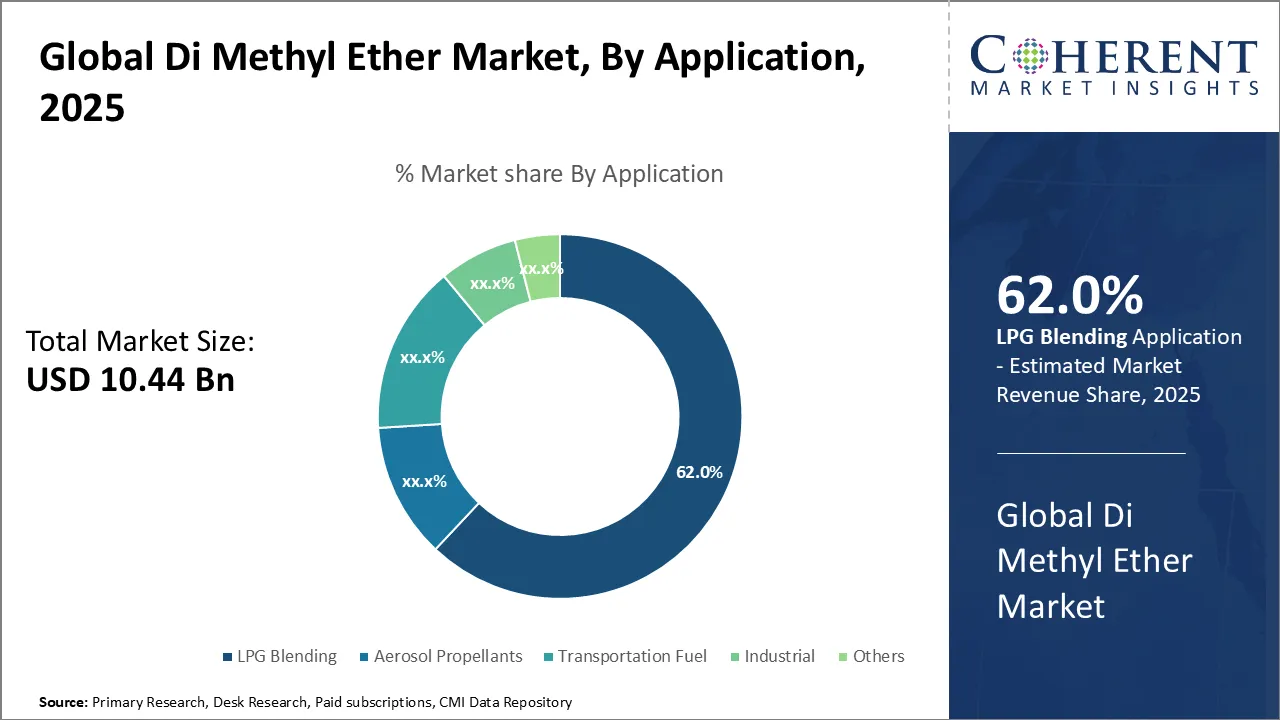
LPG Blending expected to hold largest market share of 62% in 2025. The LPG blending segment in the Dimethyl Ether (DME) market expands as industries and households seek cleaner, more efficient fuel solutions. Users incorporate DME-LPG blends to lower emissions and enhance combustion performance without modifying existing infrastructure. Governments promote these blends through low-emission fuel policies, while increasing environmental awareness drives wider adoption. By blending DME with LPG, producers strengthen energy security, optimize fuel supply and costs, and broaden applications across residential, commercial, and industrial sectors in rapidly developing and urbanizing regions. For instance, in September 2025, Biofriends Inc. and Cheongmyeong Co. have signed an MOU to build Korea’s first commercial-scale biogas-to-biomethanol plant, with some biomethanol converted into DME, a clean fuel compatible with existing LPG infrastructure.
The fossil fuel-based Dimethyl Ether (DME) market grows due to the abundant and cost-effective supply of natural gas and coal, which industries use as primary feedstocks. Manufacturers leverage established processes and mature technologies to produce DME efficiently at large scales. Companies integrate DME seamlessly into transportation, LPG blending, and industrial applications thanks to its compatibility with existing energy infrastructure. Increasing demand for cleaner-burning alternatives to diesel and LPG drives producers to adopt fossil-based DME, enhancing energy security while addressing environmental regulations and market requirements. For instance, in November 2025, Godavari Biorefineries Limited has partnered with ICT Mumbai to launch the world’s first single-step CO₂-to-DME pilot plant, converting carbon dioxide into DME, a clean fuel alternative.
To learn more about this report, Download Free Sample
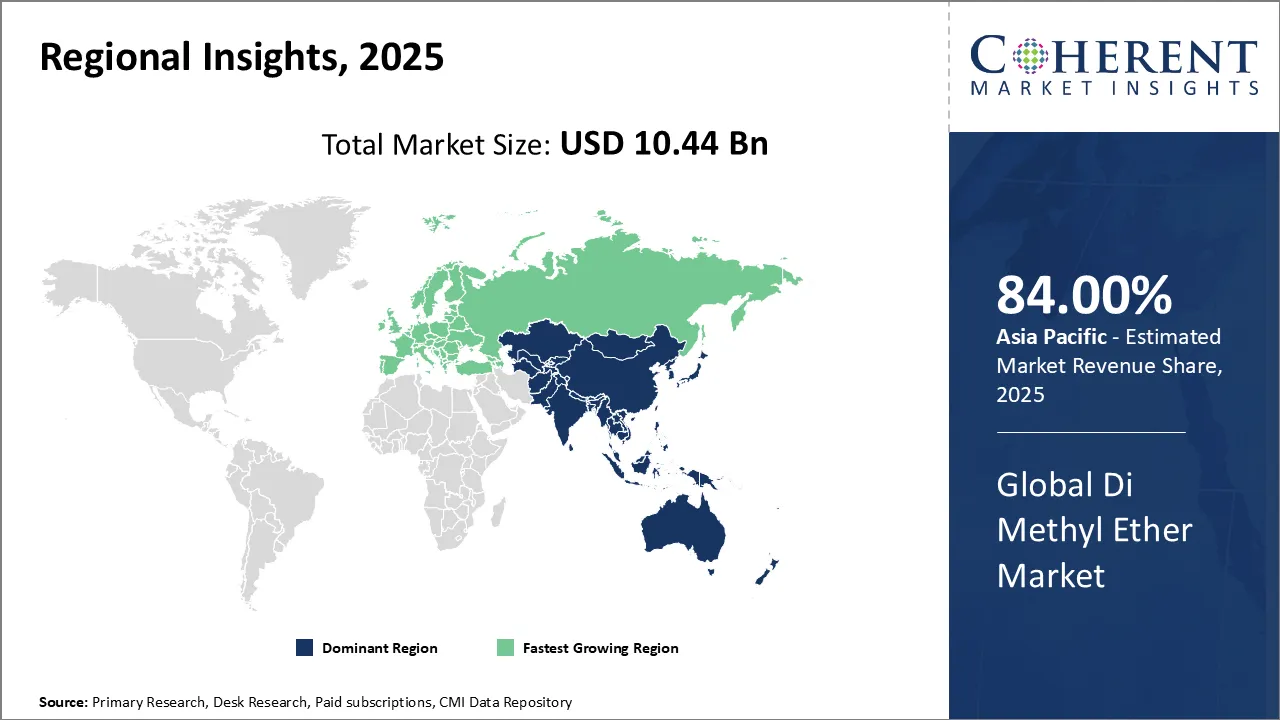
Asia Pacific dominates the overall market with an estimated share of 84% in 2025. The Asia-Pacific Dimethyl Ether (DME) market grows as rapid industrialization, urbanization, and the demand for cleaner energy drive adoption. Countries in the region increasingly use DME for LPG blending, transportation fuels, and industrial applications to improve air quality. Governments actively promote low-emission fuels and invest in production infrastructure, supporting market expansion. Companies leverage abundant feedstocks and established manufacturing capabilities to produce DME efficiently, enabling its widespread use across residential, commercial, and industrial sectors throughout the region. For instance, Union Minister Dr. Harsh Vardhan inaugurated the DME-fired “Aditi Urja Sanch” unit and DME-LPG blended fuel cylinders at CSIR-NCL, making them available for public and canteen use on a trial basis via video conference.
The European Dimethyl Ether (DME) market expands as the region prioritizes sustainable, low-emission energy solutions. Industries and the transport sector increasingly use DME as a cleaner alternative to diesel and LPG, driven by strict environmental regulations. Companies invest in advanced production technologies and renewable feedstocks to boost market development. Governments and private firms collaborate to expand infrastructure and diversify applications, actively promoting DME integration across residential, commercial, and industrial sectors, establishing Europe as a leading region for clean fuel adoption. For instance, Enerkem and Dimeta have launched feasibility studies for two large-scale projects to convert waste into renewable dimethyl ether (DME).
The Indian Dimethyl Ether (DME) market is expanding as the country pursues cleaner fuel alternatives to tackle pollution and strengthen energy security. Industries, the transport sector, and households increasingly use DME for LPG blending and as a diesel substitute because of its low-emission properties. The government actively supports DME production and infrastructure through subsidies and favorable policies. Companies leverage abundant methanol and coal feedstocks, along with rising industrialization and urbanization, to produce DME efficiently and expand its applications across multiple sectors in India. For instance, in May 2024, Lummus Technology has announced the commercial launch of CDDME, a renewable dimethyl ether (DME) technology enhanced with catalytic distillation.
The United Kingdom Dimethyl Ether (DME) market is expanding as the country advances sustainable energy and low-emission alternatives. Industries and the transportation sector increasingly use DME as a cleaner replacement for diesel and LPG, complying with strict environmental regulations. Companies invest in advanced production technologies and renewable feedstocks to drive market growth, while government and private sector collaborations develop supporting infrastructure. Growing awareness of cleaner fuels encourages adoption across commercial, residential, and industrial applications, establishing the UK as a leading participant in the shift toward sustainable energy solutions. For instance, Suez UK is exploring a waste-to-LPG-substitute partnership with Circular Fuels, which plans to build a Teesside facility to convert waste into fuel-ready dimethyl ether (DME).
Industries and transportation sectors are increasingly adopting DME as a cleaner alternative to conventional fuels like diesel and LPG. Rising environmental concerns, stricter emission regulations, and the push for sustainable energy solutions drive this trend. DME’s clean-burning properties, low particulate emissions, and compatibility with existing fuel infrastructure make it attractive for industrial, residential, and transport applications, accelerating its adoption across regions seeking to reduce pollution and promote green energy solutions.
DME is increasingly blended with LPG to improve combustion efficiency and reduce emissions in households and commercial sectors. The trend is supported by governments promoting low-emission fuels and industries seeking energy diversification. LPG-DME blends enable easier integration into existing distribution and appliance systems, allowing consumers to adopt cleaner fuels without major infrastructure changes, further driving the market while addressing energy security and air quality challenges.
Blending DME with LPG offers a promising opportunity to improve fuel efficiency and reduce emissions in residential, commercial, and industrial applications. Companies can leverage DME to create blended products compatible with existing LPG infrastructure, minimizing costs and technical challenges for consumers. This opportunity aligns with regulatory pushes for cleaner household fuels and industrial energy solutions, providing a path for manufacturers and distributors to capture new market segments while promoting energy security and environmental benefits.
| Report Coverage | Details | ||
|---|---|---|---|
| Base Year: | 2024 | Market Size in 2025: | USD 10.44 Bn |
| Historical Data for: | 2020 To 2024 | Forecast Period: | 2025 To 2032 |
| Forecast Period 2025 to 2032 CAGR: | 9.1% | 2032 Value Projection: | USD 19.21 Bn |
| Geographies covered: |
|
||
| Segments covered: |
|
||
| Companies covered: |
China Energy Ltd., Fuel DME Production Co., Ltd., Korea Gas Corporation, Royal Dutch Shell PLC, Akzo Nobel NV, Oberon Fuels, Inc., Grillo-Werke AG, Shenhua Ningxia Coal Industry Group Co., Ltd., E. I. du Pont de Nemours & Co, and Mitsubishi Corporation |
||
| Growth Drivers: |
|
||
| Restraints & Challenges: |
|
||
Uncover macros and micros vetted on 75+ parameters: Get instant access to report
In November 2025, Godavari Biorefineries Limited, in collaboration with ICT Mumbai, commissioned the world’s first single-step CO₂-to-DME pilot plant. This landmark initiative advances circular carbon solutions by directly converting carbon dioxide into dimethyl ether (DME), a clean alternative to LPG, diesel, and conventional chemical feedstocks.
Share
Share
About Author
Yash Doshi is a Senior Management Consultant. He has 12+ years of experience in conducting research and handling consulting projects across verticals in APAC, EMEA, and the Americas.
He brings strong acumen in helping chemical companies navigate complex challenges and identify growth opportunities. He has deep expertise across the chemicals value chain, including commodity, specialty and fine chemicals, plastics and polymers, and petrochemicals. Yash is a sought-after speaker at industry conferences and contributes to various publications on topics related commodity, specialty and fine chemicals, plastics and polymers, and petrochemicals.
Missing comfort of reading report in your local language? Find your preferred language :
Transform your Strategy with Exclusive Trending Reports :
Frequently Asked Questions
Joining thousands of companies around the world committed to making the Excellent Business Solutions.
View All Our Clients
 Schedule a meeting with report Author