Constrained Layer Damping Market Analysis & Forecast: 2026-2033

The Constrained Layer Damping Market is estimated to be valued at USD 11.45 Bn in 2026 and is expected to reach USD 16.76 Bn by 2033, exhibiting a compound annual growth rate (CAGR) of 9.6% from 2026 to 2033.
The Constrained Layer Damping (CLD) market is expanding as industries actively seek solutions for noise and vibration control in automotive, aerospace, construction, and industrial applications. Manufacturers prioritize cabin comfort, structural vibration reduction, and regulatory compliance, driving the adoption of advanced damping materials. Companies are developing innovative viscoelastic polymers, lightweight metals, and hybrid structures to enhance performance and versatility. Growing use in electric vehicles, industrial machinery, and modern building infrastructure further boosts market demand, establishing CLD solutions as key components for superior acoustic and structural performance
|
Current Events |
Description and its impact |
|
Advances in Automotive Electrification |
|
|
Economic Fluctuations and Raw Material Pricing |
|
|
Regional Infrastructure and Construction Trends |
|
Uncover macros and micros vetted on 75+ parameters: Get instant access to report
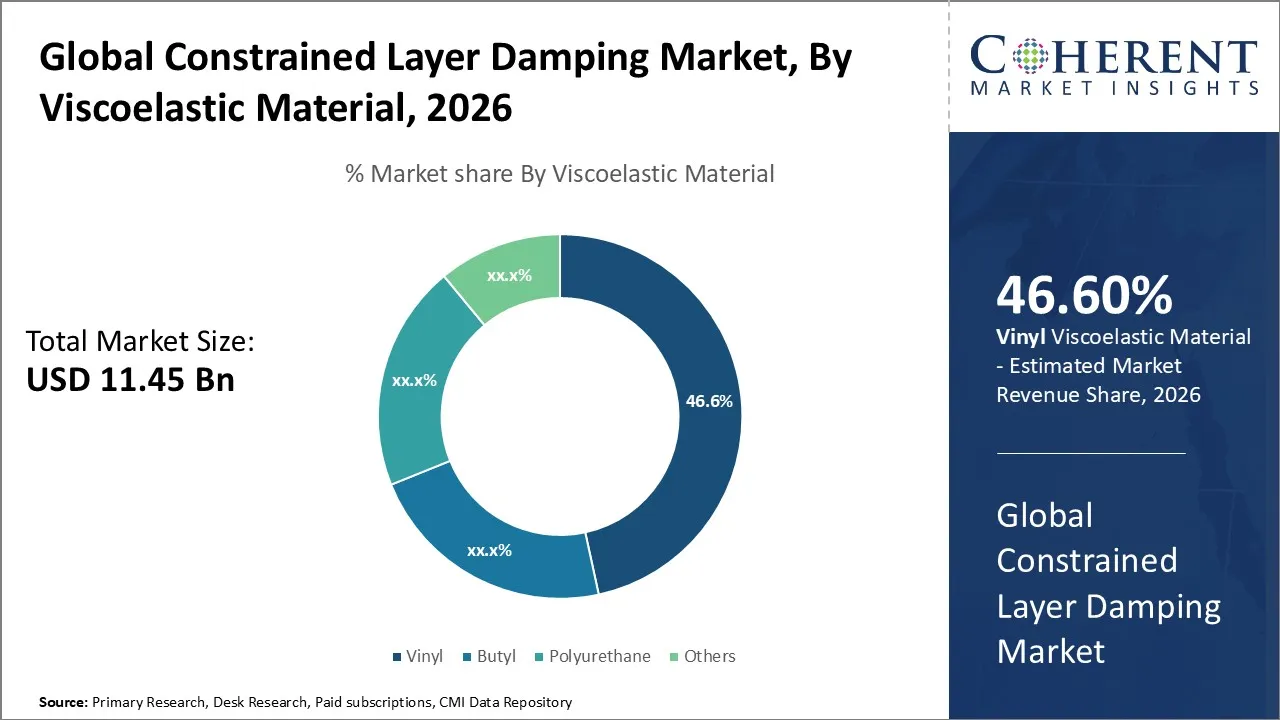
Vinyl holds the largest market share of 46.60% in 2026. Industries are increasingly adopting vinyl in the Constrained Layer Damping (CLD) market because it combines cost-effectiveness, easy processing, and dependable vibration-damping performance. Manufacturers use vinyl in applications that require moderate noise and vibration control, including appliances, HVAC systems, and mass-market automotive parts. Its adaptable nature enables simple installation and seamless integration with existing structures while maintaining durability under diverse conditions. The material’s versatility and affordability drive its selection across multiple sectors, actively expanding CLD applications and boosting market adoption. For instance, in October 2025, Audio-Technica has launched five AT33x cartridges for stereo and mono vinyl playback, along with two slipmats, a stainless-steel disc stabilizer, cartridge alignment tools, and a pair of AT-ST3 speaker stands with cork-damped feet.
Aluminum expected to hold largest market share of 54.4% in 2026. Companies are turning to aluminum in the Constrained Layer Damping (CLD) market for its lightweight characteristics, excellent stiffness-to-weight ratio, and robust structural strength. They incorporate aluminum in automotive, aerospace, and industrial applications to enhance vibration control while reducing overall weight. Its seamless compatibility with viscoelastic layers and easy fabrication streamline the production of damping components. Offering durability, high performance, and versatility, aluminum functions as a preferred constraining layer, actively promoting the adoption and growth of CLD solutions across various industries.
Automotive acquired the prominent market share of 49.8% in 2026. Automakers are driving the Constrained Layer Damping (CLD) market by prioritizing cabin comfort and minimizing structural vibrations. They integrate CLD materials into floors, doors, roofs, and panels to meet rising consumer demand for quieter, smoother rides and comply with stricter noise regulations. The expansion of electric and hybrid vehicles increases the need for vibration control as powertrain noise decreases. By developing lightweight, high-performance damping materials, manufacturers actively enhance NVH performance while maintaining efficiency, promoting wider adoption across vehicle platforms.
To learn more about this report, Download Free Sample
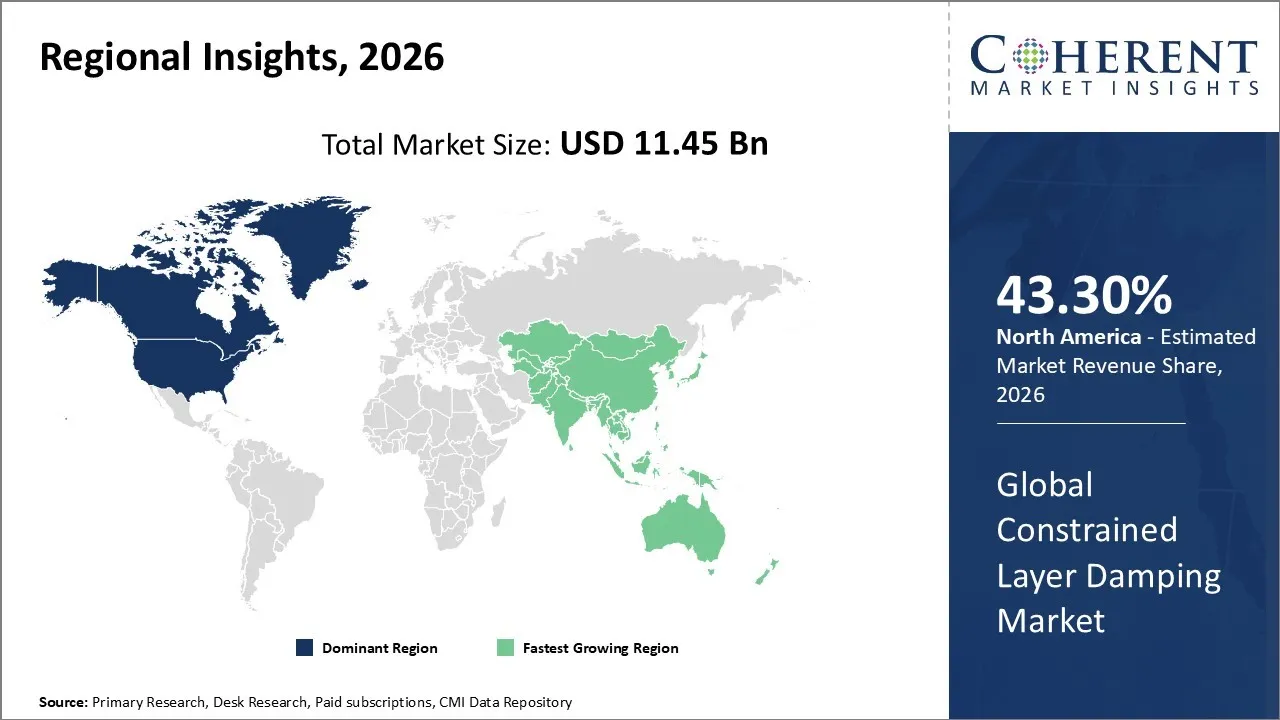
North America dominates the overall market with an estimated share of 43.3% in 2026. Companies in North America are actively shaping the Constrained Layer Damping (CLD) market, driven by high demand from automotive, aerospace, and industrial sectors. They are adopting advanced viscoelastic materials and lightweight metals to meet strict noise and vibration requirements. The expansion of electric vehicles and modern building infrastructure is broadening CLD applications, while innovations in fabrication and integration are enhancing efficiency and performance. Increasing construction, retrofit, and industrial projects further propel growth, establishing North America as a center for technological advancement and diversified CLD adoption. For instance, in May 2024, Technics has launched the SL-1200M7B, developed in collaboration with Lamborghini, featuring a two-layer platter with enhanced vibration damping, a high-rigidity cabinet, and a high-damping insulator to block vibrations under tough conditions.
Companies across Asia Pacific are rapidly expanding the Constrained Layer Damping (CLD) market by adopting advanced vibration and noise control solutions in the automotive, electronics, and construction industries. They are integrating cost-effective viscoelastic materials and lightweight metals to meet increasing performance requirements and regulatory standards. Rising electric vehicle production, urban infrastructure projects, and industrial modernization are driving wider CLD applications. By innovating in manufacturing processes and material technologies, regional manufacturers are improving efficiency and durability, establishing Asia Pacific as a dynamic hub for large-scale CLD adoption and growth.
Manufacturers in the United States are driving the Constrained Layer Damping (CLD) market by focusing on reducing noise and vibration in automotive, aerospace, and industrial applications. They are using high-performance viscoelastic materials and lightweight metals to improve structural integrity and cabin comfort while complying with strict regulations. Expanding electric vehicle production, modern infrastructure projects, and industrial upgrades are broadening CLD applications. By innovating in material formulation and fabrication methods, U.S. companies are enhancing efficiency and durability, positioning the country as a leader in advanced and technology-driven CLD solutions.
Companies in China are actively expanding the Constrained Layer Damping (CLD) market by adopting vibration and noise reduction solutions across automotive, electronics, and construction industries. They are using cost-effective viscoelastic materials and lightweight metals to meet increasing performance demands and regulatory standards. Rapid growth in electric vehicle production, urban infrastructure, and industrial modernization is broadening CLD applications. By innovating material technologies and optimizing fabrication processes, Chinese manufacturers are improving durability and efficiency, establishing the country as a key hub for large-scale adoption and technological advancement in CLD solutions. For instance, in December 2025, Nissan Motor Co., Ltd. announced that its China joint venture, Zhengzhou Nissan, will launch the all-new Frontier Pro and Frontier Pro PHEV—Nissan’s first plug-in hybrid pickup—designed, developed, and built in China for global markets, featuring a quiet, well-damped cabin with a panoramic sunroof and premium audio.
The shift toward electric and hybrid vehicles is reshaping CLD applications, as reduced engine noise highlights road, wind, and structural vibrations. Automakers are increasingly integrating advanced CLD materials into floors, doors, and panels to enhance cabin comfort. Lightweight, high-performance viscoelastic materials and hybrid layers are becoming standard to maintain NVH standards while supporting efficiency, making electric vehicle platforms a significant driver of innovation and demand in the CLD market.
CLD materials are increasingly used in buildings, industrial machinery, and urban infrastructure projects to control vibration and noise. Construction firms apply damping sheets in flooring, walls, and ceilings to meet acoustic standards, while manufacturers of machinery adopt CLD components to reduce operational noise. This cross-sector adoption is driving material innovation, such as improved adhesion, temperature tolerance, and durability, enabling broader applications beyond traditional automotive and aerospace markets.
Rapid urbanization and infrastructure development across emerging and developed regions create demand for CLD applications in buildings, bridges, and transit systems. Opportunities exist for manufacturers to supply damping sheets and panels that improve acoustic comfort, vibration control, and structural stability. Retrofitting existing structures with modern CLD solutions also presents a growing market segment, as governments and construction companies aim to meet stricter noise and vibration standards while enhancing occupant experience.
| Report Coverage | Details | ||
|---|---|---|---|
| Base Year: | 2025 | Market Size in 2026: | USD 11.45 Bn |
| Historical Data for: | 2020 To 2024 | Forecast Period: | 2026 To 2033 |
| Forecast Period 2026 to 2033 CAGR: | 9.6% | 2033 Value Projection: | USD 16.76 Bn |
| Geographies covered: |
|
||
| Segments covered: |
|
||
| Companies covered: |
Sika Ag, Trelleborg Ab, Henkel Ltd., Flexcon Company, Inc, Nitto Denko Corporation, Pyrotek Inc., Vibratec, Autoneum, Rousch, Avery Dennison Corporation, American Acoustical Products, Polymer Technology Inc. Soundown Corporation, Heathcote Industrial Plastics, Vibracoustic Gmbh, Megasorber Pty Ltd, and 3M |
||
| Growth Drivers: |
|
||
| Restraints & Challenges: |
|
||
Uncover macros and micros vetted on 75+ parameters: Get instant access to report
Share
Share
About Author
Vidyesh Swar is a seasoned Consultant with a diverse background in market research and business consulting. With over 6 years of experience, Vidyesh has established a strong reputation for his proficiency in market estimations, supplier landscape analysis, and market share assessments for tailored research solution. Using his deep industry knowledge and analytical skills, he provides valuable insights and strategic recommendations, enabling clients to make informed decisions and navigate complex business landscapes.
Missing comfort of reading report in your local language? Find your preferred language :
Transform your Strategy with Exclusive Trending Reports :
Frequently Asked Questions
Joining thousands of companies around the world committed to making the Excellent Business Solutions.
View All Our Clients
 Schedule a meeting with report Author