Commercial or Corporate Card Market Analysis & Forecast: 2026-2033

The commercial or corporate card market is estimated to be valued at USD 47.7 Bn in 2026 and is expected to reach USD 76.6 Bn by 2033, growing at a compound annual growth rate (CAGR) of 7.5% from 2026 to 2033.
The commercial or corporate card market provides spend management systems and automated payment technologies primarily for enterprise treasury, workforce procurement, and financial operations. This market includes sophisticated virtual card platforms, multi-currency corporate credit lines, and integrated expense reconciliation systems, along with cloud-based management software, ERP connectivity, and long-term audit and compliance services.
The global demand for fiscal transparency and operational efficiency is being identified more frequently each year, creating a greater need for real-time, frictionless payment among global corporations, mid-market firms, and government agencies. The CFOs and the regulatory authority understand the importance of spend control automation in mitigating business risks and optimizing capital in the long run. The implementation of strict anti-fraud standards and digital-first banking policies is contributing to steady market growth, particularly in North America and the Asia Pacific region, where business travel is recovering and digital payment infrastructure is expanding. The market is also highly significant in regions with established banking frameworks and high corporate expenditure, including the US, Europe, and China.
|
Current Event |
Description and the Impact |
|
Technological Innovations and Digital Transformation
|
|
|
Regional Market-Specific Developments |
|
|
Macroeconomic and Global Financial Trends
|
|
Uncover macros and micros vetted on 75+ parameters: Get instant access to report
The use of artificial intelligence is transforming the market by automating complex financial workflows and improving security. Modern AI models analyze vast amounts of transaction data in real time to detect subtle patterns of fraud. These systems also make it easier to manage spending by automatically categorizing corporate expenses and flagging policy violations. Predictive analytics enables issuers to assess credit card risk with high precision and make personalized credit limit decisions in real time, in alignment with actual business health. AI-powered assistants address billing disputes and manage routine inquiries, thereby reducing administrative burdens for financial teams. These improvements assist businesses gain deeper insights into their capital flow while maintaining robust control over employee spending.
For instance, in July 2025, at CES 2026, the emerging AI hardware firm MMEETT unveiled the AI Business Card, a contactless, AI-powered social interface crafted to redefine the manner in which professionals share information in real-world environments. Its AI-driven features include real-time transcription, multilingual translation, and the automated organization of meeting discussions.
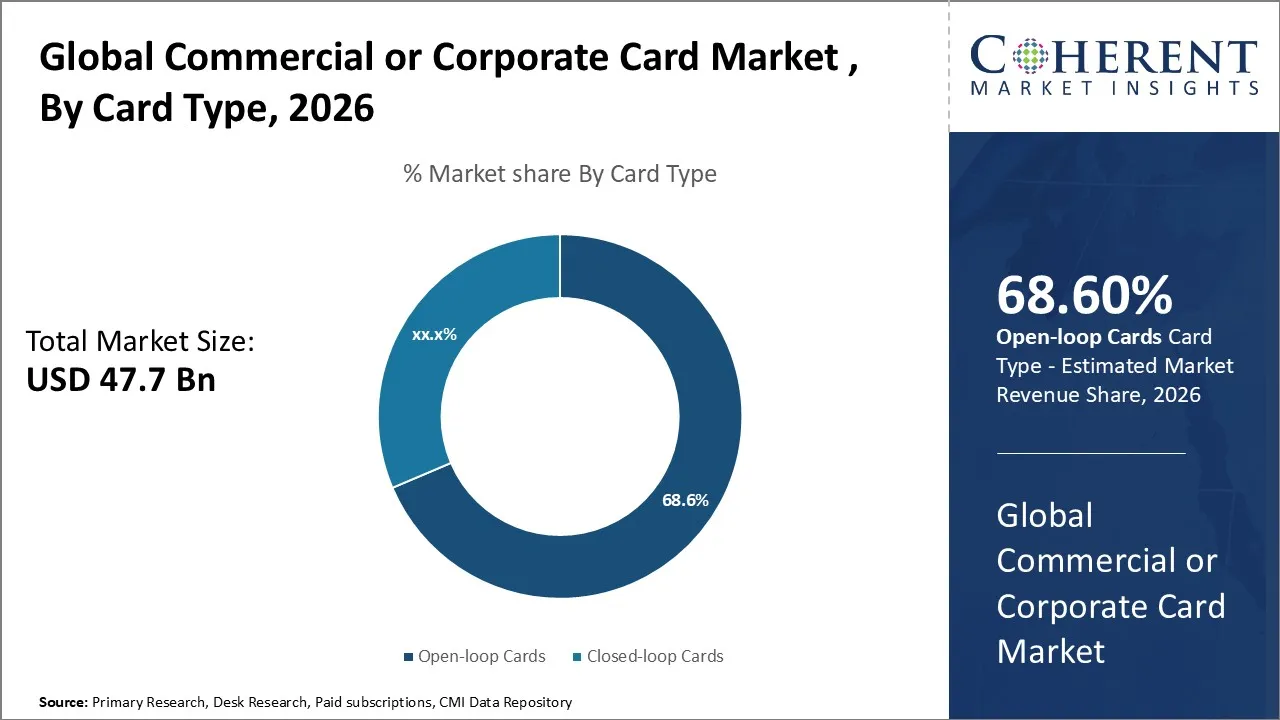
In terms of card type, the open-loop cards segment contributes the highest share of 68.60% in 2026 of the market driven by their wide global acceptance. These cards operate on major financial networks like Visa and Mastercard, thus allowing users to conduct transactions at nearly any merchant that accepts electronic payments worldwide. This universal compatibility makes them the preferred choice for companies with international travel requirements and global supply chains. Unlike closed-loop cards, which are restricted to specific vendors, open-loop systems provide the flexibility needed for a diverse range of business expenses.
For instance, in October 2025, Fortech and Mastercard collaborated to launch a new feature for fleet cards. The partnership aims to improve fleet management efficiency both in Italy and Europe. The collaboration will provide an open-loop fleet management payment solution, facilitating direct access to transaction data via corporate cards.
In terms of product type, the purchase cards segment contributes the highest share of 36.20% in 2026 of the market owing to the rising adoption of procurement automation and better spend control. The purchase cards make the procure-to-pay process smoother, as employees can make purchases for the business without going through the time-consuming process. There has been an increasing adoption of integrating purchasing cards with sophisticated ERP systems so that the organization can monitor retail spending and miscellaneous expenses in real time. The reconciliation process has been automated, resulting in fewer errors in financial statements.
For instance, in July 2025, PhotonPay, a worldwide provider of digital financial services, announced the official release of its physical Mastercard Commercial Credit Card, representing a significant milestone in its global payment solutions portfolio and offering a unified, secure payment experience to international businesses throughout online as well as offline channels.
In terms of end user, the large enterprises segment contributes the highest share of 62.50% in 2026 of the market owing to centralized expense management systems and higher transaction volumes. Large businesses generally handle thousands of employees, requiring a highly organized system for spend management. These organizations utilize corporate cards to enforce travel and expense policies while simultaneously collecting significant rewards and cash-back incentives. The inclusion of card transactions into cloud accounting systems makes it possible for large businesses to conduct audits as well as detect fraudulent transactions. In addition, the large volume of transactions facilitates the negotiation of favorable terms for these companies from the card issuers, thus reducing the overall cost of credit.
For instance, in November 2025, American Express and Emburse strengthened their strategic alliance through the introduction of two new features named American Express Virtual Card issuance and Real-Time Transaction Data, within Emburse Enterprise Expense. It is an AI-driven platform designed to assist large enterprises in streamlining travel, expense, invoice, and payment processes all while enhancing visibility and control.
To learn more about this report, Download Free Sample
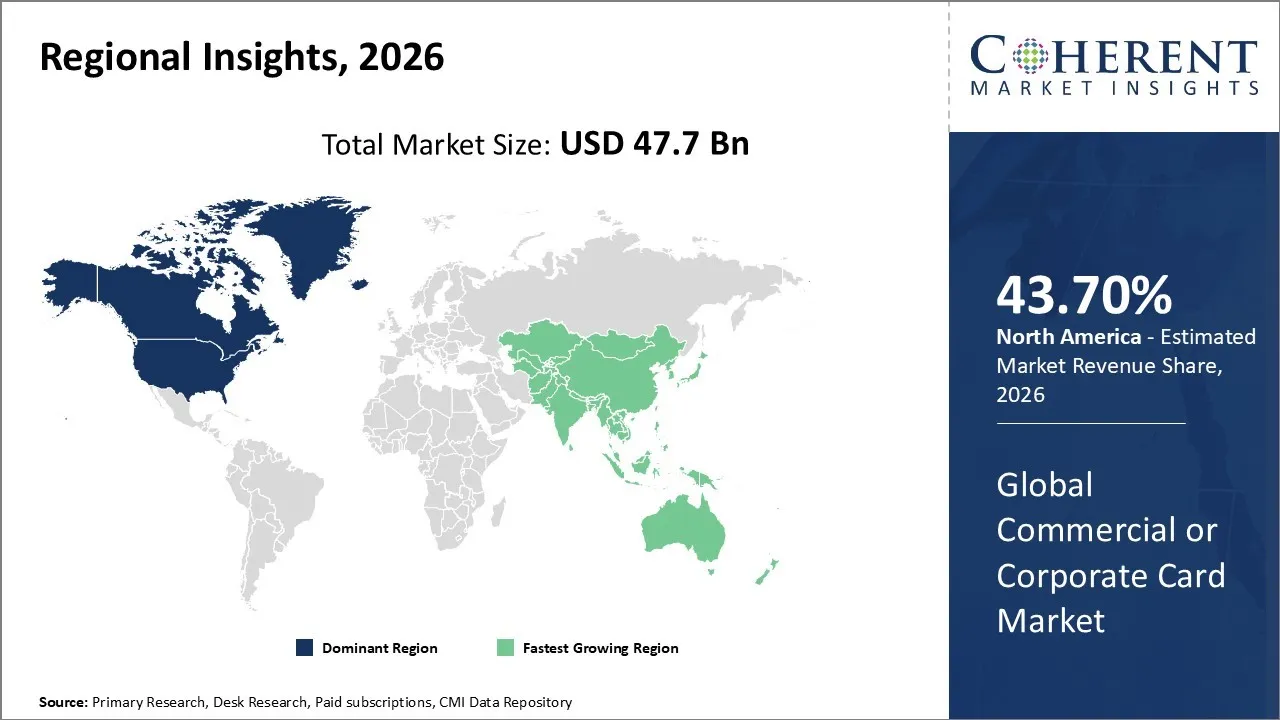
North America has remained the dominant region with 43.70% in 2026 of the global commercial or corporate card market over the past decade due to its highly sophisticated financial infrastructure and the early widespread adoption of digital payment technologies by major enterprises. The region maintains this leadership with its mature corporate culture prioritising automated expense management and real-time financial transparency. Global payment giants like Visa, Mastercard, and American Express drive a continuous pipeline of innovation, including virtual card tokenization and seamless ERP integration. Commercial cards are actively being used by most businesses in this region for procurement and travel. High transaction volumes and a regulatory environment that promotes cashless B2B transactions also help in enhancing the market position of this region. This establishes it as a leader in setting global standards for corporate spending.
For instance, in May 2025, Ramp, the leading and rapidly growing corporate card and financial operations platform in the United States, extended its collaboration with Stripe, a provider of programmable financial services, to introduce the industry's inaugural stablecoin-backed corporate cards featuring completely integrated spend management software.
Asia Pacific has become the fastest-growing region in the commercial card market, fueled by rapid digital transformation and the burgeoning expansion of the SME sector across China, India, and Southeast Asia. Government-led initiatives promote cashless economies and accelerate this growth by integrating corporate cards with popular mobile wallet ecosystems like Alipay and WeChat Pay. The region is quickly closing the gap with Western markets by leveraging mobile-first financial technologies and executing a massive shift away from traditional paper-based procurement systems to secure digital payment alternatives.
For instance, in August 2025, PT Bank Negara Indonesia Tbk. (BNI) and PT JCB International Indonesia, a division of JCB International Co. Ltd., (JCB), unveiled the BNI JCB Ultimate Corporate Card in Indonesia. This premium credit card is tailored to address the varied requirements of Japanese companies operating in Indonesia, facilitating their business activities and partnerships with local entities.
The US market is at the forefront due to its highly developed financial infrastructure and the broad adoption of digital payment technology in business processes. The companies drive the global move towards virtual cards and automated expense management systems for enhancing operational transparency. Major financial institutions and fintech companies are thus propelling this supremacy through seamless ERPs and effective fraud prevention strategies. In addition, the regulatory environment in the country makes it easy for businesses to shift from using paper checks to electronic B2B transactions. The businesses in the country leverage high transaction volumes and cutting-edge data analytics to maximize cashback rewards and optimize their working capital. As a result, the country continues to lead the global market.
China is emerging as a high-growth market propelled by rapid digitalization and government-led initiatives that promote cashless transactions. Large-scale infrastructure projects and the rise of a massive SME sector fuel the demand for efficient corporate payment tools throughout the nation. The businesses in the country are increasingly integrating corporate cards with dominant mobile wallet ecosystems like Alipay and WeChat Pay to streamline local and international transactions.
In addition, the government’s focus on digital transformation encourages increased business travel, further increasing credit card usage. As companies increase their footprint in the world, they adopt advanced credit solutions in order to manage cross-border procurement and complex supply chain logistics effectively. This trend makes China the key driver of growth in the region’s market.
| Report Coverage | Details | ||
|---|---|---|---|
| Base Year: | 2025 | Market Size in 2026: | USD 47.7 Bn |
| Historical Data for: | 2020 To 2024 | Forecast Period: | 2026 To 2033 |
| Forecast Period 2026 to 2033 CAGR: | 7.5% | 2033 Value Projection: | USD 76.6 Bn |
| Geographies covered: |
|
||
| Segments covered: |
|
||
| Companies covered: |
AirPlus International Ltd., Amazon.com, Inc., American Express Company, Bank of America Corporation, Citigroup, Inc., JP Morgan Chase & Co. Inc., U.S. Bancorp, Wex Inc., Wells Fargo & Company, Corporate Spending Innovations Enterprises, Inc., NGC US, LLC, and Bank of China Limited. |
||
| Growth Drivers: |
|
||
| Restraints & Challenges: |
|
||
Uncover macros and micros vetted on 75+ parameters: Get instant access to report
The shift toward a cashless economy acts as a primary catalyst for the rapid expansion of the commercial or corporate card market. Businesses are moving away from traditional paper-based systems and adopting digital payment methods. They provide unparalleled efficiency and transparency in managing corporate spending. Commercial cards no longer strictly serve travel and entertainment needs. They now function as essential tools for automated expense management and B2B procurement.
With the direct integration of these cards into cloud-based ERP systems, organizations gain real-time visibility into expenditures alongside advanced data analytics capabilities. The integration also strengthens fraud mitigation controls, thus allowing firms to optimize cash flow management. Moreover, the growing adoption of virtual cards and contactless technologies streamlines expense oversight for distributed and remote workforces. Supported by features such as extended credit lines and attractive rebate programs, the increasing demand for cashless solutions is reshaping corporate finance operations. As a result, these trends are helping build an efficient, secure, and data-driven financial system for modern enterprises.
*Definition: The Commercial or Corporate Card Market leverages integrated spend management software and advanced digital payment rails to streamline complex business transactions. This sector centers on leveraging artificial intelligence and virtual card systems for executing financial tasks. These include real-time expense reconciliation, vendor payments, and cross-border procurement with high precision. These digital solutions are widely adopted by large enterprises and mid-market companies where liquidity management and regulatory compliance are essential pillars of modern fiscal operations. Specialized ERP integrated platforms and automated approval workflows help in minimizing the risk of unauthorized spending while reducing the heavy reliance on manual accounting for repetitive data entry prior to financial cycles closing. The demand for these solutions comes from multinational companies, government offices, and industrial units.
Share
Share
About Author
Suraj Bhanudas Jagtap is a seasoned Senior Management Consultant with over 7 years of experience. He has served Fortune 500 companies and startups, helping clients with cross broader expansion and market entry access strategies. He has played significant role in offering strategic viewpoints and actionable insights for various client’s projects including demand analysis, and competitive analysis, identifying right channel partner among others.
Missing comfort of reading report in your local language? Find your preferred language :
Transform your Strategy with Exclusive Trending Reports :
Frequently Asked Questions
Joining thousands of companies around the world committed to making the Excellent Business Solutions.
View All Our Clients
 Schedule a meeting with report Author