Cell Counting Devices Market Analysis & Forecast: 2026-2033

Cell counting devices market is estimated to be valued at USD 11,600 Mn in 2026 and is expected to reach USD 19,600 Mn in 2033, exhibiting a compound annual growth rate (CAGR) of 7.8% from 2026 to 2033.
Cell counting is a method of counting or quantifying the cells. This method is used to determine the concentration and viability of cells. There are various types of methods present for counting of cells such as counting chambers, by plating and calculating colony forming unit, or by automation, which includes electrical resistance mechanism, flow cytometer, image analysis, and stereologic cell counting. Some of the indirect methods of cell counting are spectrophotometry and impedance microbiology technique. Cell counting is important for diagnosis and treatment of diseases. It is also used by researchers to study the behavior of pathogens including viruses, bacteria, etc. and to estimate the amount for addition of reagents in an experiment. Life expectancy of cancerous cells is determined through cell counting method.
|
Current Event |
Description and its Impact |
|
Global AI and Machine Learning Integration in Healthcare |
|
|
China's Biotechnology Sector Growth and Trade Relations |
|
Uncover macros and micros vetted on 75+ parameters: Get instant access to report
AI (artificial intelligence) is altering the Cell Counting Devices Market by making cell analysis more accurate, faster, and easier to repeat. AI-powered algorithms make it possible to automatically find, assess, and classify cells, which lowers the risk of human error and makes research and clinical diagnostics more reliable. Combining AI with advanced imaging and flow cytometry systems makes it possible to do high-throughput analysis, which is very important for cancer research, stem cell therapies, and drug development. As clinical trials and regenerative medicine grow, AI-powered cell counting devices are likely to become more popular. These devices give labs smarter, more efficient tools that improve precision medicine and speed up scientific discoveries.
For instance, in April 2025, Scientists made a microfluidic device that uses AI to quickly count CD4+ T-cells in whole blood. The system uses microfluidics and artificial intelligence to provide quick, accurate, and portable immune monitoring. This new idea is highly significant for HIV care because it makes tests available and affordable for hospitals and clinics all over the world, especially in areas with few resources.
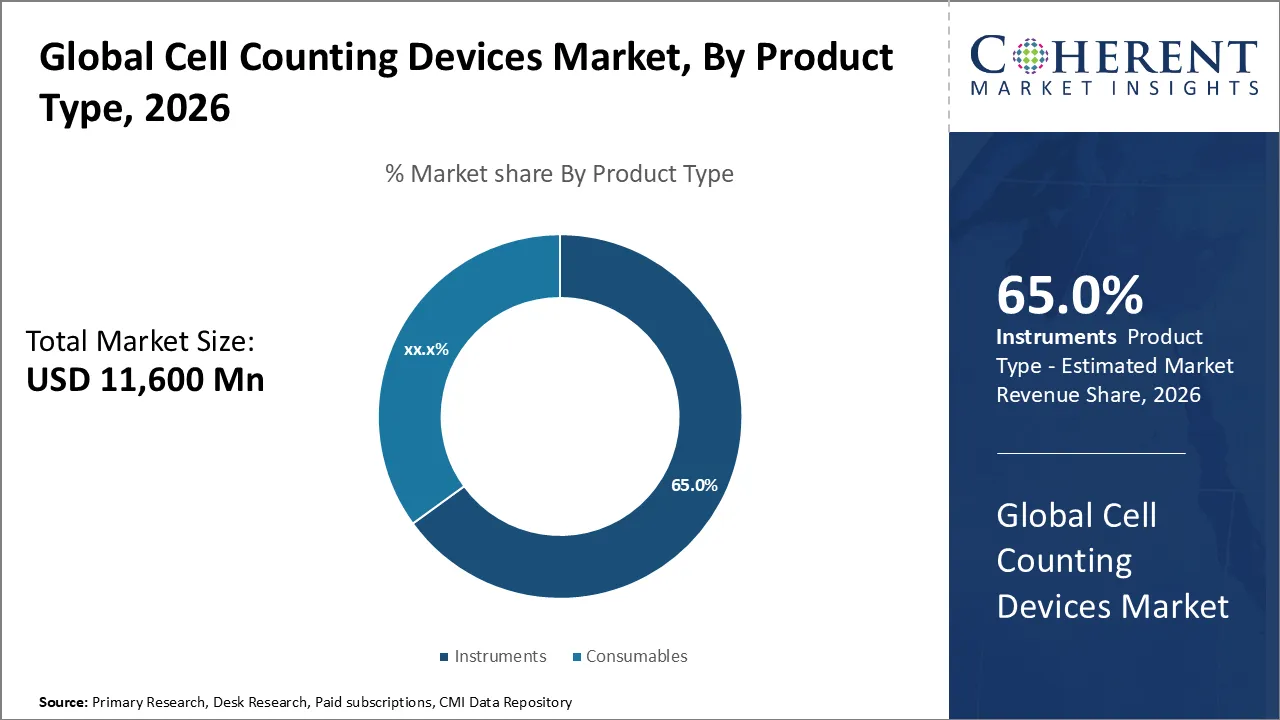
In terms of product type, the instruments segment is expected to hold 65% share of the market in 2026. They are essential for cancer research, immunology, and diagnostics as they are accurate, fast, and flexible. Spectrophotometers and hemocytometers contribute but automated instruments drive most revenue. Consumables are growing quickly, but instruments remain the most important part of the market.
For instance, in May 2025, BD announced that they are releasing a groundbreaking cell analyzer that uses new spectral and real-time cell imaging technologies. This new feature improves cell counting by making it more accurate, faster, and flexible. The device is meant to help with cancer research, immunology, and diagnostics, which makes hospitals around the world even more dependent on advanced tools.
In terms of end user, the hospital segment is expected to lead the market with 37% share in 2026. The need for accurate blood counts, cancer diagnostics, and monitoring of infectious diseases in patient care is growing, drives their leadership. As personalized medicine becomes becoming increasingly vital in treatment, hospitals depend on advanced tools, which give them the highest market share in the world.
For instance, in December 2025, Newton Optics stated that China has a new national standard for counting cells (GB/T 42076.2-2025). Starting in February 2026, it focuses on advanced automated fluorescence
To learn more about this report, Download Free Sample
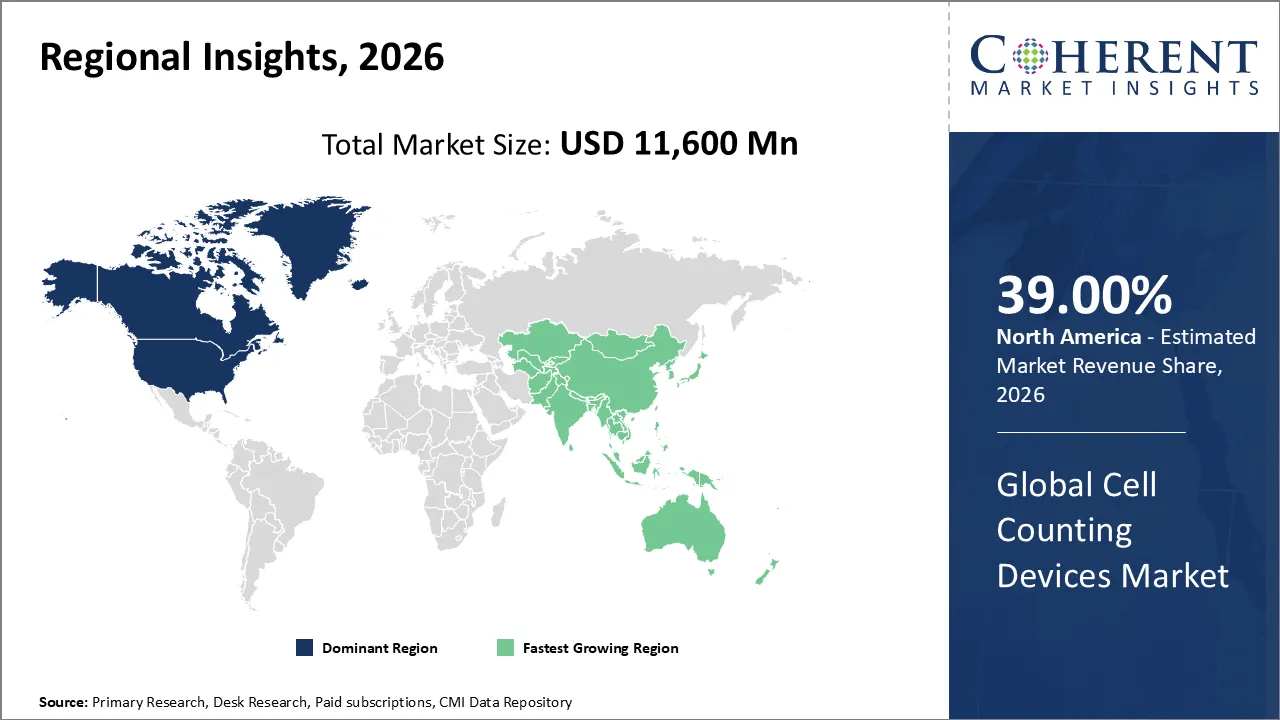
North America is expected to lead the cell counting devices market with 39% share in 2026, due to strong research and development in the pharmaceutical and biotechnology industries, an increase in cancer cases, and the widespread use of automated tools like flow cytometers. Strong healthcare infrastructure, government funding, and big companies in the industry all help the region grow and keep its top market position.
For instance, in April 2025, Denovix demonstrates the way flow cytometry and image-based automated cell counting offer more accurate, faster, and more consistent. Traditional hemocytometers lack in accuracy, but new tools like the CellDrop counter and imaging cytometers give exact counts. These technologies help with cancer research, immunology, and diagnostics, which shows how important advanced cell counting devices are around the world.
Asia Pacific is expected to exhibit the fastest growth, owing to rising investment into biotechnology, better healthcare infrastructure, and more clinical trials in stem cell and regenerative medicine. The rise in chronic diseases and government support for life sciences research is also driving adoption, making this the fastest-growing region in the world.
For instance, in April 2025, Logos Biosystems released the LUNA-BX7 Automated Cell Counter, which uses advanced optics and AI-powered software to accelerate and improve cell analysis. The device makes research and clinical labs more efficient by making it easier to use and more accurate. It supports studies in cancer, stem cells, and drug development.
The U.S. Cell Counting Devices Market is going to be in high demand in 2026 due to rising prevalence of cancer, strong research and development in pharmaceuticals and biotechnology, and automated instruments are becoming more common. Strong healthcare infrastructure, government funding for life sciences, and the leading businesses in the industry all help to drive innovation, which keeps North America as the largest market in the world.
For instance, in January 2026, Researchers created an open-source robotic system that automates cell culture tasks by combining a custom cell counting imager with the Opentrons OT-2 robot. The system makes 96-well plate seeding more consistent, cuts down on hands-on time by 61%, and makes it easier to repeat experiments. It is a low-cost option for laboratories conducting high-throughput experiments.
In 2026, China's cell counting devices market is in high demand considering the biotechnology and pharmaceutical industries are growing quickly, the government supports stem cell and regenerative medicine, and chronic diseases has high prevalence. The growth of advanced automated devices is driven by the expansion of healthcare infrastructure and the rise in clinical trials. This leads to strong market growth.
| Report Coverage | Details | ||
|---|---|---|---|
| Base Year: | 2025 | Market Size in 2026: | USD 11,600 Mn |
| Historical Data for: | 2020 To 2024 | Forecast Period: | 2026 To 2033 |
| Forecast Period 2026 to 2033 CAGR: | 7.8% | 2033 Value Projection: | USD 19,600 Mn |
| Geographies covered: |
|
||
| Segments covered: |
|
||
| Companies covered: |
Paul Marienfeld GmbH & Co. KG, ChemoMetec A/S, BioTek Instruments, Inc., Becton, Dickinson and Company, Tip Biosystems, Corning Inc., Bio-Rad Laboratories, Inc., Agilent Technologies, Inc., GE Healthcare, and Thermo Fisher Scientific. |
||
| Growth Drivers: |
|
||
| Restraints & Challenges: |
|
||
Uncover macros and micros vetted on 75+ parameters: Get instant access to report
As the number of chronic diseases like cancer, HIV, and blood-related disorders rises, the need for accurate cell analysis for diagnosis and treatment monitoring grows. As the number of people with cancer around the world continues to rise, a rising number of healthcare providers are using hematology analyzers and flow cytometers to make sure the results are accurate. This trend greatly increases the cell counting devices market share as hospitals and diagnostic centers depend on cutting-edge technologies to meet the needs of more patients.
Biotechnology and pharmaceutical companies are intensifying into research to find and make new drugs. Cell viability and proliferation studies are very important for this work. Companies are investing into high-throughput screening and automated cell counting systems that make things faster and more accurate in order to speed up innovation. The rise in research activity is directly driving the cell counting devices market demand, as laboratories and research and development facilities need reliable tools to support large-scale experiments and clinical trials, which in turn leads to growth in the global life sciences sector.
Stem cell therapies and regenerative medicine depend on accurate cell counting to make sure that treatments work and are correct. As increasing amounts of clinical trials are conducted in these fields, the need for advanced cell counting devices is growing. Researchers and clinicians need reliable tools to measure cell viability and proliferation. This increase in activity is a big chance for companies that make specialized tools for stem cell use to strengthen their position in the changing healthcare landscape. This is especially true since the cell counting devices market forecast to keep growing in the coming years.
The cell counting devices market value is thriving as there is a high demand for them in laboratories, clinics, and biopharmaceutical companies, driven by the need to count cells accurately and quickly. Automated cell counters are now the most popular type of product. They have taken a large share of installations because they can give quick, accurate results, reduce on human error, and add digital analysis tools to workflows. Manual counters and traditional hemocytometers remain useful in academic and cost-sensitive settings, but their use is going down as automation grows.
Consumables and accessories like reagents, assay kits, and tools for preparing samples are a big source of recurring revenue, reflecting labs continue to require these materials to count cells consistently. Flow cytometers, hematology analyzers, and image-based counters are important tools for advanced research and diagnosis, especially in fields like oncology, immunology, and regenerative medicine where accurate cell analysis informs decision-making.
North America has the largest market share in terms of regions, propelled by extensive biomedical research infrastructure and was one of the first places to use advanced technologies. Asia-Pacific is one of the fastest-growing regions, due to rising investment on life science research and modernizing healthcare.
Share
Share
About Author
Komal Dighe is a Management Consultant with over 8 years of experience in market research and consulting. She excels in managing and delivering high-quality insights and solutions in Health-tech Consulting reports. Her expertise encompasses conducting both primary and secondary research, effectively addressing client requirements, and excelling in market estimation and forecast. Her comprehensive approach ensures that clients receive thorough and accurate analyses, enabling them to make informed decisions and capitalize on market opportunities.
Missing comfort of reading report in your local language? Find your preferred language :
Transform your Strategy with Exclusive Trending Reports :
Frequently Asked Questions
Joining thousands of companies around the world committed to making the Excellent Business Solutions.
View All Our Clients
 Schedule a meeting with report Author