Catering And Food Service Contractor Market Analysis & Forecast: 2026-2033

The Catering and Food Service Contractor Market is estimated to be valued at USD 290 Bn in 2026 and is expected to reach USD 420 Bn by 2033, growing at a compound annual growth The rate (CAGR) of 5.4% from 2026 to 2033.
The Catering and Food Service Contractor Market is developing at a rapid pace driven by its expanding role in corporate hospitality, large-scale catering operations, and off-site management. Moreover, increasing workforce decentralization and tightening health and safety standards are expected to drive market growth over the forecast period. Contract catering is a diverse service-driven industry and is mainly composed of specialized providers formed from the consolidation of hospitality expertise. It is a fundamental sector in the commercial, institutional, and industrial owing to its high logistical capacity and superior menu customization properties.
The industry is undergoing a transformative period bolstered by improvements in automated kitchen technologies and the rise of sustainable, plant-forward menu formulations. There is a high demand for specialized services in diverse industries such as healthcare, education, and corporate offices. These developments have expanded the functional capabilities of contractors, thus helping them in improving their operational efficiency, nutritional transparency, and supply chain resilience.
|
Current Event |
Description and the Impact |
|
Technological and Innovation Trends |
|
|
Regional Economic Rebound and Changing Consumer Behaviors |
|
|
Sustainability and Regulatory Changes |
|
Uncover macros and micros vetted on 75+ parameters: Get instant access to report
Artificial intelligence is transforming the catering and food service contractor market by improving operational efficiency and financial sustainability. Contractors use predictive analytics to forecast meal demand, which allows them to procure ingredients precisely and slash food waste. These firms also deploy AI driven software to optimize labor management by automating staff schedules based on real-time traffic and historical trends. AI enhances the dining experience via personalized digital menus, automated dietary tracking, and streamlined kiosk ordering. By automating administrative tasks and optimizing supply chains, AI empowers contractors to protect thin profit margins while maintaining high standards for food safety.
For instance, in October 2025, Kanpla has released Kai (Kanpla AI), an advanced digital assistant created to incorporate the capabilities of artificial intelligence into contract catering. Kanpla is a software as a service provider committed to revolutionizing the contract foodservice sector through innovative technology.
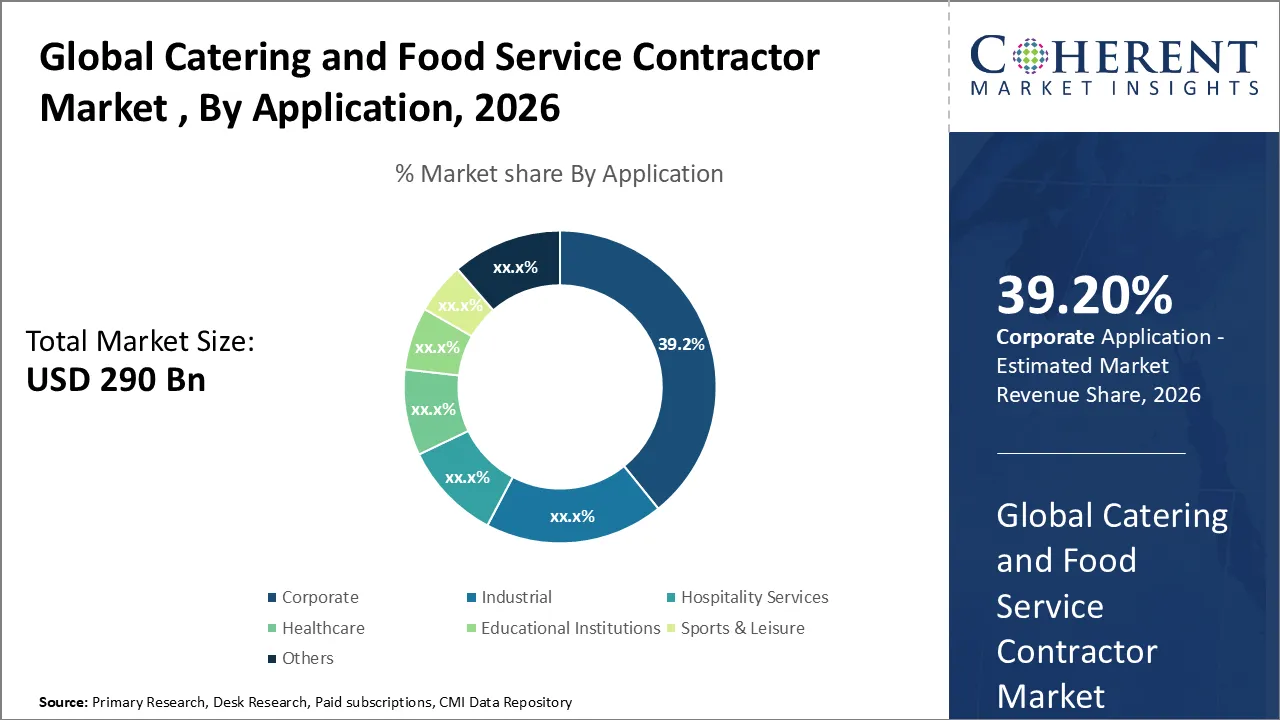
In terms of application, the corporate segment contributes the highest share of 39.20% in 2026 of the market. This is owing growing trend of organizations outsourcing non-core functions to specialized contractors in order to improve operational efficiency and food safety. There is an increased demand for flexible dining solutions like modular meal kits and tech-enabled mobile ordering that can adapt to fluctuating daily office attendance. Alongside this, some companies also take advantage of quality, sustainable on-site catering as a strategic approach for employee retention and wellness. This is driven by the rise in corporate events and the professional town hall concept, where professional food services act as a driver for creating a cooperative work environment as well as hosting professional events on a large scale.
For instance, in January 2023, St. Louis-based Elite Cuisine, specializing in corporate dining and catering services, has joined forces with Superior Vend-All, a Kansas City-based firm that offers vending machine and micro-market solutions for corporate break rooms. The merged entity will be designated as Apex Restaurant and Market Solutions Inc.,
To learn more about this report, Request Free Sample
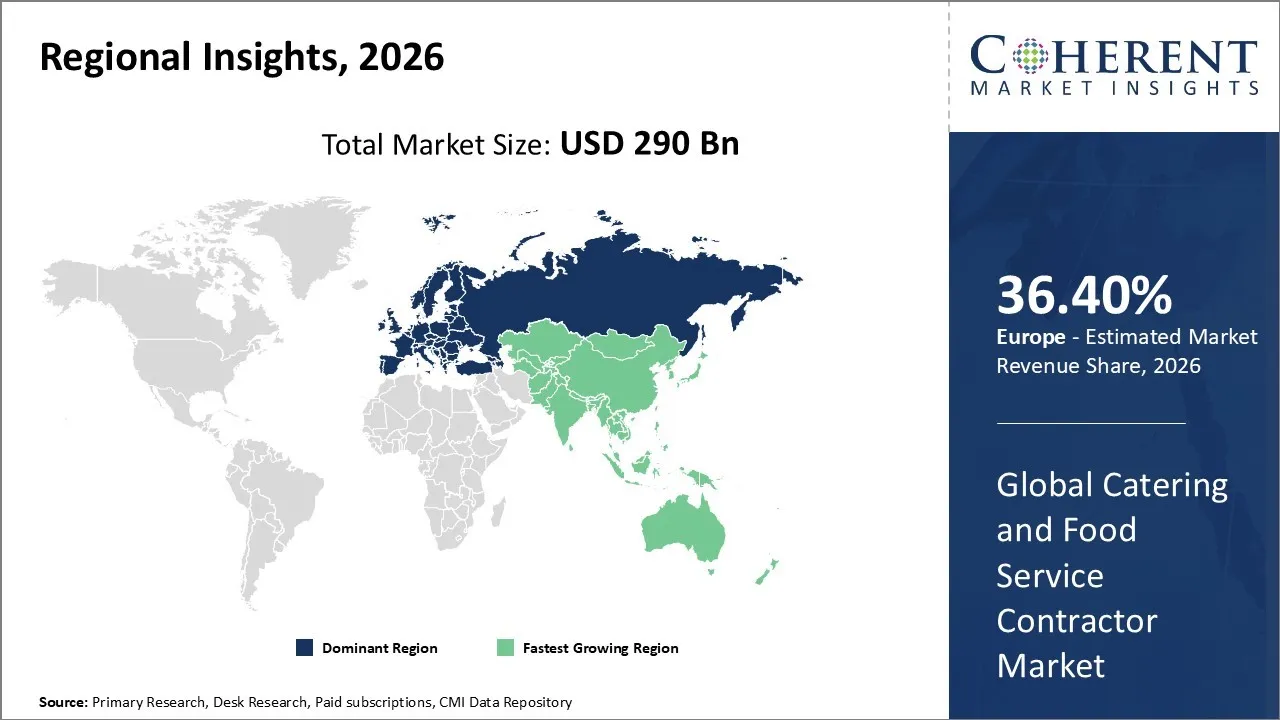
Europe has remained the dominant region with 36.40% in 2026 of the global Catering and Food Service Contractor Market over the past decade due to a mature outsourcing culture across corporate and public sectors. The industry is defined by a rigorous transition toward sustainability and carbon-neutral operations. The leading firms like Compass Group and Sodexo are highly spending in AI driven kitchen management to minimize food waste and optimize supply chains. Health-conscious menus are no longer a niche preference but a primary requirement in government and healthcare contracts.
For instance, in June 2024, Sodexo was appointed to deliver catering and food services at Oasis Restore. It is the UK's first purpose-built Secure School. This represents an extension of its longstanding collaboration with Oasis.
The Asia Pacific region has shown considerable growth due to the rise in urbanization and the growing population of the middle class. The rise in demand for professional catering due to the increase in multinational companies setting up headquarters in India, China, and Vietnam has also contributed to the growth of the market. A key driver of growth is the rise of dual-income households, which has notably increased the consumption of ready-to-eat institutional meals. Unlike other regions, Asia Pacific is pioneering a mobile-first approach, integrating cloud kitchens and digital ordering platforms into standard service contracts. The growth of the aviation and tourism sectors in the region has increased the demand for scalable in-flight and event catering services. The market is now prioritizing convenience and speed, which reflects the lifestyle changes of the younger generation.
For instance, in July 2025, dnata Catering & Retail, a premier global provider of inflight hospitality services, has entered into a management agreement with PT IAS Hospitality Indonesia (IASH) to oversee its inflight catering division, IAS Food Services, at Denpasar International Airport. The strategic alliance combines dnata’s international expertise with IASH’s local capabilities to address the increasing demand within one of Asia’s most rapidly expanding aviation markets.
Germany currently serves as the primary engine of the European market and generates the highest revenue in the region. The presence of a sophisticated institutional sector is also contributing to this trend due to the high demand in healthcare and corporate dining. The contractors are prioritizing a quality-first approach to adhere to rigorous health and sustainability regulations. To deal with the lack of manpower, these players lead the market with the implementation of smart kitchen automation and AI-driven inventory management systems. Corporate clients also influence the market by demanding plant-based and clean-label menus to meet employee wellness and ESG goals. Germany remains the global benchmark for operational excellence and regulatory compliance owing to its robust infrastructure.
China is growing owing to its rapid urbanization and a rising middle class population. The industry is undergoing a structural shift as cloud kitchens and digital delivery platforms capture a substantial portion of total revenue. International and domestic chains are speeding up this growth by rapidly expanding their footprints into lower-tier cities. The businesses in the country lead the world in digital integration by using livestreaming commerce and advanced mobile payment ecosystems to engage customers. The government initiatives like the Big Food program also support this expansion by encouraging a diversified and secure food supply. This combination of technological agility and immense scale establishes China as the most dynamic growth hub in the global market.
| Report Coverage | Details | ||
|---|---|---|---|
| Base Year: | 2025 | Market Size in 2026: | USD 290 Bn |
| Historical Data for: | 2020 To 2024 | Forecast Period: | 2026 To 2033 |
| Forecast Period 2026 to 2033 CAGR: | 5.4% | 2033 Value Projection: | USD 420 Bn |
| Geographies covered: |
|
||
| Segments covered: |
|
||
| Companies covered: |
Compass Group Plc., Sodexo, Aramark Corporation, Elior Group, Delaware North, Westbury Street Holdings, Ovations Food Services, Thompson Hospitality, Dine Contract Catering, and Olive Catering Services |
||
| Growth Drivers: |
|
||
| Restraints & Challenges: |
|
||
Uncover macros and micros vetted on 75+ parameters: Get instant access to report
The rising trend of outsourcing food services serves as a primary catalyst for the expansion of the global catering and food service contractors market over the forecast period. Companies and organizations are tapping into the specialized knowledge of professional contractors, offering better cost predictability and resource discipline. The shift of variable costs, such as labor, equipment, and procurement volatility, to a fixed rate has enabled these organizations to allocate their prime resources to core mission activities. This is likely to be highly visible in areas such as healthcare and education, where food safety regulations and nutrition requirements have made foodservice management a strategic necessity.
In addition, the integration of advanced technologies and a focus on employee wellness help in speeding up this market. Modern contractors deploy AI-driven inventory systems and digital ordering platforms to minimize food waste and optimize service delivery for a hybrid workforce. Companies are increasingly using external providers to offer healthy, customizable food options that help retain talent and match modern employee preferences. Leading organizational values include sustainability and ethical sourcing. Reliance on expert food service contractors is still evolving from a convenience tactic to an essential part of institutional and corporate strategy.
For instance, Mercy Medical Center, Des Moines outsourced their food service department to address high food and labor costs, waste, and inventory management. They wanted better efficiency, profitability, and social and environmental responsibility. They improved food program efficiency, menu variety, retail opportunities, and quality by working with a food and nutrition service.
The Catering and Food Service Contractor Market is characterized by large-scale operational depth and sustained demand across corporate, institutional, healthcare, education, defense, and event-based end-use segments. Industry assessments consistently indicate that institutional and corporate catering together account for the largest volume of contracted meals globally, supported by long-term service agreements and recurring demand patterns. In developed markets, a significant proportion of large organizations outsource food services to optimize operating efficiency, standardize food safety compliance, and manage workforce costs.
Healthcare and education remain structurally important application areas, collectively representing a substantial share of global contracts due to high daily meal volumes and mandatory nutrition standards. In parallel, corporate catering continues to expand in business parks, IT campuses, and manufacturing facilities, driven by workforce consolidation and extended working hours. Regionally, North America and Europe exhibit high penetration of contract catering models, while Asia Pacific shows accelerated adoption supported by urbanization, expansion of organized workplaces, and growth in managed institutions.
Operational differentiation increasingly depends on digital integration, with a growing number of contractors deploying app-based meal ordering, cashless payments, and kitchen analytics to reduce food waste and improve demand forecasting. Menu customization, nutrition-focused offerings, and sustainable sourcing have shifted from optional features to core tender requirements in many institutional contracts. Despite ongoing cost pressures related to labor and raw materials, the market remains resilient due to contract stability, scale efficiencies prevent margin erosion, and consolidation among major operators strengthens competitive positioning.
Definition: The Catering and Food Service Contractor Market is made up of specialized entities in the business of outsourcing food preparation and catering services to various social, institutional, and corporate settings. The market comprises third-party firms responsible for the management of on-site cafeteria facilities in health institutions, learning institutions, and workplaces, as well as the provision of high-quality food catering services to celebrations associated with on-off events. Daily activities in the market are handled in an intricate manner involving expert food planning and procurement as well as staff training to promote high food safety standards. The growth is largely fueled by the ever-growing demand for nutritious food, sustainable procurement, and e-ordering systems.
Share
Share
Joining thousands of companies around the world committed to making the Excellent Business Solutions.
View All Our Clients