Blow-Fill-Seal (BFS) Packaging Services in Healthcare Market Analysis & Forecast: 2026-2033
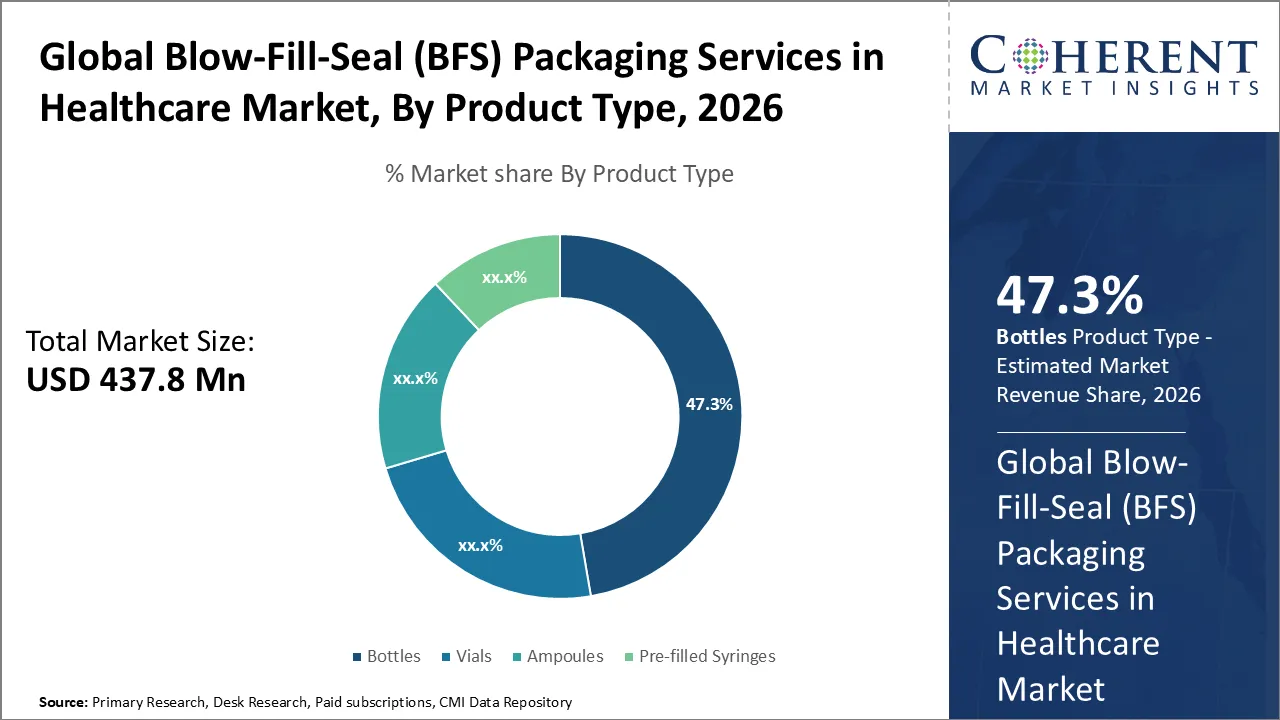
Blow-Fill-Seal (BFS) packaging services in healthcare market is estimated to be valued at USD 437.8 Mn in 2026 and is expected to reach USD 697.0 Mn in 2033, exhibiting a compound annual growth rate (CAGR) of 6.9% from 2026 to 2033.
Blow-fill-seal (BFS) is a manufacturing technique used for packaging of injectable solutions, antibiotics, ophthalmological drops, suspensions, infusion solutions, solutions for hemofiltration, and others. In this technique, a container is formed, filled, and sealed, all in one step. It is a type of aseptic packaging system requiring no human intervention. The container can be filled with very low volume (0.1ml) to very large volume (100ml and above) and the configurations of the vials can be changed during the procedure.
|
Current Event |
Description and its Impact |
|
Regulatory Harmonization and Quality Standards Evolution |
|
|
Technological Disruption and Industry 4.0 Integration |
|
Uncover macros and micros vetted on 75+ parameters: Get instant access to report
|
Dimension |
BFS Rotary Machines |
Traditional Vial Isolators |
Description |
|
Production Speed (2025) |
Up to 20,000 units/hour |
~2,000–3,000 units/hour |
BFS is 6–10x faster |
|
Production Speed (2026) |
Scaling to 22,000–24,000 units/hour in advanced facilities |
~2,500–3,500 units/hour |
Incremental BFS improvements |
|
Europe (Recipharm, Unither) |
BFS lines average 18,000–20,000 units/hour |
Isolators ~2,500 units/hour |
Strong BFS adoption in France, Germany, UK |
|
North America (ApiJect) |
BFS injectables ~20,000 units/hour |
Isolators ~3,000 units/hour |
FDA-driven sterile injectable demand |
|
Asia-Pacific (Rommelag, India/China facilities) |
BFS ~15,000–18,000 units/hour |
Isolators ~2,000 units/hour |
Rapid growth, vaccine equity focus |
Uncover macros and micros vetted on 75+ parameters: Get instant access to report
In terms of product type, the bottles segment is expected to hold 47.3% share of the market in 2026. They are widely used in eye drops, respiratory therapies, and oral liquids, which makes them flexible, easy for patients to use, and highly prevalent in unit-dose formats.
In terms of material type, the polypropylene segment is expected to lead 58.1% share of the market in 2026. It is the most suitable choice for BFS containers as it is more resistant to chemicals, sterile, and works well with pharmaceutical formulations. This makes healthcare packaging safe and long-lasting.
To learn more about this report, Download Free Sample
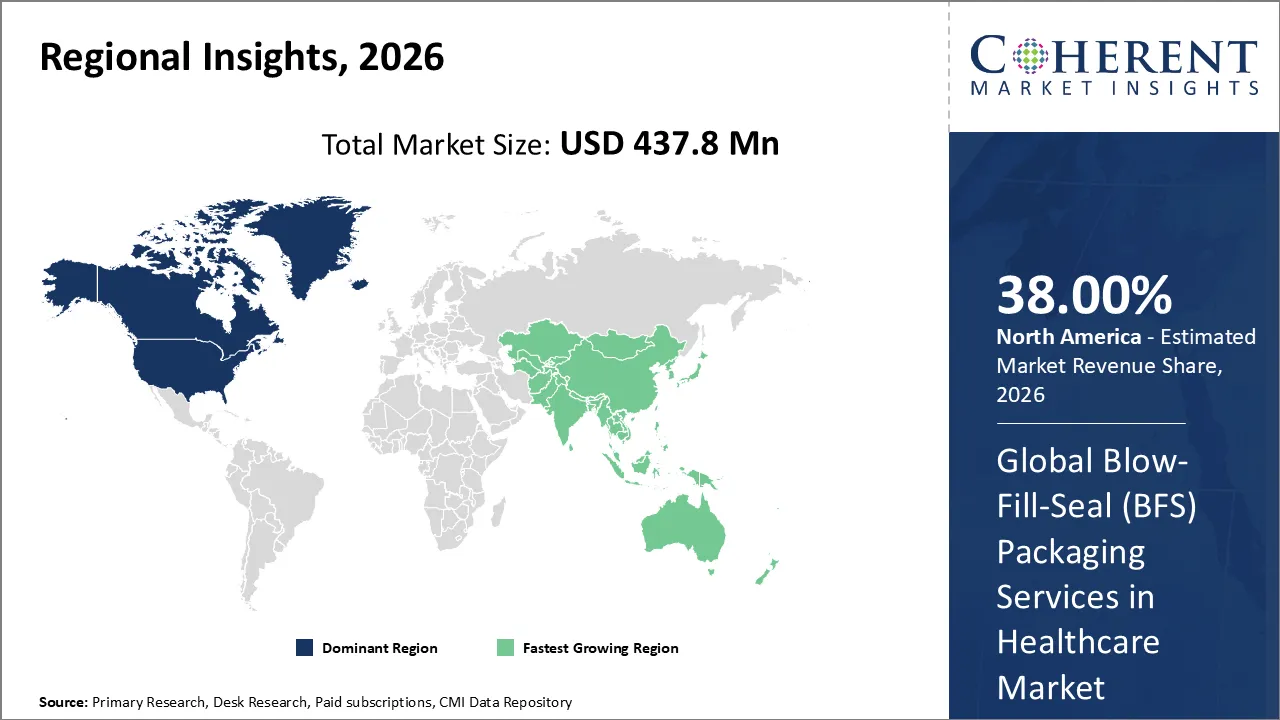
North America is expected dominating the Blow-Fill-Seal (BFS) packaging services in healthcare market with 38% share in 2026, driven by the rising number of chronic diseases, strict FDA rules on sterility, and the need for inexpensive, single-dose drug delivery. Pharmaceutical companies like BFS for safe, contamination-free packaging, and this is being used more in biologics and injectables.
For instance, in January 2026, Apiject announced it will build a new generic injectable drug manufacturing facility in Apex, North Carolina. The site will use Blow-Fill-Seal (BFS) technology to make sterile injectables, which will make the U.S. supply chain more stable. The facility increases the country's ability to make important medicines, making drug packaging faster, safer, and free of contamination.
Asia Pacific is expected to exhibit the fastest growth, driven by the growing pharmaceutical industry, the rise in chronic disease cases, and government programs that encourage sterile drug delivery. BFS packaging is a popular choice across the region since its use helps to increase vaccine production, make manufacturing more cost-effective, and improve healthcare infrastructure.
For instance, in March 2025, At Bio Asia Taiwan, Rommelag Switzerland AG exhibited Blow-Fill-Seal (BFS) aseptic filling systems. The company is based in Switzerland and focuses on BFS uses for sterile liquids, injectables, vaccines, and eye drops. Taiwan (Asia-Pacific) is the main focus of the region, but Rommelag's BFS technology is important for healthcare around the world.
In 2026, BFS packaging services become increasingly popular in U.S. healthcare because there is a growing need for drug delivery that is sterile and free of contamination, as well as for production that is cost-effective and meets strict FDA rules. BFS is a popular choice for packaging drugs because growing numbers of injectable therapies, biologics, and patient safety are important.
For example, in May 2025, Amneal Pharmaceuticals and ApiJect Systems announced to work together in the U.S. to make their sterile manufacturing and Blow-Fill-Seal (BFS) better. The partnership makes advanced pharmaceutical production better, especially when it comes to drug delivery systems and sterile packaging. This move makes it easier for the country to make sterile injectables and encourages new ideas in BFS technology that can be used in healthcare.
In 2026, the French healthcare market sees more demand for BFS packaging services due to strict EU sterility standards, the rise of biologics and ophthalmic drugs, and a focus on patient safety. BFS is a popular choice for pharmaceutical packaging because it does not become contaminated, is cheap, and meets environmental and legal requirements.
For example, Unither Pharmaceuticals makes its Euroject® BFS Injectable in France in December 2025. The factories are in Coutances and Amiens. ANSM is in charge of the area, which is mostly in Europe.However, the U.S. FDA and Korean FDA also check the facilities, which makes it possible to send vaccines all over the world, especially to developing countries.
| Report Coverage | Details | ||
|---|---|---|---|
| Base Year: | 2025 | Market Size in 2026: | USD 437.8 Mn |
| Historical Data for: | 2020 To 2024 | Forecast Period: | 2026 To 2033 |
| Forecast Period 2026 to 2033 CAGR: | 6.9% | 2033 Value Projection: | USD 697.0 Mn |
| Geographies covered: |
|
||
| Segments covered: |
|
||
| Companies covered: |
Recipharm AB, Automatic Liquid Packaging Solutions, Llc, Nephron Pharmaceuticals Corporation, Robert Bosch Packaging Technology GmbH, Catalent, Inc, Horizon Pharmaceuticals, Inc., Unither, ApiJect Systems Corporation, LESVI, and Asept Pak, Inc. |
||
| Growth Drivers: |
|
||
| Restraints & Challenges: |
|
||
Uncover macros and micros vetted on 75+ parameters: Get instant access to report
With Blow-Fill-Seal (BFS) technology, molding, filling, and sealing are all performed in one automated step. This reduces on the need for humans to be involved and the risk of contamination. This makes sure that the packaging is sterile, which is especially crucial for injectables, ophthalmics, and respiratory therapies where patient safety is the most important thing. As hospitals and clinics focus more on preventing infections, the use of BFS keeps going up. Because of this, the Blow-Fill-Seal (BFS) Packaging Services in Healthcare Market share is growing, showing the value it is becoming in sterile pharmaceutical packaging solutions around the world.
Pharmaceutical companies that need reliable packaging often choose Blow-Fill-Seal (BFS) packaging services since they meet strict FDA, EMA, and EU GMP sterility standards. As global rules about drug delivery that is free of contamination become stricter, more people are using BFS as it guarantees consistent quality and safety. This compliance advantage builds trust between healthcare providers and manufacturers. In addition to this, the Blow-Fill-Seal (BFS) packaging services in healthcare market demand is growing quickly, partially due to regulatory pressures and the need for better sterile packaging technologies.
As more individuals rely on biologics, advanced cell therapies, and vaccines, Blow-Fill-Seal (BFS) packaging technology is becoming more useful. To keep these sensitive formulations effective and safe for patients, they need to be made in sterile, contamination-free environments. BFS packaging comes in unit-dose formats that are perfect for biologics. This makes sure that they are accurate and meet international standards. Biologics and vaccines are still the most important things in pharmaceutical pipelines. The Blow-Fill-Seal (BFS) packaging services in healthcare market forecast shows strong growth considering growing numbers of individuals are using sterile drug delivery solutions around the world.
The Blow-Fill-Seal (BFS) packaging services market in healthcare is growing as a key part of sterile pharmaceutical and medical packaging, due to is a demand for unit-dose formats that are free of contamination and as regulations stress the importance of aseptic production standards. Data illustrates that North America is currently the leading region, with high BFS adoption rates driven by strong pharmaceutical infrastructure and compliance frameworks. Next are Europe and Asia Pacific. The latter is helped by the fact that new markets are becoming better at making drugs and packaging them for other companies.
The best thing about BFS technology is that it uses a closed, continuous system to make, fill, and seal containers. This lowers the chance of contamination and contact with people, making it great for injectable drugs, eye drops, respiratory therapies, and other important liquid medicines. Because of this, more and more pharmaceutical companies are switching to BFS systems. BFS systems are also becoming more popular in pediatric and unit-dose packaging since they are more accurate and safer.
According to material trends, polyethylene and polypropylene are the most common substrates used in BFS operations. This is because they are flexible, work well in sterile environments, and make good barriers in sterile healthcare settings. More and more BFS lines are using automation and digital integration to meet strict industry standards for quality control and throughput.
The BFS packaging services market shows that the healthcare packaging industry is focused on packaging solutions that are clean, quick, and focused on the needs of the patient. This is especially true in the pharmaceutical industry, where unit-dose and preservative-free containers are becoming more common.
Share
Share
About Author
Ghanshyam Shrivastava - With over 20 years of experience in the management consulting and research, Ghanshyam Shrivastava serves as a Principal Consultant, bringing extensive expertise in biologics and biosimilars. His primary expertise lies in areas such as market entry and expansion strategy, competitive intelligence, and strategic transformation across diversified portfolio of various drugs used for different therapeutic category and APIs. He excels at identifying key challenges faced by clients and providing robust solutions to enhance their strategic decision-making capabilities. His comprehensive understanding of the market ensures valuable contributions to research reports and business decisions.
Ghanshyam is a sought-after speaker at industry conferences and contributes to various publications on pharma industry.
Missing comfort of reading report in your local language? Find your preferred language :
Transform your Strategy with Exclusive Trending Reports :
Frequently Asked Questions
Joining thousands of companies around the world committed to making the Excellent Business Solutions.
View All Our Clients
 Schedule a meeting with report Author