Automated Suturing Devices Market Analysis & Forecast: 2026-2033

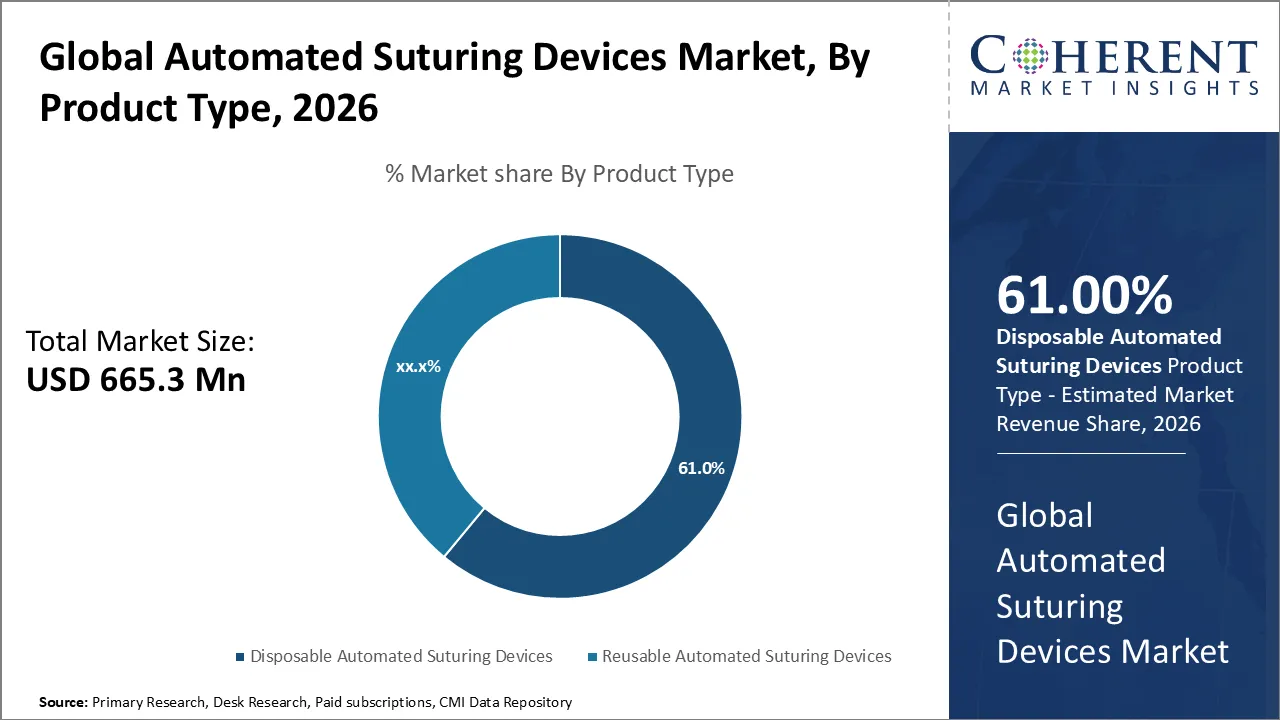
Automated suturing devices market is estimated to be valued at USD 665.3 Mn in 2026 and is expected to reach USD 973.6 Mn by 2033, exhibiting a compound annual growth rate (CAGR) of 5.6% from 2026 to 2033.
The increasing use of minimally invasive and robotic-assisted surgeries is fueling the demand for automated suturing devices. Hospitals and surgical centers are increasingly adopting advanced surgical technologies that enhance precision, minimize operation time, and optimize patient recovery. Specifically designed automated suturing devices that offer efficiency, safety, and ease of use in both disposable and reusable forms are experiencing a growing demand. The companies are increasingly concentrating on the launch of innovative products that can handle complex surgical procedures such as cardiac, gastrointestinal, and orthopedic surgeries.
|
Current Events |
Description and its impact |
|
Global Supply Chain Disruptions and Raw Material Shortages |
|
|
Technological Advancement in Robotics and AI Integration
|
|
Uncover macros and micros vetted on 75+ parameters: Get instant access to report
Based on product type, the disposable automated suturing devices segment is projected to hold the largest market share of 61% in 2026, owing to their ease of use, reduced risk of infection, and elimination of sterilization requirements. Disposable devices are most useful in high-volume surgical procedures where efficiency and cleanliness are of utmost importance. The surgeon can easily use the ready-to-use devices.
For instance, in May 2025, Applied Medical Technology, Inc. announced two new suture passing instruments, RHAPSO™ and GEMINI®, which would help improve the precision and control of suturing in a confined surgical setting.
By application, the minimally invasive surgeries segment is projected to account for the largest market share of 65% in 2026. This is because minimally invasive surgeries are preferred due to the reduced recovery time, minimal scarring, and low chances of complications. The development of automated suturing systems for laparoscopic and robotic surgeries helps surgeons to accurately close the wound in a small space.
For instance, in January 2025, Surgimatix, an early‑stage medical technology company, launched its “aproxim8™” product, which targets the fixation of soft tissues in laparoscopic procedures by providing an automated solution for suturing like fixation.
Based on end-user, the hospitals segment is expected to account for the largest market share of 52% in 2026. Hospitals, especially the tertiary care centers and surgical specialty centers, are responsible for the largest usage of automated suturing devices because of their high surgical volumes, advanced infrastructure, and skilled surgical staff. The demand for automated suturing devices is fueled by the need for improved efficiency.
For instance, in October 2025, Medtronic plc initiated a U.S. IDE clinical study in the country to evaluate its Hugo™ robotic-assisted surgery system, especially in gynecologic surgery. This is an indication of the adoption of robotic systems by hospitals that may include automated suture assistance and advanced closure technology to improve precision and outcomes.
To learn more about this report, Download Free Sample
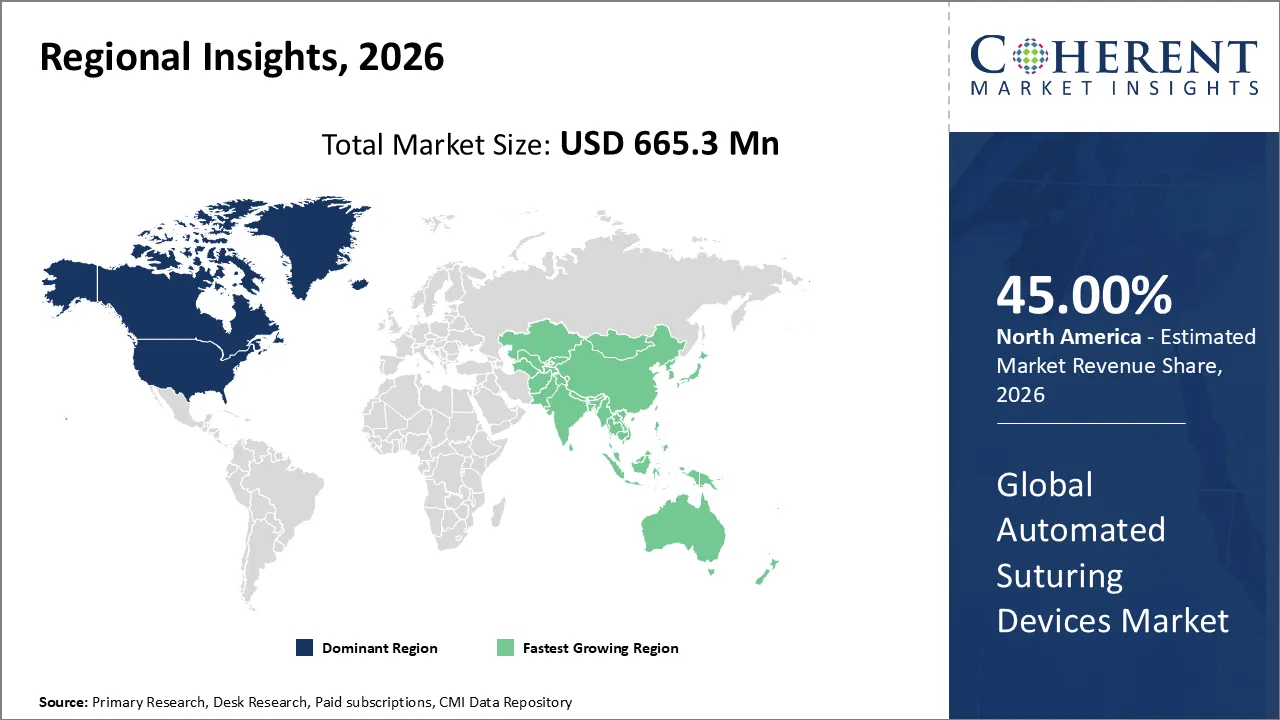
North America is anticipated to lead the automated suturing devices market in 2026, with a projected market share of 45%. The growth of the market in this region can be attributed to factors such as the well-developed healthcare infrastructure, the high adoption rate of minimally invasive and robotic-assisted surgeries, the presence of key medical device companies, and the high surgical volumes in hospitals and specialized surgical centers.
The Asia Pacific market is expected to be the fastest-growing in the automated suturing devices market because of the increasing healthcare expenditure, development of surgical infrastructure, awareness about advanced surgical technology, and the increasing number of procedures performed in China, India, and Japan. The new hospitals and surgical centers are adopting the cost-effective automated suturing technology.
For instance, in November 2024, the Yashoda Group of Hospitals in India signed an MoU with Medtronic to expand robotic-assisted surgery capabilities across its facilities.
Is the U.S. automated suturing devices market booming from advanced healthcare infrastructure and surgical adoption?
The U.S. automated suturing devices market is growing rapidly due to the increasing adoption of minimally invasive and robotic-assisted surgeries, high surgical volume, and strong presence of key players in the medical device industry. Hospitals and surgical centers are increasingly adopting automated suturing devices to enhance the efficiency of surgical procedures.
Is China’s healthcare modernization driving automated suturing devices market growth?
The Chinese movement towards modernized surgical infrastructure and hospital systems is propelling the use of automated suturing devices. The increasing awareness of minimally invasive surgery and the need for precise surgical instruments are propelling hospitals to adopt these devices in operating rooms.
In August 2024, Edge Medical launched its MP2000 multi-port surgical robot in China. The MP2000 multi-port surgical robot is a surgical robot that allows surgeons to perform complex surgeries with greater accuracy and efficiency. This is further accelerating the demand for automated suturing devices.
| Report Coverage | Details | ||
|---|---|---|---|
| Base Year: | 2025 | Market Size in 2026: | USD 665.3 Mn |
| Historical Data for: | 2020 To 2024 | Forecast Period: | 2026 To 2033 |
| Forecast Period 2026 to 2033 CAGR: | 5.6% | 2033 Value Projection: | USD 973.6 Mn |
| Geographies covered: |
|
||
| Segments covered: |
|
||
| Companies covered: |
Medtronic Plc., Boston Scientific, C. R. Bard, Inc., Apollo Endosurgery, EndoEvolution, LLC, LSI Solutions, Inc., Baxter International, Inc., and SuturTek Inc. |
||
| Growth Drivers: |
|
||
| Restraints & Challenges: |
|
||
Uncover macros and micros vetted on 75+ parameters: Get instant access to report
The rising demand for minimally invasive and robotic-assisted surgeries has resulted in an increased demand for automated suturing devices. The adoption of automated suturing devices by surgeons and hospitals is expected to increase due to their ability to enhance the precision of surgeries, reduce the time required for operations, and improve the outcomes of patient recovery.
The market can experience growth opportunities with the development of AI-enabled and robotic-integrated suturing devices. New devices with improved precision, safety, and ergonomics can be introduced in the market. The development of products for complex laparoscopic and robotic surgery procedures, as well as the development of products for specific surgical specialties, may attract more hospitals and surgical centers to the market.
The automated suturing devices market is shifting from being a niche application to becoming an integral part of modern surgery. The increasing use of minimally invasive and robotic-assisted surgery has led to the inclusion of automated suturing devices in these procedures. The uniqueness of this trend is that these devices are not only complementary tools but are becoming an integral part of surgery.
Hospitals and surgical facilities are increasingly incorporating automated suturing systems into their normal practices, ranging from laparoscopic surgery to more complex intracorporeal suturing. The integration of such systems into hospitals and surgical facilities indicates an increasing level of confidence in the technology, which is being relied upon not only for specialized surgeries but also for more routine surgeries, where the variability of human skill may affect outcomes. Robotic-assisted suturing systems are being considered essential components of modern operating rooms, marking a paradigm shift in which manual suturing skills are no longer considered sufficient for providing quality care.
Government support is also influencing market momentum. Fast-track approvals and innovation-friendly processes for advanced suturing devices indicate the importance of these devices in modern surgical infrastructure. Companies that specialize in intelligent design, compatibility with robotic systems, and user-friendly designs for surgeons will lead the market, as hospitals begin to focus on devices that enhance precision and surgical confidence.
Share
Share
About Author
Komal Dighe is a Management Consultant with over 8 years of experience in market research and consulting. She excels in managing and delivering high-quality insights and solutions in Health-tech Consulting reports. Her expertise encompasses conducting both primary and secondary research, effectively addressing client requirements, and excelling in market estimation and forecast. Her comprehensive approach ensures that clients receive thorough and accurate analyses, enabling them to make informed decisions and capitalize on market opportunities.
Missing comfort of reading report in your local language? Find your preferred language :
Transform your Strategy with Exclusive Trending Reports :
Frequently Asked Questions
Joining thousands of companies around the world committed to making the Excellent Business Solutions.
View All Our Clients
 Schedule a meeting with report Author