Augmented Reality In Healthcare Market Analysis & Forecast: 2026-2033

Augmented Reality In Healthcare Market Size and Forecast – 2026 – 2033
The Global Augmented Reality in Healthcare Market size is estimated to be valued at USD 4.5 billion in 2026 and is expected to reach USD 12.8 billion by 2033, exhibiting a compound annual growth rate (CAGR) of 16.7% from 2026 to 2033.
Global Augmented Reality In Healthcare Market Overview
Augmented reality healthcare products combine digital overlays with real-world clinical environments to support diagnosis, treatment, and training. These products include AR headsets, smart glasses, visualization software, and interactive imaging platforms. They enable surgeons, physicians, and medical students to view anatomical structures, patient data, or procedural guidance in real time. Applications range from surgical navigation and rehabilitation to medical education and remote assistance. Accuracy, real-time performance, and integration with hospital systems are key product attributes.
Key Takeaways
Surgical visualization dominates the application segment, accounting for more than 45% of the market share, due to enhanced procedural outcomes and integration into standard surgical protocols.
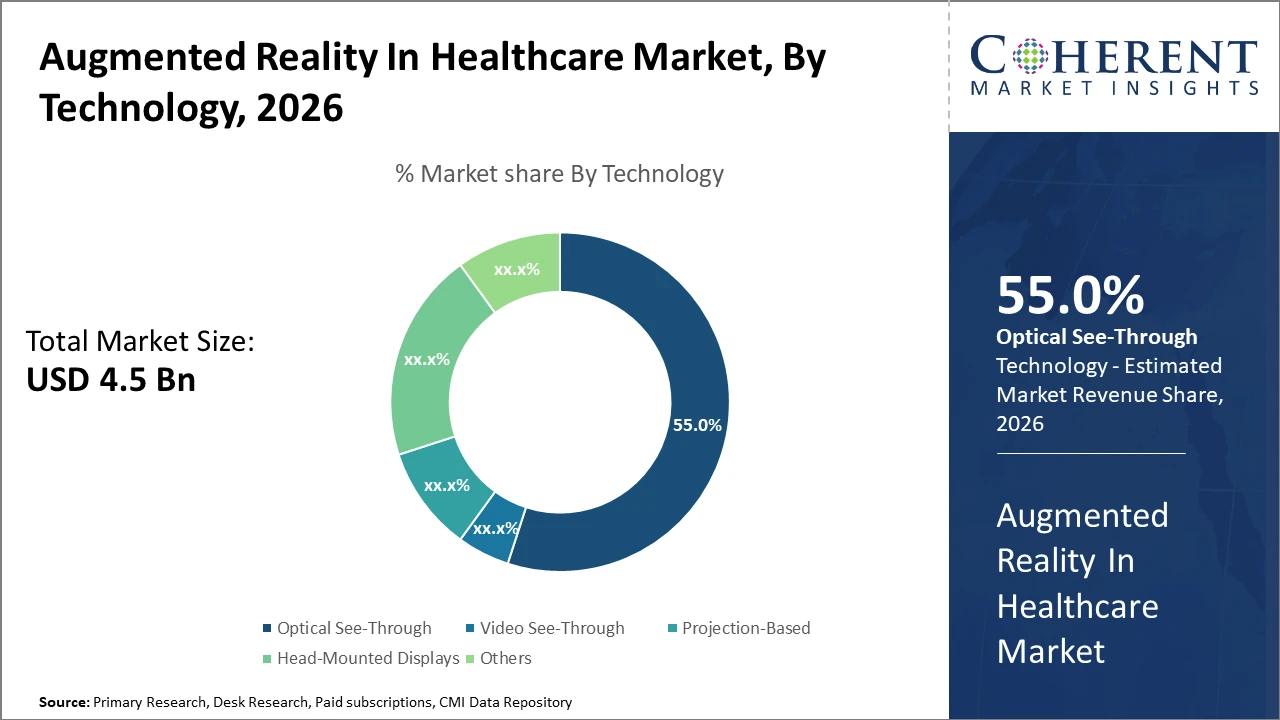
Optical See-Through technology leads in the technology segment, favored for its high-definition display and wireless capabilities, enhancing user convenience.
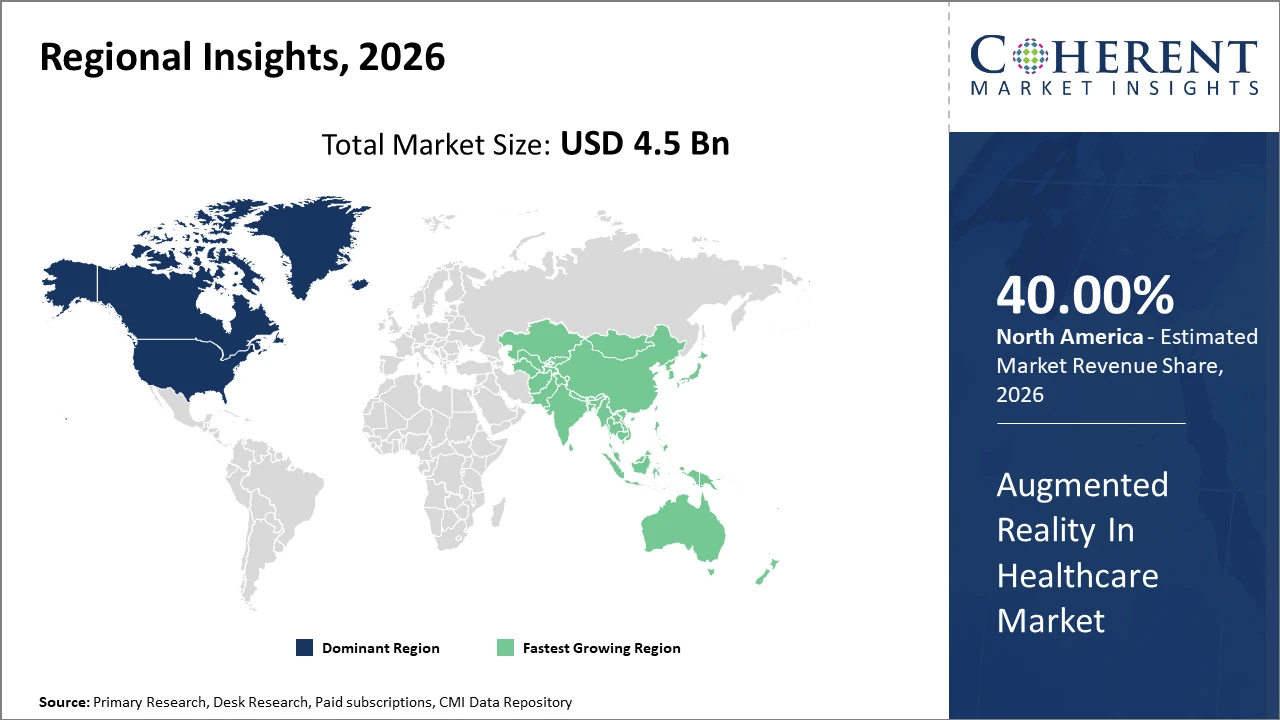
North America holds the largest industry share with over 40% market revenue contribution, driven by high healthcare spending and advanced technology infrastructure.
Asia Pacific is the fastest-growing region, exhibiting a CAGR above 19%, fueled by rising healthcare investments and increased AR device imports.
Augmented Reality In Healthcare Market Segmentation Analysis
To learn more about this report, Download Free Sample
Augmented Reality In Healthcare Market Insights, By Technology Type
Optical See-Through dominates the market share with 55%. This dominance is attributed to its high-definition visualization capabilities and seamless integration into surgical environments. The Optical See-Through segment benefits from improved wireless connectivity and lightweight designs, facilitating mobility for surgeons. The fastest growing subsegment is Head-Mounted Displays, increasingly adopted in both training and patient care management due to enhanced ergonomics and immersive experiences. Video See-Through offers high accuracy visualization but is limited by latency issues, while Projection-Based AR remains niche, primarily used in experimental and research applications.
Augmented Reality In Healthcare Market Insights, By Application
In terms of application, the market is segmented into Surgical Visualization, Medical Training and Education, Patient Care Management, Rehabilitation and Therapy, and Others. Surgical Visualization leads the market share with over 45%, propelled by the demand for precision surgeries and real-time data overlay. This subsegment is witnessing robust growth as it integrates with AI for improved diagnostics. The fastest-growing is Medical Training and Education, fueled by the necessity for remote learning tools and simulators post-pandemic, which allow immersive anatomical explorations. Patient Care Management utilizes AR for chronic disease monitoring, while Rehabilitation and Therapy harness AR to improve patient engagement and recovery rates, albeit with comparatively lower market penetration.
Augmented Reality In Healthcare Market Insights, By End-User
Hospitals and Clinics dominate the market share as primary adopters of AR for surgical and diagnostic uses, driving demand for advanced devices and software solutions tailored for clinical workflows. The fastest-growing end user is Home Care Settings, reflecting the increasing use of AR in remote monitoring and telehealth to manage long-term health conditions. Academic and Research Institutes capitalize on AR for medical training tools, whereas Diagnostic Centers leverage AR-enhanced imaging for better patient outcomes, but at a modest growth rate relative to other subsegments.
Augmented Reality In Healthcare Market Trends
The Augmented Reality in Healthcare market is witnessing transformative trends encompassing AI integration, remote healthcare delivery, and scalable AR hardware.
AI-powered AR platforms are streamlining complex diagnostic and surgical workflows by delivering real-time contextual data, evidenced by over 20 hospitals adopting AI-AR assisted tumor detection techniques in 2025, which led to an 18% increase in surgical precision.
Another pivotal trend is the advancement of telemedicine through AR, enhancing remote clinical examinations and patient interaction across underserved geographies.
For example, the number of AR-enabled telehealth consultations in North America doubled in two years by 2025, driven by robust internet infrastructure and rising consumer health tech adoption.
Lastly, the evolution of wearable AR devices tailored for clinicians enhances mobility and hands-free operation, reducing fatigue and augmenting productivity.
Several manufacturers introduced lightweight AR glasses with extended battery lives in 2024, lowering adoption barriers and increasing market penetration.
Augmented Reality In Healthcare Market Insights, By Geography
To learn more about this report, Download Free Sample
North America Augmented Reality In Healthcare Market Analysis and Trends
In North America, the dominance in the Augmented Reality in Healthcare market is primarily due to substantial healthcare expenditure, advanced digital infrastructure, and ongoing innovation by key players such as Philips Healthcare and Microsoft Corporation. The region accounts for over 40% of total market revenue, supported by a large number of clinical trials employing AR technologies and favorable government policies encouraging digital health adoption.
Asia Pacific Augmented Reality In Healthcare Market Analysis and Trends
Meanwhile, the Asia Pacific exhibits the fastest growth with a CAGR exceeding 19%, propelled by expanding healthcare infrastructure, increasing AR device imports, and initiatives to digitize medical services in countries like China and India. The region's growing middle-class population and rising investment by prominent entities such as GE Healthcare and Canon Medical Systems in local markets drive rapid adoption.
Augmented Reality In Healthcare Market Outlook for Key Countries
USA Augmented Reality In Healthcare Market Analysis and Trends
The USA remains the largest market for augmented reality in healthcare, fueled by widespread integration of AR in surgical procedures, training, and patient care. Market players like Brainlab AG and Magic Leap have introduced specialized AR systems adopted by leading hospitals, including Mayo Clinic, which reported a 25% reduction in surgical errors using AR technologies in 2024. Government incentives for healthcare digitization and robust funding in AR R&D contribute to sustaining the market's significant revenue share in the USA.
China Augmented Reality In Healthcare Market Analysis and Trends
China's market is witnessing accelerated growth driven by government initiatives promoting smart healthcare, increased healthcare spending, and collaborations between local hospitals and multinational AR technology providers. In 2025, the expansion of AR-based medical training facilities surpassed 150 centers nationwide. Additionally, companies like AccuVein are partnering with Chinese medical institutions to localize AR applications, catering to the vast patient base and addressing regional healthcare disparities.
Analyst Opinion
The escalation in AR-enabled surgical applications is a critical driver of market size expansion. Recent data shows that over 60% of leading hospitals worldwide incorporated AR systems in operating rooms in 2024, exemplifying increased surgical precision and reduced operation times. This demand for AR-assisted procedures supports projected market revenue growth by enhancing clinical outcomes and reducing post-operative complications.
On the demand side, AR adoption for medical training surged on traditional training methods. In 2025, medical simulation platforms employing AR attracted over 40% more users compared to pre-pandemic levels, demonstrating the technology’s adaptability and expanding use cases in medical education. This trend substantially contributes to expanding the augmented reality in the healthcare market share by drawing investments toward training solutions.
Pricing dynamics across AR healthcare platforms have stabilized as hardware costs softened by 8% year-over-year in 2024, driven by mass production and technological advancements. This cost-easing enables broader adoption among mid-tier hospitals, strengthening market diffusion across various healthcare segments and substantiating market growth forecasts.
Micro-indicators reveal heightened import volumes of AR-specific medical devices in the Asia Pacific, increasing by 25% in 2025 compared to 2023. This growth points to the robust expansion of healthcare infrastructure in emerging economies and supports a competitive market environment, stimulating further investment and innovation in AR healthcare solutions.
Market Scope
| Report Coverage | Details | ||
|---|---|---|---|
| Base Year: | 2025 | Market Size in 2026: | USD 4.5 billion |
| Historical Data for: | 2020 To 2024 | Forecast Period: | 2026 To 2033 |
| Forecast Period 2026 to 2033 CAGR: | 16.7% | 2033 Value Projection: | USD 12.8 billion |
| Geographies covered: |
|
||
| Segments covered: |
|
||
| Companies covered: | AccuVein, Proprio Vision, EchoPixel, Brainlab AG, SentiAR, Philips Healthcare, GE Healthcare, Microsoft Corporation, Vuzix Corporation, Canon Medical Systems Corporation. | ||
| Growth Drivers: |
|
||
Uncover macros and micros vetted on 75+ parameters: Get instant access to report
Augmented Reality In Healthcare Market Growth Factors
The surge in demand for minimally invasive surgeries employing AR visualization is a primary driver, drastically reducing patient recovery times and boosting procedure accuracy. Additionally, expanding investments in healthcare infrastructure and digital transformation initiatives across emerging markets such as India and Brazil underpin significant business growth. Another driver includes increasing use of AR in patient engagement and remote care, fostering better chronic disease management through real-time data overlay on AR devices. Furthermore, technological advancements that improve AR hardware wearability and software capabilities continue to lower deployment barriers and accelerate adoption in clinical workflows, thereby propelling market growth.
Augmented Reality In Healthcare Market Development
In 2024, Fresenius Medical Care launched augmented reality (AR) glasses designed for ICU nurses to support kidney replacement therapy training. The AR solution blends real-world clinical environments with digital learning overlays, enabling nurses to access step-by-step guidance, visual instructions, and procedural simulations at the point of care. This innovation was aimed at improving training efficiency, reducing errors, and accelerating skill development in critical care settings.
In late 2024, Ocutrx released the DigiLoupe AR headset for spinal surgery, introducing advanced surgical visualization through projected 3D holograms. The headset allows surgeons to view anatomical structures, surgical pathways, and critical data directly within their field of vision, enhancing precision and situational awareness during complex spinal procedures. The launch marked a significant advancement in the application of augmented reality for operative guidance and surgical outcomes.
Key Players
Leading Companies of the Market
AccuVein
Proprio Vision
EchoPixel
Brainlab AG
SentiAR
Philips Healthcare
GE Healthcare
Microsoft Corporation
Vuzix Corporation
Canon Medical Systems Corporation
Leading companies focus on strategic collaborations and technology licensing to expand market footprint, such as Magic Leap’s partnership with leading medical universities to develop AR training modules, which elevated adoption rates by 30% in 2025. Philips Healthcare’s entry into AR-enhanced imaging systems also exemplifies a growth strategy leveraging integration of AR with existing product lines, enhancing market share and customer retention.
Augmented Reality In Healthcare Market Future Outlook
The future outlook for this market is strongly positive, driven by demand for precision medicine, minimally invasive surgery, and remote collaboration. Continued improvements in real-time visualization, interoperability, and cloud connectivity will expand AR use cases across diagnostics, rehabilitation, and telemedicine. Declining hardware costs and improved usability will reduce adoption barriers. Integration with electronic health records and imaging systems will further embed AR into clinical workflows. Over the long term, augmented reality is expected to become a standard component of modern healthcare delivery and training infrastructure.
Augmented Reality In Healthcare Market Historical Analysis
The augmented reality in healthcare market emerged from visualization technologies originally developed for industrial design, defense, and entertainment applications. Early healthcare adoption was largely experimental, with limited use in medical education and anatomical visualization due to high costs and immature hardware. Initial skepticism among clinicians, lack of clinical validation, and integration challenges with hospital IT systems slowed early growth. Over time, improvements in imaging accuracy, processing power, and wearable comfort enabled practical clinical applications. Pilot implementations demonstrated value in surgical planning, intraoperative guidance, and medical training. As healthcare digitization advanced, AR technologies gained recognition as functional clinical tools rather than experimental innovations.
Sources
Primary Research Interviews:
Surgeons
Radiologists
Healthcare IT professionals
AR software developers
Databases:
FDA Digital Health Database
HIMSS Analytics
OECD Health IT
Magazines:
Healthcare IT News
XR Today
Medical Device Network
HealthTech Magazine
MedTech Dive
Journals:
Journal of Medical Internet Research
IEEE Transactions on Medical Imaging
Surgical Endoscopy, NPJ Digital Medicine
Computers in Biology and Medicine
Newspapers:
Reuters Technology
Financial Times (Health Tech)
The Wall Street Journal (Healthcare)
Bloomberg Technology
The Guardian (Tech)
Associations:
HIMSS
Augmented Reality for Enterprise Alliance
Radiological Society of North America
American College of Surgeons
Digital Medicine Society
Share
Share
About Author
Manisha Vibhute is a consultant with over 5 years of experience in market research and consulting. With a strong understanding of market dynamics, Manisha assists clients in developing effective market access strategies. She helps medical device companies navigate pricing, reimbursement, and regulatory pathways to ensure successful product launches.
Missing comfort of reading report in your local language? Find your preferred language :
Transform your Strategy with Exclusive Trending Reports :
Frequently Asked Questions

Credibility and Certifications

860519526


9001:2015

27001:2022


Need a Custom Report?
We can customize every report - free of charge - including purchasing stand-alone sections or country-level reports
Customize NowSelect a License Type
Joining thousands of companies around the world committed to making the Excellent Business Solutions.
View All Our Clients
 Schedule a meeting with report Author