all report title image

Asthma Therapeutics Market Analysis & Forecast: 2026-2033

Asthma Therapeutics Market, By Drug Class (Corticosteroids, Beta2-Agonists (Long-acting and Short-acting), Leukotriene Inhibitors, Long-acting Muscarinic Antagonists (LAMA), Interleukin Antagonists, Anti-immunoglobulin E (IgE) Agents, Combination Products (Including Beta2 Agonists/Corticosteroids, Beta2 Agonists/Muscarinic Antagonists/Corticosteroids, and Others), and Others), By Route of Administration (Oral, Inhalation, and Injection), By Distribution Channel (Hospitals Pharmacies, Retail Pharmacies, and Online Pharmacies), By Geography (North America, Latin America, Europe, Asia Pacific, Middle East, and Africa)

  • Published In : 30 Jan, 2026
  • Code : CMI2698
  • Page number :157
  • Formats :
      Excel and PDF :
  • Industry : Pharmaceutical
  • Historical Range : 2020 - 2024
  • Forecast Period : 2026 - 2033

Asthma Therapeutics Market Size and Trends: 2026-2033

Asthma therapeutics market is estimated to be valued at USD 20.44 Bn in 2026 and is expected to reach USD 23.30 Bn by 2033, exhibiting a compound annual growth rate (CAGR) of 1.9% from 2026 to 2033.

Key Takeaways

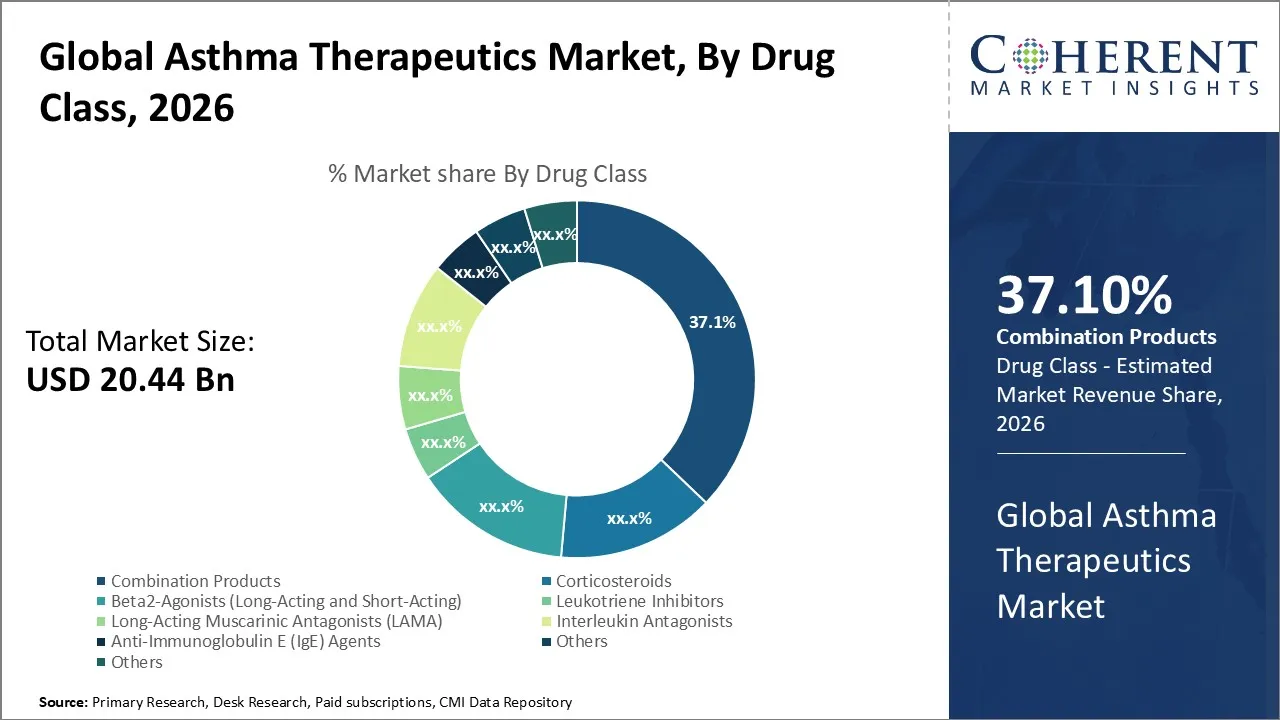
  • Based on Drug Class, the combination products segment is expected to lead the market with around 39% share in 2026, driven by widespread guideline-recommended use, improved patient compliance, and superior clinical outcomes.
  • Based on Route of Administration, the inhalation segment is expected to hold approximately 72% share of the market in 2026, as inhaled therapies remain the first-line treatment due to rapid onset of action and targeted drug delivery.
  • Based on Distribution Channel, the retail pharmacies segment is projected to account for about 57% share of the market in 2026, owing to broad product availability, established supply chains, and high prescription refill rates.
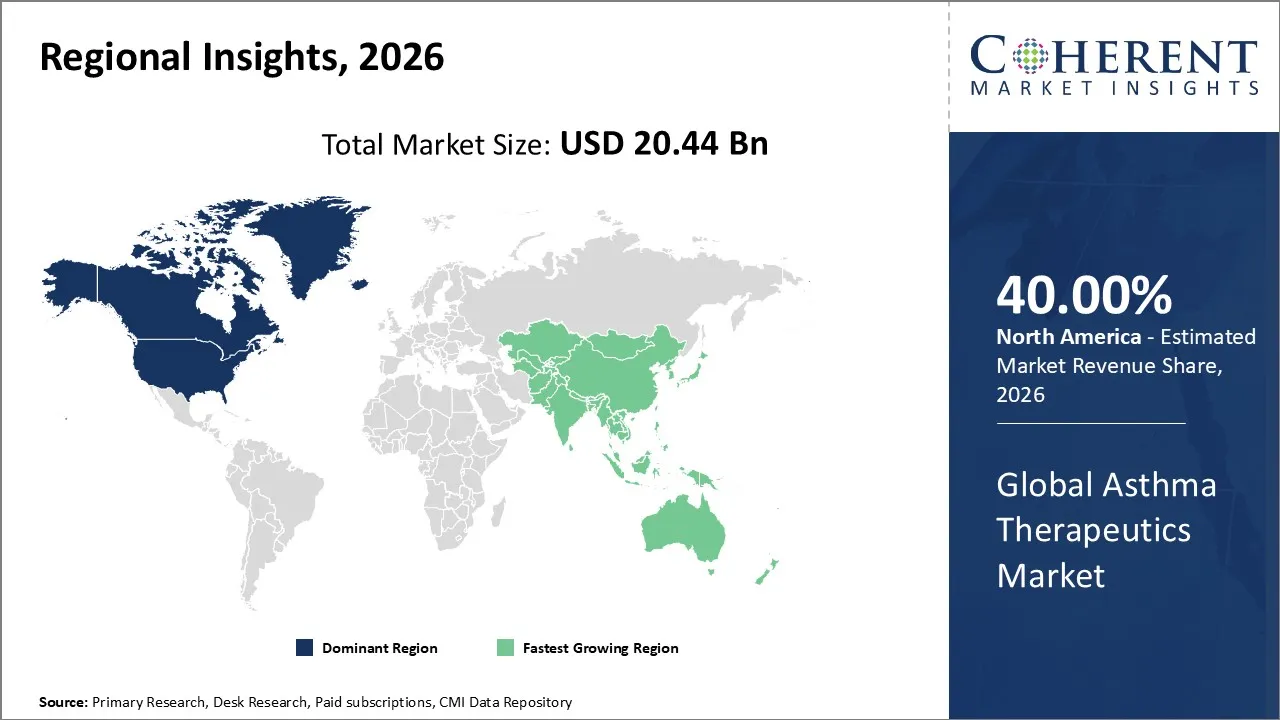
  • Based on Region, North America is set to lead the asthma therapeutics market with 40% share in 2026. While, Asia Pacific is anticipated to be the fastest growing region.

Market Overview

The increasing prevalence of asthma in all age groups, along with growing exposure to environmental pollutants and allergens, is fueling the demand for effective asthma therapies. The growing trend of adopting guideline-driven treatment strategies, including combination inhalers and biologic therapies, has greatly improved the management of the disease and its outcomes. The pharmaceutical industry is witnessing an increasing trend of developing and launching new drug formulations, including long-acting inhalers and biologic therapies.

Current Events and Its Impacts on the Asthma Therapeutics Market

Current Events

and its impact

Climate Change and Rising Air Pollution Levels

  • Description: Increase in the intensity of wildfires in North America and Australia
  • Impact: Results in acute respiratory emergencies that need urgent asthma medication and increased treatment
  • Description: Effects of the urban heat island on respiratory diseases
  • Impact: Enhances seasonal asthma attacks, leading to an increase in the sales of short-acting bronchodilators.

Regulatory Modernization and Drug Approval Acceleration

  • Description: FDA's expedited approval mechanisms for novel biologics
  • Impact: Enables faster market entry for novel asthma therapeutics, particularly targeted immunotherapies
  • Description: Extension of the EMA's adaptive licensing program
  • Impact: Facilitates earlier European market access for breakthrough asthma treatments with limited initial data

Uncover macros and micros vetted on 75+ parameters: Get instant access to report

How is Product Innovation driving the growth in the asthma therapeutics market?

  • Advanced Combination Inhalers: The development of dual and triple combination therapies that enhance symptoms, reduce exacerbations, and improve patient compliance.
  • Biologic Therapies: The introduction of targeted therapies using monoclonal antibodies, including interleukin and anti-IgE therapies, for severe asthma patients, allowing for precision medicine and personalized treatment approaches.
  • Smart Inhaler Technology: The use of digital sensors and mobile apps to track inhaler use and patient compliance, providing real-time feedback to patients and healthcare professionals.
  • Once-Daily Formulations: Innovations in long-acting drug formulations that decrease dosing frequency, improving patient compliance and convenience.

Segmental Insights

Asthma Therapeutics Market By Drug Class

To learn more about this report, Download Free Sample

Asthma Therapeutics Market Insights, By Drug Class – Combination products dominate due to improved clinical efficacy and adherence

Based on drug type, the combination products segment is projected to offer the largest market share of approximately 39% in 2026, due to the widespread adoption of these products according to guidelines and their improved efficacy compared to monotherapies. Combination products, like inhalers that have corticosteroids and long-acting beta-agonists or muscarinic antagonists, help with symptoms and lower the number of flare-ups.

For instance, in October 2025, AstraZeneca announced a distribution update for its combination rescue inhaler Airsupra (albuterol/budesonide) by selling it directly to consumers in the U.S. through its AstraZeneca Direct service, improving access and affordability while leveraging its FDA-approved combination therapy product status.

Asthma Therapeutics Market Insights, By Route of Administration – Inhalation remains the preferred mode of therapy

By route of administration, the inhalation segment is projected to hold approximately 72% of the overall market share in 2026, followed by the oral route, as inhalation-based therapies are considered the primary mode of treatment for asthma. This is because the inhalation route enables the direct administration of the drug to the lungs.

For instance, in July 2025, the European Medicines Agency (EMA) approved a propellant with a low global warming potential (GWP) for existing inhalation medicines like Trixeo Aerosphere and Riltrava Aerosphere. This made it possible to have more environmentally friendly inhalers without lowering their effectiveness.

Asthma Therapeutics Market Insights, By Distribution Channel – Retail pharmacies lead supported by strong prescription volumes

Based on the distribution channel, retail pharmacies are expected to account for a market share of approximately 57% in 2026. This is due to the wide availability of products and a high rate of prescription refills. Retail pharmacies are considered the main entry point for patients seeking chronic asthma medications. The growing number of patients who need prescription refills and the rise in long-term maintenance therapies both support the idea that retail pharmacies are the most important players in the global asthma therapeutics market.

For instance, in September 2025, AstraZeneca launched AstraZeneca Direct, a direct-to-consumer platform where patients could order their medications, like AIRSUPRA (an asthma inhaler), directly online with home delivery and up to 70% off the list price.
Regional Insights

Asthma Therapeutics Market By Regional Insights

To learn more about this report, Download Free Sample

North America Asthma Therapeutics Market Analysis & Trends

North America is anticipated to lead the market for asthma therapeutics in 2026, with a projected market share of 40%. The dominance of the North American market can be attributed to factors such as the well-established healthcare infrastructure, the high prevalence of asthma, the widespread use of advanced therapies such as combination inhalers and biologics, and the favorable reimbursement policies.

For instance, in May 2025, GSK announced expanded analyses and data from its respiratory portfolio at the 2025 American Thoracic Society conference, including additional insights supporting twice-yearly dosing with depemokimab for asthma and COPD outcomes.

Asia Pacific Asthma Therapeutics Market Analysis & Trends

The Asia Pacific market is expected to grow the fastest for asthma treatments because asthma is becoming more common, people are getting better access to healthcare, cities are growing, and people in developing countries like China, India, and Japan are becoming more aware of respiratory diseases. The growth is also due to the growing middle class, which has more money to spend, and government health programs that help people get diagnosed and treated for asthma early.

For instance, in December 2025, Altamira Therapeutics announced marketing approval of Bentrio® nasal spray by China’s NMPA for allergic rhinitis, a condition often co-occurring with or exacerbating asthma symptoms.

Asthma Therapeutics Market Outlook for Key Countries

Is the U.S. asthma therapeutics market accelerating with biologics and next-generation inhalers?

The U.S. asthma therapeutics market continues to expand, driven by high disease prevalence, strong reimbursement frameworks, and rapid adoption of advanced biologic therapies and combination inhalers. The increasing awareness of severe and uncontrolled cases of asthma has led to an increased demand for new treatments beyond conventional short-acting bronchodilators to targeted therapies such as monoclonal antibodies and combination rescue inhalers.

For instance, in Chiesi USA, Inc. announced that the FDA accepted for review its New Drug Application (NDA) for a single-inhaler triple-therapy asthma treatment combining an inhaled corticosteroid, a long-acting beta-agonist (LABA), and an anticholinergic agent.

Is Japan’s aging population shaping demand for advanced asthma therapies?

The asthma therapeutics market in Japan is driven by its rapidly aging population, high accessibility of healthcare, and strong preference for evidence-based, doctor-recommended treatments. Older patients are more susceptible to chronic respiratory diseases, thus creating a constant demand for maintenance therapies, inhaled corticosteroid combinations, and biologic add-on therapies. The Japanese market also focuses on safety, efficacy, and compliance, thus encouraging pharmaceutical companies to develop treatments with simplified dosing regimens.

For instance, in December 2025, Sanofi & Regeneron’s Dupixent (dupilumab) was approved in Japan for the treatment of bronchial asthma in children aged 6–11 years whose symptoms are inadequately controlled with current therapy.

Market Report Scope

Asthma Therapeutics Market Report Coverage

Report Coverage Details
Base Year: 2025 Market Size in 2026: USD 20.44 Bn
Historical Data for: 2020 To 2024 Forecast Period: 2026 To 2033
Forecast Period 2026 to 2033 CAGR: 1.9% 2033 Value Projection: USD 23.30 Bn
Geographies covered:
  • North America: U.S. and Canada
  • Latin America: Brazil, Argentina, Mexico, and Rest of Latin America
  • Europe: Germany, U.K., Spain, France, Italy, Russia, and Rest of Europe
  • Asia Pacific: China, India, Japan, Australia, South Korea, ASEAN, and Rest of Asia Pacific
  • Middle East: GCC Countries, Israel, and Rest of Middle East
  • Africa: South Africa, North Africa, and Central Africa
Segments covered:
  • By Drug Class: Corticosteroids, Beta2-Agonists (Long-Acting and Short-Acting), Leukotriene Inhibitors, Long-Acting Muscarinic Antagonists (LAMA), Interleukin Antagonists, Anti-Immunoglobulin E (IgE) Agents, Combination Products, and Others
  • By Route of Administration: Oral, Inhalation, and Injection
  • By Distribution Channel: Hospitals Pharmacies, Retail Pharmacies, and Online Pharmacies
Companies covered:

GlaxoSmithKline Plc., Philips Healthcare, AstraZeneca Plc., Teva Pharmaceutical Industries Ltd., Boehringer Ingelheim GmbH, Sanofi-Aventis SA, CareFusion Corporation, Sunovion Pharmaceuticals, Inc. Merck & Co., Inc., and Roche Diagnostics.

Growth Drivers:
  • Rising prevalence of asthma across all age groups
  • Increasing awareness and early diagnosis of respiratory diseases
Restraints & Challenges:
  • Development of next-generation biologics with extended dosing intervals
  • Expansion of pediatric and adolescent asthma treatment approvals

Uncover macros and micros vetted on 75+ parameters: Get instant access to report

Asthma Therapeutics Market Driver

Rising prevalence of asthma and growing awareness of disease management

One of the main factors propelling the market for asthma treatments is the increase in asthma cases in both developed and developing nations. The number of children and adults with asthma is rising as a result of urbanization, air pollution, occupational exposure, and lifestyle modifications. Early diagnosis and treatment are the outcome of improved diagnostic accuracy and raised patient and healthcare professional awareness. The market for maintenance inhalers, combination products, and cutting-edge biologic therapies is also being driven by government initiatives, new clinical guidelines, and easier access to healthcare services that support long-term disease management.

Asthma Therapeutics Market Opportunity

Introduction of novel biologics and advanced drug-delivery technologies

The asthma therapeutics market provides a significant opportunity with the emergence of new biologic therapies and new drug delivery systems. The pharmaceutical sector is experiencing a rising trend in targeted biologic therapies that specifically target certain inflammatory pathways, which provide improved results for patients with severe or uncontrolled asthma. Additionally, new inhaler devices, including smart inhalers and long-acting inhalers, have the potential to improve patient compliance.

Analyst Opinion (Expert Opinion)

  • The asthma therapeutics market is growing steadily due to the increasing prevalence of asthma worldwide. Asthma is a widespread disease that affects hundreds of millions of people globally, with a substantial patient base in North America, Europe, and the Asia-Pacific region. Urbanization, air pollution, lifestyle changes, and enhanced diagnostic capabilities have led to an increase in the number of people being diagnosed with the disease, thereby increasing the demand for both rescue and maintenance medications.
  • North America continues to be the leading market for asthma therapies, driven by the well-developed healthcare infrastructure, favorable reimbursement environment, and swift adoption of innovative therapies. The Asia-Pacific market is also growing at a rapid pace, driven by increasing awareness, growing accessibility of healthcare, and the gradual inclusion of innovative therapies in the national reimbursement schemes. The hospital pharmacy channel continues to contribute significantly to the distribution channel, while retail and online pharmacies are gaining importance.
  • Overall, the asthma therapeutics market is currently undergoing a shift from traditional symptomatic management to more targeted treatments. This is being driven by breakthroughs in biologic drugs, advances in inhaler technology, and a growing emphasis on chronic disease management. As innovation and demand drive the market, it is likely to enter a more specialized space.

Top Strategies Followed by Asthma Therapeutics Market Players

  • Established players are also actively engaged in research and development activities to promote innovation in highly effective therapies. Top pharmaceutical companies such as GSK, AstraZeneca, and Sanofi are actively investing in R&D to develop innovative biologics, combination inhalers, and personalized therapies. They are also actively engaged in conducting extensive clinical trials to improve efficacy, minimize side effects, and improve patient compliance through innovations in drug delivery and dosage regimens.
  • Mid-tier players compete on price while ensuring therapeutic quality. These players utilize cost-effective manufacturing, outsourcing, and collaborations with contract development organizations (CDMOs) to lower their manufacturing costs. By providing affordable inhalers and generic biologics, they ensure that their pricing remains competitive, especially in emerging markets where the incidence of asthma is rising.
  • Niche players or small-scale players cater to specific niches. Some niche players target pediatric, geriatric, or difficult-to-treat asthmatic patients with specialized formulations or patient-friendly devices. By embracing digital health technology, such as smart inhalers that monitor usage and compliance, niche players can differentiate themselves. Partnerships with local hospitals, clinics, or telemedicine services can also help them reach more customers despite limited budgets.

Emerging Startups in the Asthma Therapeutics Market

  • Innovative biologics and inhaler technologies are a focus. Startups such as Kymera Therapeutics and Vectura are developing novel biologics that target specific inflammatory pathways and "smart" inhalers that use sensors and apps to monitor lung function.
  • Digital health and connected care solutions are gaining popularity. Companies are working towards the integration of apps, wearables, and connected inhalers to allow patients to monitor their symptoms, medications, and environment. This integration of therapeutics and technology improves patient care and helps patients implement personalized treatment plans.
  • Serving underserved or niche patient populations. Some startups target pediatric asthma, severe or uncontrolled asthma, or co-morbidities such as chronic rhinosinusitis. Others work on novel formulations that decrease dosing intervals or simplify use, catering to patients who have difficulty with traditional inhalers. Collaborations with hospitals, research institutions, and telemedicine companies expand their reach in the market.

Asthma Therapeutics Industry News

  • In January 2025, Philips unveiled AI‑powered diagnostics, monitoring, and clinical decision support solutions to aid respiratory care and broader healthcare workflows, which include tools that indirectly support chronic respiratory disease management.
  • In March 2025, GSK announced the FDA accepted the Biologics License Application (BLA) for depemokimab for add‑on maintenance treatment of asthma with type 2 inflammation and chronic rhinosinusitis with nasal polyps.
  • In April 2025, Sanofi reported clinical updates in its respiratory pipeline, including topline Phase 2 data for amlitelimab in moderate to severe asthma and its Lunsekimig candidate in asthma and other inflammatory respiratory diseases.

Market Segmentation

  • Drug Class Insights (Revenue, USD Bn, 2026 - 2033)
    • Corticosteroids
    • Beta2-Agonists (Long-Acting and Short-Acting)
    • Leukotriene Inhibitors
    • Long-Acting Muscarinic Antagonists (LAMA)
    • Interleukin Antagonists
    •  Anti-Immunoglobulin E (IgE) Agents
    •  Combination Products
    •  Others
  • Route of Administration Insights (Revenue, USD Bn, 2026 - 2033)
    • Oral, Inhalation
    • Injection
  • Distribution Channel Insights (Revenue, USD Bn, 2026 - 2033)
    • Hospitals Pharmacies
    • Retail Pharmacies
    • Online Pharmacies
  • Regional Insights (Revenue, USD Bn, 2026 - 2033)
    • North America
      • U.S.
      • Canada
    • Latin America
      • Brazil
      • Argentina
      • Mexico
      • Rest of Latin America
    • Europe
      • Germany
      • U.K.
      • Spain
      • France
      • Italy
      • Russia
      • Rest of Europe
    • Asia Pacific
      • China
      • India
      • Japan
      • Australia
      • South Korea
      • ASEAN
      • Rest of Asia Pacific
    • Middle East
      • GCC Countries
      • Israel
      • Rest of Middle East
    • Africa
      • South Africa
      • North Africa
      • Central Africa
  • Key Players Insights
    • GlaxoSmithKline Plc.
    • Philips Healthcare
    • AstraZeneca Plc.
    • Teva Pharmaceutical Industries Ltd.
    • Boehringer Ingelheim GmbH,
    • Sanofi-Aventis SA
    • CareFusion Corporation
    • Sunovion Pharmaceuticals, Inc.
    • Merck & Co., Inc.
    • Roche Diagnostics

Sources

Primary Research Interviews

  • Asthma Therapeutics Manufacturers & Brand Managers
  • Respiratory Drug Product Designers
  • Pharmaceutical Distributors & Wholesalers
  • Pulmonologists, Respiratory Specialists & Clinical Practitioners
  • Hospital & Pharmacy Chain Category Heads
  • E‑commerce Platform Pharmaceutical Managers
  • Healthcare Consultants & Clinical Trial Investigators
  • Others

Databases

  • Bloomberg Terminal
  • Thomson Reuters Eikon
  • S&P Global Market Intelligence
  • Statista
  • PubMed
  • ClinicalTrials.gov
  • Others

Magazines

  • Pharmaceutical Executive
  • Pharma Times
  • Drug Discovery & Development
  • PharmaVOICE
  • Pharmaceutical Technology
  • Others

Journals

  • Journal of Asthma
  • Respiratory Medicine
  • Allergy, Asthma & Clinical Immunology
  • American Journal of Respiratory and Critical Care Medicine
  • International Journal of Chronic Obstructive Pulmonary Disease
  • Others

Newspapers

  • The Wall Street Journal – Health & Pharmaceuticals Section
  • Financial Times – Healthcare Section
  • Reuters Health
  • Bloomberg News – Life Sciences & Pharma
  • USA Today – Health & Wellness Section
  • Others

Associations

  • American Lung Association (ALA)
  • Global Initiative for Asthma (GINA)
  • European Respiratory Society (ERS)
  • American Thoracic Society (ATS)
  • Others

Public Domain Sources

  • U.S. Food & Drug Administration (FDA) Publications & Approvals
  • European Medicines Agency (EMA) Reports
  • World Health Organization (WHO) – Respiratory Disease Data
  • Centers for Disease Control and Prevention (CDC) – Asthma Surveillance Data
  • U.S. National Library of Medicine – Clinical Guidelines & Research
  • Others

Proprietary Elements

  • CMI Data Analytics Tool
  • Proprietary CMI Existing Repository of Information for the Last 8 Years

Share

Share

About Author

Ghanshyam Shrivastava - With over 20 years of experience in the management consulting and research, Ghanshyam Shrivastava serves as a Principal Consultant, bringing extensive expertise in biologics and biosimilars. His primary expertise lies in areas such as market entry and expansion strategy, competitive intelligence, and strategic transformation across diversified portfolio of various drugs used for different therapeutic category and APIs. He excels at identifying key challenges faced by clients and providing robust solutions to enhance their strategic decision-making capabilities. His comprehensive understanding of the market ensures valuable contributions to research reports and business decisions.

Ghanshyam is a sought-after speaker at industry conferences and contributes to various publications on pharma industry.

Missing comfort of reading report in your local language? Find your preferred language :

Frequently Asked Questions

The Asthma Therapeutics Market is estimated to be valued at USD 20.44 Bn in 2026 and is expected to reach USD 23.30 Bn by 2033.

The CAGR of the Asthma Therapeutics Market is projected to be 1.9% from 2026 to 2033.

Increasing prevalence of asthma, rising awareness about respiratory diseases, advancements in biologics and inhalation therapies, and growing adoption of personalized medicine are the major factors driving market growth.

High cost of biologic therapies, stringent regulatory requirements, and limited access to healthcare in emerging regions are the major factors hampering market growth.

In terms of drug type, inhaled corticosteroids (ICS) segment is estimated to dominate the market in 2026.

GlaxoSmithKline Plc., Philips Healthcare, AstraZeneca Plc., Teva Pharmaceutical Industries Ltd., Boehringer Ingelheim GmbH, Sanofi-Aventis SA, CareFusion Corporation, Sunovion Pharmaceuticals, Inc., Merck & Co., Inc., and Roche Diagnostics are the major players.

North America is expected to lead the asthma therapeutics market in 2026, owing to high healthcare expenditure, strong presence of key players, and growing adoption of advanced biologics and inhalers.

Select a License Type

EXISTING CLIENTELE

Joining thousands of companies around the world committed to making the Excellent Business Solutions.

View All Our Clients
trusted clients logo
© 2026 Coherent Market Insights Pvt Ltd. All Rights Reserved.