Schedule a meeting with report Author
GREEN AIRPORT MARKET SIZE AND SHARE ANALYSIS - GROWTH TRENDS AND FORECASTS (2026 - 2033)
Green Airport Market, By Technology (Renewable Energy Systems, Energy-efficient Lighting, Electric Ground Support Equipment (GSE), Advanced Waste Management Systems, and Water Conservation Systems), By Application (Terminal Infrastructure, Airside Operations, and Landside Operations), By Geography (North America, Latin America, Asia Pacific, Europe, Middle East, and Africa)
- Published In : 31 Dec, 2025
- Code : CMI7759
- Page number : 141
- Formats :
Excel and PDF
- Industry : Information and Communication Technology
- Historical Range : 2020 - 2024
- Base Year : 2025
- Estimated Year : 2026
- Forecast Period : 2026 - 2033
Green Airport Market Size and Forecast – (2026 to 2033)
The Global Green Airport Market is estimated to be valued at USD 7.02 Bn in 2026 and is expected to reach USD 14.74 Bn by 2033, exhibiting a compound annual growth rate (CAGR) of 14.7% from 2026 to 2033.
Key Takeaways
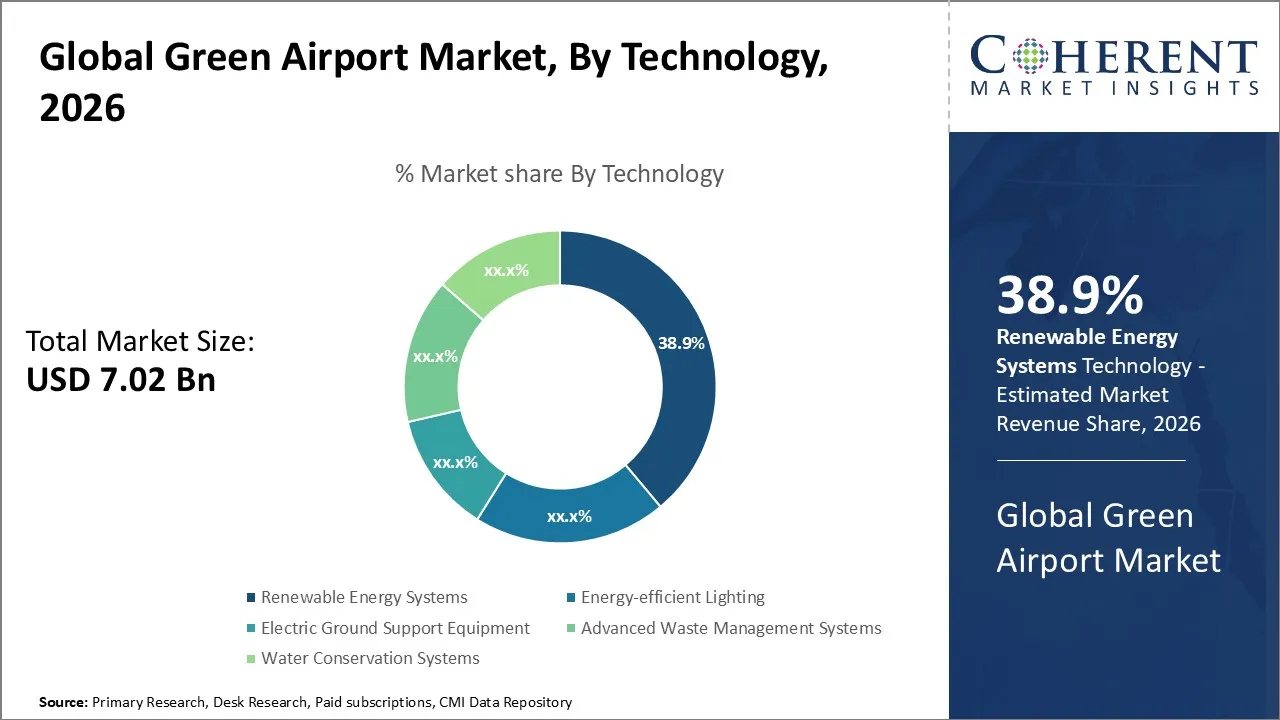
- By Technology, Renewable energy systems segment is anticipated to hold a significant portion of 38.9% in the market in 2026, driven by the adoption of bioenergy, solar energy, and wind power solutions.
- By Application, Terminal infrastructure segment is estimated to hold a share of 43.6% in 2026.
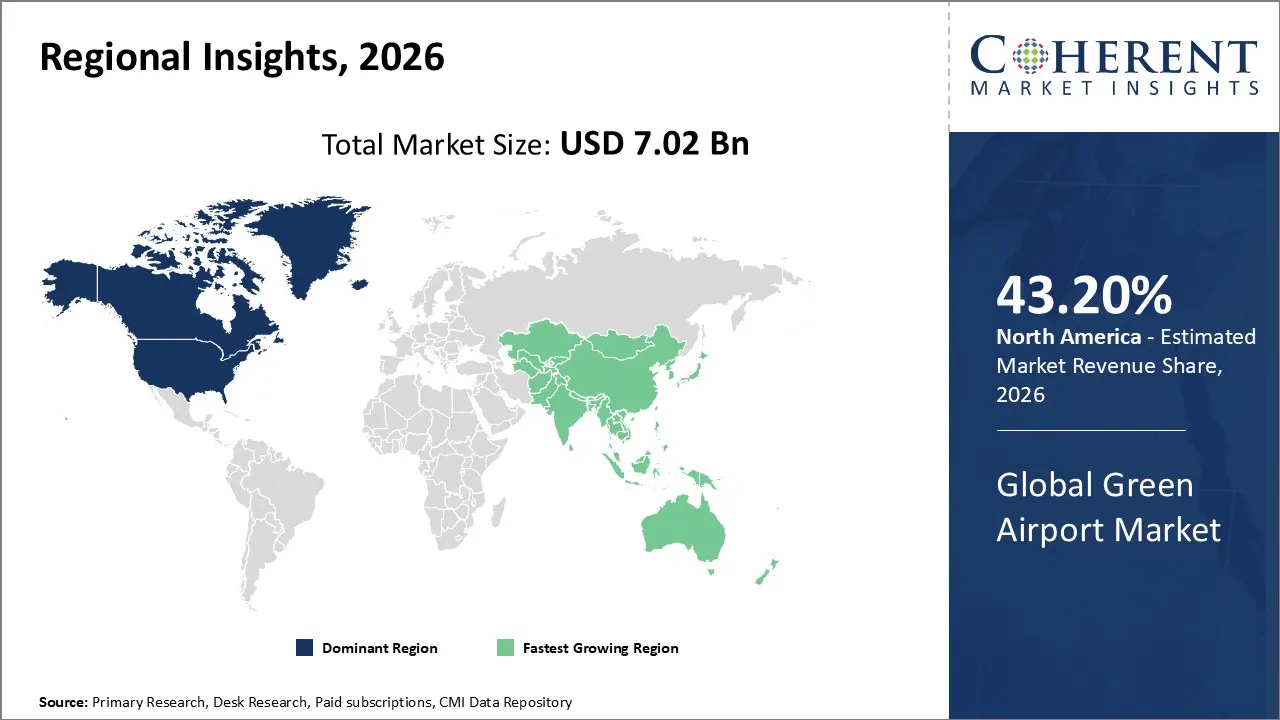
- By Region, North America is expected to maintain its dominance with an estimated market share of 43.2% in 2026.
Market Overview
Green airport technologies and processes are becoming increasingly important globally. Major investment is being made in renewable energy sources, electric vehicles, sustainability reporting, and waste management at airports. Airports are proactively working to curb carbon emissions and implement sustainable practices to minimize environmental footprint. Various initiatives including renewable energy generation, energy efficient buildings, and waste management are being undertaken to achieve net zero carbon emissions target over the long term. Continuous focus on improving energy efficiency of facilities and operations is driving the adoption of new technologies. The market is expected to witness significant growth over the forecast period supported by strong regulatory push and consumer demand for greener air travel.
Current Events and Its Impact on the Green Airport Market
|
Current Events |
Description and its impact |
|
Global Regulatory and Policy Shifts |
|
|
Technological Advancements in Sustainable Infrastructure |
|
|
Geopolitical and Environmental Pressures |
|
Uncover macros and micros vetted on 75+ parameters: Get instant access to report
Technology Insights - Renewable Energy Systems Adoption Fuels Market Growth
The renewable energy systems segment is expected to hold the largest share of 38.9% in 2026 in the global green airport market due to growing awareness about climate change issues. Airports around the world are installing extensive solar photovoltaic panel arrays and wind turbines to generate clean electricity on-site. Renewable energy sources allow airports to reduce their carbon emissions while gaining energy independence. Many major airports have set ambitious renewable energy generation targets to power a significant portion of their operations through solar and wind by the end of the decade. This reliably lowers energy expenses even as traditional power costs rise over time. Government incentives like tax credits further boost the financial case for investing in solar and wind infrastructure at airports.
In October 2025, the Airports Authority of India (AAI) issued a tender for the design, supply, installation, testing, and commissioning of a solar power plant at Srinagar International Airport, as part of its initiative to expand renewable energy use at major airports nationwide.
Application Insights – Terminal Infrastructure Dominate Due to High Visibility
Based on application, the terminal infrastructure segment is expected to account for the bulk of investment and activity, holding a market share of 43.6%. Terminals are the main entry point and first impression for most airport visitors. As such, upgrading their sustainability features and performance has high visibility and impact. Retrofitting terminals with energy-efficient lighting, optimized Heating, Ventilation, and Air Conditioning (HVAC) systems, water reuse technologies, and advanced waste management helps cut operating costs while providing passengers with a comfortable low-carbon experience. Many initiatives within airport terminals also improve the traveler experience directly. Digital displays showcase an airport's green accomplishments and educate travelers on their individual carbon footprints. These interactive features nurture customer goodwill and boost community participation in environmental programs. For instance, in August 2025, VINCI Airports, a Corporate Partner of the FTE Digital, Innovation & Startup Hub, launched a new US$250 million passenger terminal project at Las Américas International Airport in the Dominican Republic through Aerodom.
Regional Insights
To learn more about this report, Download Free Sample
North America Green Airport Market Trends
North America is expected to dominate the market with an estimated share of 43.20% in 2026. The dominance in the green airport market can be attributed to stringent government policies around environmental sustainability. Countries like the U.S. and Canada have invested heavily in renewable energy infrastructure at major airports. Leading airports, like Los Angeles International Airport and Denver International Airport, have adopted initiatives like solar panels and electric ground support equipment to reduce their carbon footprint. For instance, in July 2025, Rhode Island’s T.F. Green Airport introduced a new security feature to help families speed up the checkpoint process, as the Department of Homeland Security works to make airport security lines more efficient.
Asia Pacific Green Airport Market Trends
The Asia Pacific region is expected to exhibit the fastest growth in the green airport market. Rapid growth in air traffic and construction of new airports provide significant opportunities. Countries like China and India are strongly encouraging the development of green airports as part of their climate change agenda. Major players, like China Communications Construction Company (CCCC) and Huawei Technologies, have introduced advanced technologies tailored for the region. For instance, in December 2024, IndiGoReach, IndiGo’s CSR initiative, launched the Zero Waste Airport Project at Indore Airport with AAI and AAS Foundation to create a sustainable airport using the 4R strategy: Reduce, Reuse, Recycle, and Recover.
U.S. Green Airport Market Trends
The U.S. green airport market is driven by large airports in cities such as Chicago, Los Angeles, and New York, which have set ambitious sustainability targets. These airports are actively investing in renewable energy systems, electric ground support equipment (GSE), energy-efficient lighting, and water conservation solutions to reduce their carbon footprint. The Federal Aviation Administration (FAA) continues to support these initiatives through grants and incentives, accelerating the adoption of green technologies. Public-private partnerships are also playing a crucial role in promoting eco-friendly infrastructure, as seen in the recent Los Angeles International Airport (LAX) and Chicago O'Hare projects, where sustainability is a key focus.
China Green Airport Market Trends
China is witnessing rapidly increasing investments in green airport infrastructure as the country prioritizes sustainability in its aviation sector. The government’s Five-Year Plan emphasizes the need for eco-friendly airport construction, energy-efficient lighting, and large-scale solar and wind energy integration. Chinese firms like China Communications Construction Company (CCCC), China State Construction Engineering Corporation (CSCEC), and Beijing Urban Construction Group are deeply involved in sustainable airport projects, ensuring that best practices—both domestic and international—are incorporated into new developments. For instance, in April 2024, HKIA won the “Best Airport in China” award for the second consecutive year at the 2025 TTG China Travel Awards and received recognition for its green airport initiatives.
End-user Feedback and Unmet Needs in the Green Airport Market
- Sustainability Expectations: End users, including passengers and airport operators, increasingly expect airports to adopt eco-friendly practices, such as renewable energy, water conservation, and waste reduction. Many reports limited visibility on sustainability initiatives, indicating a need for clearer communication of green measures and their impact on environmental performance.
- Energy Efficiency Requirements: Airport stakeholders seek energy-efficient systems in terminals, runways, and support infrastructure. Feedback highlights gaps in lighting, HVAC, and operational automation, with users desiring smart energy management solutions that reduce operational costs while minimizing environmental impact without compromising passenger comfort.
- Waste Management and Recycling: Passengers and staff report dissatisfaction with recycling availability and waste segregation. End users emphasize the need for advanced waste management systems that reduce landfill dependency, encourage circular economy practices, and integrate smart monitoring for better operational efficiency in airport facilities.
Green Airport Market Trend
Sustainable Energy Integration
Airports are increasingly adopting renewable energy sources, including solar, wind, and biofuels, to reduce carbon footprints. This trend focuses on integrating on-site energy generation with energy-efficient building designs. Operators are exploring smart grids, energy storage, and demand-response systems to ensure continuous, sustainable energy supply while maintaining operational efficiency, passenger comfort, and regulatory compliance.
Smart Infrastructure and IoT Adoption
Modern airports are implementing IoT-enabled systems to optimize operations, energy consumption, and passenger flow. Smart sensors, automated lighting, HVAC, and predictive maintenance enhance efficiency while reducing environmental impact. These technologies also support real-time monitoring and reporting, helping airports meet sustainability targets, lower operational costs, and improve overall passenger experiences through smarter, eco-friendly infrastructure.
Green Airport Market Opportunity
Renewable Energy Deployment
Airports present a significant opportunity for renewable energy integration, such as solar panels, wind turbines, and biofuel adoption. Investments in on-site power generation and smart energy storage can reduce operational costs, improve energy security, and support carbon-neutral objectives. Collaborations with energy providers and technology developers can create scalable, sustainable solutions for both new and existing airport infrastructure, enhancing long-term environmental and financial performance.
Market Report Scope
Green Airport Market Report Coverage
| Report Coverage | Details | ||
|---|---|---|---|
| Base Year: | 2025 | Market Size in 2026: | USD 7.02 Bn |
| Historical Data for: | 2020 To 2024 | Forecast Period: | 2025 To 2032 |
| Forecast Period 2026 to 2033 CAGR: | 14.7% | 2033 Value Projection: | USD 14.74 Bn |
| Geographies covered: |
|
||
| Segments covered: |
|
||
| Companies covered: |
Boeing, Airbus, Honeywell International Inc., Siemens AG, General Electric, Thales Group, Schneider Electric, Johnson Controls International plc, ABB Ltd., Rockwell Collins, SITA, Amadeus IT Group, Indra Sistemas, L3Harris Technologies, and Leidos Holdings, Inc. |
||
| Growth Drivers: |
|
||
| Restraints & Challenges: |
|
||
Uncover macros and micros vetted on 75+ parameters: Get instant access to report
Green Airport Market News
- In December 2025, the central government has prepared an ambitious plan for the construction of a dual use green field international airport at Great Nicobar that will play an important role in the country's national security and in promoting tourism.
- In August 2025, the Government of Rajasthan transferred 440 hectares of land to the Airports Authority of India (AAI) for the development of a greenfield airport capable of accommodating A-321 aircraft operations.
Analyst Opinion (Expert Opinion)
- The trajectory of the Green Airport market underscores a decisive shift from symbolic sustainability commitments to measurable environmental outcomes, exemplified by large‑scale renewable energy integration. Rome Fiumicino’s 22 MW solar farm, projected to reduce CO₂ emissions by over 11,000 tons annually, sets a new benchmark for repurposing underutilized airport land to meet decarbonization goals without compromising operational capacity.
- Operational carbon neutrality is no longer aspirational at leading facilities; Cochin International Airport’s net zero energy certification is grounded in generating approximately 25 crore units of electricity from on‑site solar infrastructure, avoiding roughly 160,000 metric tonnes of carbon emissions. Such tangible results, rather than rhetoric, distinguish true sustainability leaders from laggards.
- The industry’s best performers are also demonstrating that sustainable practices drive economic resilience. Hubballi Airport’s 8 MW solar installation not only satisfies internal energy demand but delivers surplus power to surrounding infrastructure, yielding millions in cost savings and power sales—validating green investments as both environmental safeguards and revenue enhancers.
Market Segmentation
- Technology Insights (Revenue, USD Bn, 2020 - 2032)
- Renewable Energy Systems
- Energy-efficient Lighting
- Electric Ground Support Equipment (GSE)
- Advanced Waste Management Systems
- Water Conservation Systems
- Application Insights (Revenue, USD Bn, 2020 - 2032)
- Terminal Infrastructure
- Airside Operations
- Landside Operations
- Regional Insights (Revenue, USD Bn, 2020 - 2032)
- North America
- U.S.
- Canada
- Latin America
- Brazil
- Argentina
- Mexico
- Rest of Latin America
- Europe
- Germany
- U.K.
- Spain
- France
- Italy
- Russia
- Rest of Europe
- Asia Pacific
- China
- India
- Japan
- Australia
- South Korea
- ASEAN
- Rest of Asia Pacific
- Middle East
- GCC Countries
- Israel
- Rest of Middle East
- Africa
- South Africa
- North Africa
- Central Africa
- Key Players Insights
- Boeing
- Airbus
- Honeywell International Inc.
- Siemens AG
- General Electric
- Thales Group
- Schneider Electric
- Johnson Controls International plc
- ABB Ltd.
- Rockwell Collins
- SITA
- Amadeus IT Group
- Indra Sistemas
- L3Harris Technologies
- Leidos Holdings, Inc.
Sources
Primary Research Interviews
- Airport operations managers and sustainability officers
- Environmental engineers and energy management specialists
- Renewable energy solution providers and technology vendors
- Government and regulatory officials in aviation and environmental departments
- Aviation industry experts and academic researchers in sustainable infrastructure
Databases
- Government aviation and environmental databases
- National renewable energy and emissions databases
- Patent and technology innovation databases
- Airport performance and operational statistics databases
Magazines
- Aviation and airport operations magazines
- Sustainable infrastructure and green technology publications
- Environmental management and renewable energy magazines
- Engineering and civil infrastructure magazines
Journals
- Journals on environmental engineering and energy efficiency
- Transportation and airport operations journals
- Renewable energy and sustainable infrastructure journals
- Applied sciences and environmental management journals
Newspapers
- International and national newspapers covering aviation and environment
- Business and infrastructure news sections
- Regional newspapers reporting airport development projects
Associations
- International Civil Aviation Organization (ICAO)
- Airports Council International (ACI) and regional chapters
- Environmental and renewable energy associations related to aviation
- Sustainable infrastructure and green building councils
Public Domain Sources
- Government publications and environmental regulations
- Airport sustainability reports and press releases
- Technical white papers and publicly available research articles
- Open-access reports on energy and resource management in airports
Proprietary Elements
- CMI Data Analytics Tool
- Proprietary CMI Existing Repository of information for last 8 years
Share
Share
About Author
Monica Shevgan has 9+ years of experience in market research and business consulting driving client-centric product delivery of the Information and Communication Technology (ICT) team, enhancing client experiences, and shaping business strategy for optimal outcomes. Passionate about client success.
Missing comfort of reading report in your local language? Find your preferred language :
Transform your Strategy with Exclusive Trending Reports :
Frequently Asked Questions
EXISTING CLIENTELE
Joining thousands of companies around the world committed to making the Excellent Business Solutions.
View All Our Clients