Healthcare Cloud Computing Market Analysis & Forecast: 2026-2033

Healthcare cloud computing market is estimated to be valued at USD 97,365.7 Mn in 2026 and is expected to reach USD 268,586.6 Mn in 2033, exhibiting a compound annual growth rate (CAGR) of 15.6% from 2026 to 2033.
The practice of establishing remote computers that can be accessed online to store, manage, and analyze healthcare-related data is known as cloud computing in the industry. This contrasts with setting up a data center on-site with servers or hosting the data on a personal computer. Healthcare-related technology including IoT (Internet of Things) devices, mobile apps, patient portals, electronic medical records, and big data analytics are made possible by the cloud. It offers hassle-free flexibility and scalability, which enhances the final decision-making process
|
Current Events |
Description and its Impact |
|
Regulatory and Compliance Transformation Events |
|
|
AI and Advanced Technology Integration Events |
|
Uncover macros and micros vetted on 75+ parameters: Get instant access to report
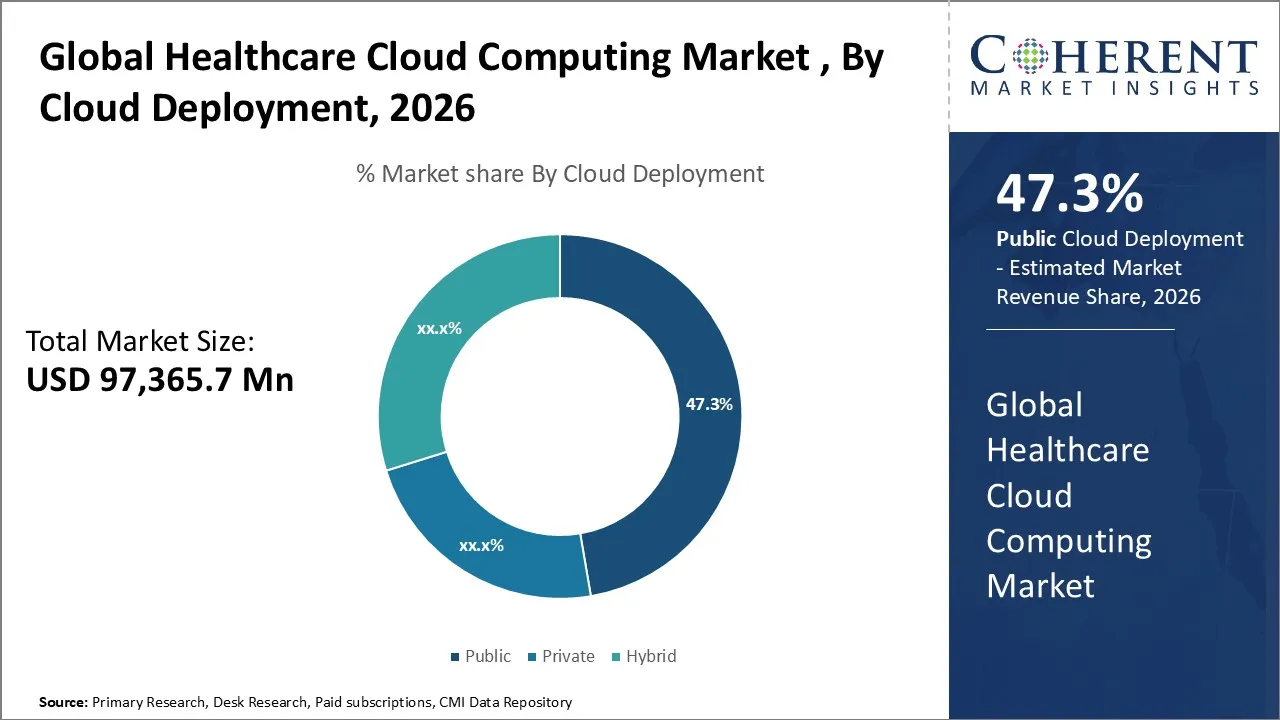
In terms of cloud deployment, the public cloud segment is expected to lead the 47.3% share of the market in 2026. Its dominance stems from cost efficiency, scalability, and ease of access for hospitals and clinics. Providers like the public cloud for storing electronic health records, enabling telemedicine, and supporting AI-driven diagnostics because it does not require an excessive amount of infrastructure investment.
For instance, in May 2025, The Oracle, Cleveland Clinic, and G42 partnership that was announced in 2025 is focused on creating a global healthcare delivery platform based on AI and powered by Oracle Cloud Infrastructure. This project shows how public cloud is becoming increasingly vital in healthcare by making it possible to manage patient data securely, do advanced analytics, and create digital health solutions that can grow around the world.
In terms of application, the clinical information systems segment is projected to capture 66.9% share of the market in 2026, driven by demand for electronic health records, PACS, and telemedicine platforms. These systems have a direct effect on patient outcomes, following the rules, and coordinating care. They will continue to be the most important application segment because they have significance for safely handling patient data and making clinical decisions in real time.
For instance, the Genesis portfolio from GE Healthcare, which was released in 2025, improves clinical information systems as part of the company's cloud strategy. It accelerates the adoption of digital innovation by focusing on imaging, diagnostics, and AI-enabled workflows. Using cloud computing, Genesis makes it easier for different systems to work together, speeds up deployment, and improves patient care. This makes clinical applications a major player in healthcare cloud computing.
In terms of end user, the healthcare providers segment is projected to account for 72.4% share of the market in 2026. Cloud computing is used by hospitals, clinics, and diagnostic centers to monitor patient data, monitor patients from afar, and help with AI-assisted diagnoses. Providers put cloud solutions at the top of their lists as they want to improve efficiency, patient care, and compliance, making them the top segment.
For instance, in November 2025, the five-year partnership between TCS and NHS Supply Chain uses AI and the cloud to change the manner in which healthcare is delivered. The initiative focuses on providers and modernizes hospital operations, improves patient care, and makes the supply chain more efficient. Cloud computing makes sure that data is safe, can grow, and is always up-to-date. This makes healthcare providers the most likely to use it in 2026.
To learn more about this report, Download Free Sample
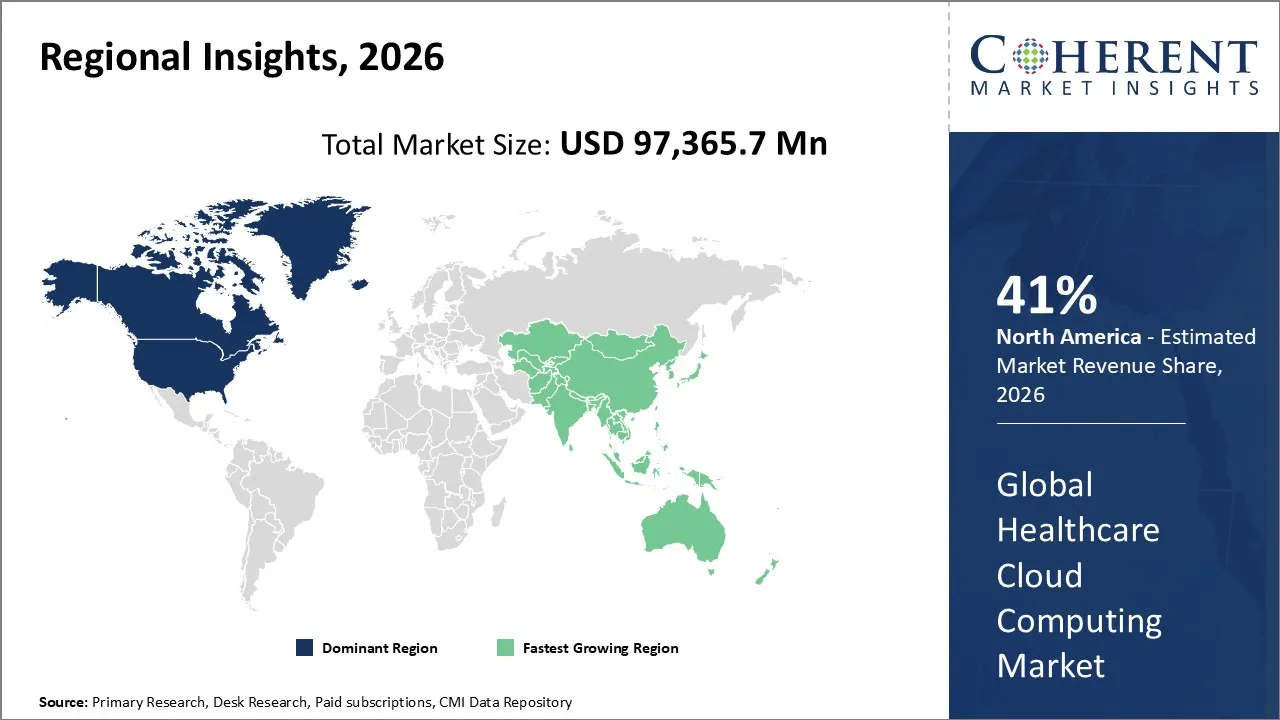
North America is expected to dominate the healthcare cloud computing market with 41% share in 2026, due to advanced IT infrastructure, strict rules like HIPAA that protect patient data, the widespread use of electronic health records, and the rapid growth of telemedicine. The fact that most major cloud providers are based in the U.S. helps drive innovation, scalability, and fast deployment.
For instance, in October 2025, BD's AI-enabled solutions are going to enhance connectivity in healthcare settings, especially in North America. Using cloud computing, these new technologies combine patient data, make systems work better together, and help AI-driven insights. The project improves the digital healthcare infrastructure, making workflows more scalable, secure, and efficient. It also sets BD up for global growth in cloud-based healthcare.
Asia Pacific is expected to exhibit the fastest growth, owing to government-led digital health initiatives, the quick growth of telemedicine, and a large number of patients who need solutions that can grow with them. The demand is growing even faster because of greater resources going into healthcare IT, more people using smartphones, and better access to healthcare in rural areas. This makes it the fastest-growing regional market.
For instance, by January 2026, HMI Medical will have all of its non-clinical operations on a single AI-powered cloud platform called Workday. The system will make it easier to manage contracts, finances, planning, and the workforce. It will also automate repetitive tasks and give real-time insights, which will improve efficiency, forecasting, and talent management across its healthcare network in Southeast Asia.
The U.S. healthcare cloud computing market will be highly competitive in 2026 because more people are using electronic health records, telemedicine, and AI-driven analytics. Providers want platforms that can grow with their needs, are safe, and monitor patient data, make billing easier, and make sure they are following the rules.
For instance, in November 2025, the goal of the partnership between PwC and AWS is to use AI and the cloud to transform the way healthcare revenue cycle management works. The project is based in North America and updates providers' billing, claims, and financial processes. By using AWS's public cloud, it makes healthcare cloud computing's role in administrative innovation stronger by improving efficiency, scalability, and compliance.
In 2026, China's healthcare cloud computing market will be highly profitable as more people are using digital health, the government is supporting smart hospitals, and AI is being used steadily for diagnostics. The need for secure, scalable data platforms, more patients, and the growth of telemedicine all drive demand. This makes sure that healthcare systems are efficient, compliant, and innovative.
For instance, in January 2026, Bupa and Tencent have started Hong Kong's first palm-based check-in service to make healthcare better. Patients can easily and safely get services with a simple palm scan thanks to biometric technology. The new technology makes registration easier, boosts productivity, and makes data more secure. This is a big step forward in the digital transformation of healthcare.
| Report Coverage | Details | ||
|---|---|---|---|
| Base Year: | 2025 | Market Size in 2026: | USD 97,365.7 Mn |
| Historical Data for: | 2020 To 2024 | Forecast Period: | 2026 To 2033 |
| Forecast Period 2026 to 2033 CAGR: | 15.6% | 2033 Value Projection: | USD 268,586.6 Mn |
| Geographies covered: |
|
||
| Segments covered: |
|
||
| Companies covered: |
IBM Corporation, Athenahealth, Siemens Healthcare GmbH, Koninklijke Philips NV, Allscripts Healthcare Solutions, Fujifilm Holdings, General Electric Company, AGFA Healthcare, Carestream Health, Inc., and Carecloud Corporation |
||
| Growth Drivers: |
|
||
| Restraints & Challenges: |
|
||
Uncover macros and micros vetted on 75+ parameters: Get instant access to report
Cloud computing gives healthcare organizations the tools they need to use AI and big data for predictive analytics, which leads to better patient outcomes and personalized medicine. AI-powered tools help doctors make better decisions, and big data helps manage population health and cut costs. By adding these technologies to scalable cloud infrastructures, providers get useful information that helps them be more efficient and come up with new ideas. The Healthcare Cloud Computing Market demand is growing because increasingly more organizations are using AI-powered solutions to improve care and make operations run more smoothly.
In September 2025, Oracle Health launched the Oracle AI Center of Excellence for Healthcare to support organizations in leveraging rapid advances in AI.
Cloud solutions are revolutionizing healthcare by enabling seamless data exchange across electronic health records (EHRs), laboratories, imaging systems, and payer platforms. This interoperability makes sure that patient information moves safely and quickly between different parties, which cuts down on fragmentation in healthcare delivery. Cloud platforms help providers make better decisions by breaking down silos. As integration becomes more important, the Healthcare Cloud Computing Market forecast shows that vendors who offer advanced interoperability solutions have an extensive amount of room to grow.
Share
Share
About Author
Komal Dighe is a Management Consultant with over 8 years of experience in market research and consulting. She excels in managing and delivering high-quality insights and solutions in Health-tech Consulting reports. Her expertise encompasses conducting both primary and secondary research, effectively addressing client requirements, and excelling in market estimation and forecast. Her comprehensive approach ensures that clients receive thorough and accurate analyses, enabling them to make informed decisions and capitalize on market opportunities.
Missing comfort of reading report in your local language? Find your preferred language :
Transform your Strategy with Exclusive Trending Reports :
Frequently Asked Questions
Joining thousands of companies around the world committed to making the Excellent Business Solutions.
View All Our Clients
 Schedule a meeting with report Author