

Aluminum Market Size and Forecast – 2026 to 2033
The global aluminum market is estimated to be valued at USD 279.24 Bn in 2026 and is expected to reach USD 445.48 Bn by 2033, exhibiting a compound annual growth rate (CAGR) of 6.9% from 2026 to 2033.
Key Takeaways
- By Product, Flat Rolled hold the largest market share of 27.3% in 2026 owing to its lightweighting in automotive & aerospace.
- By Processing, Rolling expected to hold largest market share in 30.2% in 2026 owing to the growth in construction, infrastructure & building applications.
- By Application, Equipment & Machinery acquired the prominent market share in 2026 owing to the growth in aluminum end‑use industries.
- By Region, North America dominates the overall market with an estimated share of 39.2% in 2026 owing to the automotive & lightweighting.
Market Overview
The aluminum market is rapidly evolving as industries such as automotive, construction, aerospace, packaging, and electrical increasingly demand its use. Manufacturers and designers prefer aluminum for its lightweight, durable, and highly recyclable properties, applying it in solutions that prioritize efficiency and sustainability. Urbanization, infrastructure development, and the rise of electric vehicles and green technologies actively drive its growth. Continuous innovations in processing, rolling, and alloy design boost performance and versatility, while recycling and low-carbon production practices enhance its role as a sustainable, high-value industrial metal globally.
Current Events and their Impact on the Aluminum Market
Current Events | Description and its impact |
Geopolitical Tensions and Trade Policies |
|
Energy Market Developments |
|
Regional Production and Demand Dynamics |
|
End-user Feedback and Unmet Needs in the Aluminum Market
- Automotive & Aerospace: End-users in automotive and aerospace seek lighter, stronger, and more corrosion-resistant aluminium for enhanced fuel efficiency and structural performance. They express a need for improved surface finishes, better alloy customization, and faster delivery times to meet tight production schedules and evolving design requirements.
- Construction & Infrastructure: Builders and contractors demand aluminium that combines durability, aesthetic appeal, and sustainability. They report challenges with cost fluctuations, limited availability of specialized profiles, and inconsistent quality in certain grades, highlighting the need for more reliable supply chains and innovative solutions for green building projects.
- Packaging & Consumer Goods: Packaging manufacturers request aluminium with superior barrier properties, consistent thickness, and recyclability. They highlight gaps in lightweight yet strong foils and sheets for eco-friendly products, alongside the need for faster production and improved coating technologies to enhance shelf life and consumer appeal.
- Current Industry Events of 2026
- Market Size Estimation
- Regional Breakdown
- Competitive Landscape
- Customer Intelligence
- Segmental Analysis
- Pricing Analysis
- Key Market Drivers, Challenges & Future Trends
- Customized Insights Section
Segmental Insights
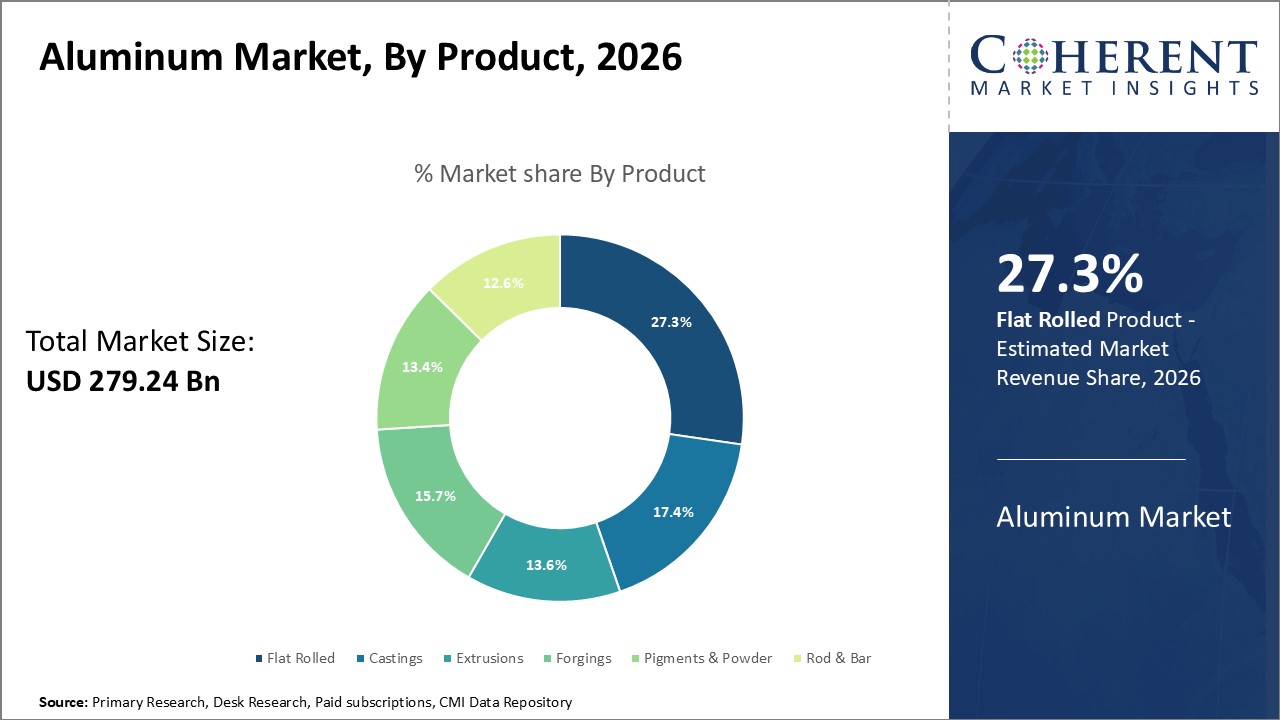
Aluminum Market Insights, By Product: Flat Rolled contribute the highest share of the market owing to its packaging demand.
Flat Rolled hold the largest market share of 27.3% in 2026. The flat-rolled aluminium market grows as automotive and aerospace manufacturers increasingly adopt sheets and coils to reduce vehicle and aircraft weight and improve efficiency. Construction demand rises with rapid urbanization and infrastructure development, as builders rely on aluminium for roofing, cladding, and structural applications due to its durability and corrosion resistance. Simultaneously, sustainable packaging drives the use of thin-gauge aluminium foils and sheets, with manufacturers leveraging their recyclability and excellent barrier properties to meet environmental and functional requirements. For instance, in October 2025, Tournaire, a French aluminium packaging company, launched its new Omni Plus aluminium bottle range, setting a new standard for sustainable packaging by combining durability with eco-friendly design.
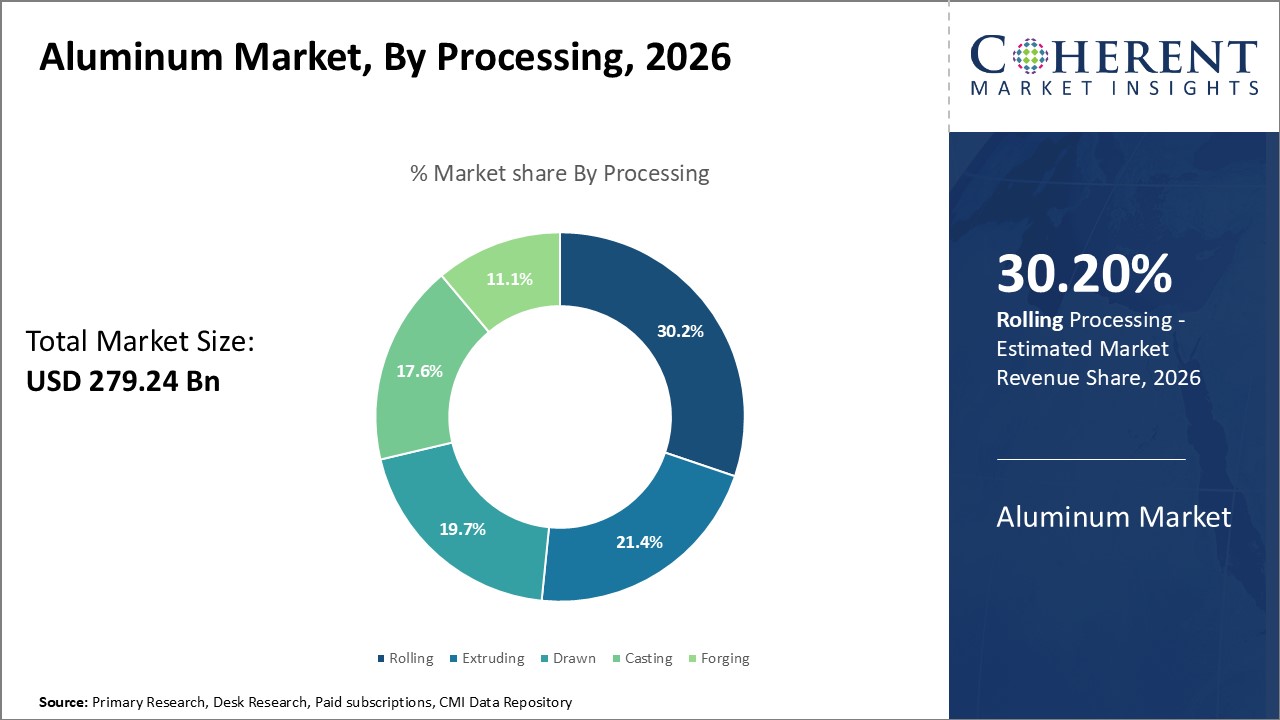
Aluminum Market Insights, By Processing: Rolling contributes the highest share of the market owing to its packaging and consumer goods demand.
Rolling expected to hold largest aluminum market share in 30.2% in 2026. The aluminium rolling segment expands as automotive and aerospace manufacturers increasingly use lighter, high-strength sheets to enhance performance and efficiency. Builders and developers drive demand in construction and infrastructure projects, choosing aluminium plates and coils for their durability and corrosion resistance. Meanwhile, advancements in hot and cold rolling technologies allow producers to create finer gauges with superior surface finishes, enabling new applications and promoting the production of sustainable, high-quality aluminium products across various industries. For instance, Vedanta Aluminium introduced 12 mm Aluminium Wire Rods for the electrical industry at IAC 2023. Produced with advanced Properzi Continuous Casting technology at its Jharsuguda and BALCO smelters, the rods support extrusion, drawing, and rolling for electrical applications in transformers, automobiles, and other industries.
Aluminum Market Insights, By Application: Equipment & Machinery contribute the highest share of the market owing to its sustainability, recyclability & pressure to upgrade equipment.
The aluminium equipment and machinery segment grows as manufacturers in automotive, aerospace, and construction increasingly demand advanced production systems. Companies invest in cutting-edge casting, rolling, and machining equipment to produce lighter, high-performance aluminium components. At the same time, the drive for automation, digital factory solutions, and modular machine building encourages wider adoption of aluminium-compatible machinery. Firms also upgrade to next-generation processing equipment to meet sustainability targets and improve energy efficiency, boosting productivity and supporting modern, eco-friendly aluminium manufacturing practices. For instance, in July 2025, Gujarat-based H&H Aluminium Pvt Ltd has set up India’s largest aluminium solar frame manufacturing facility in Rajkot, investing INR 150 million (USD 1.8 million).
Regional Insights
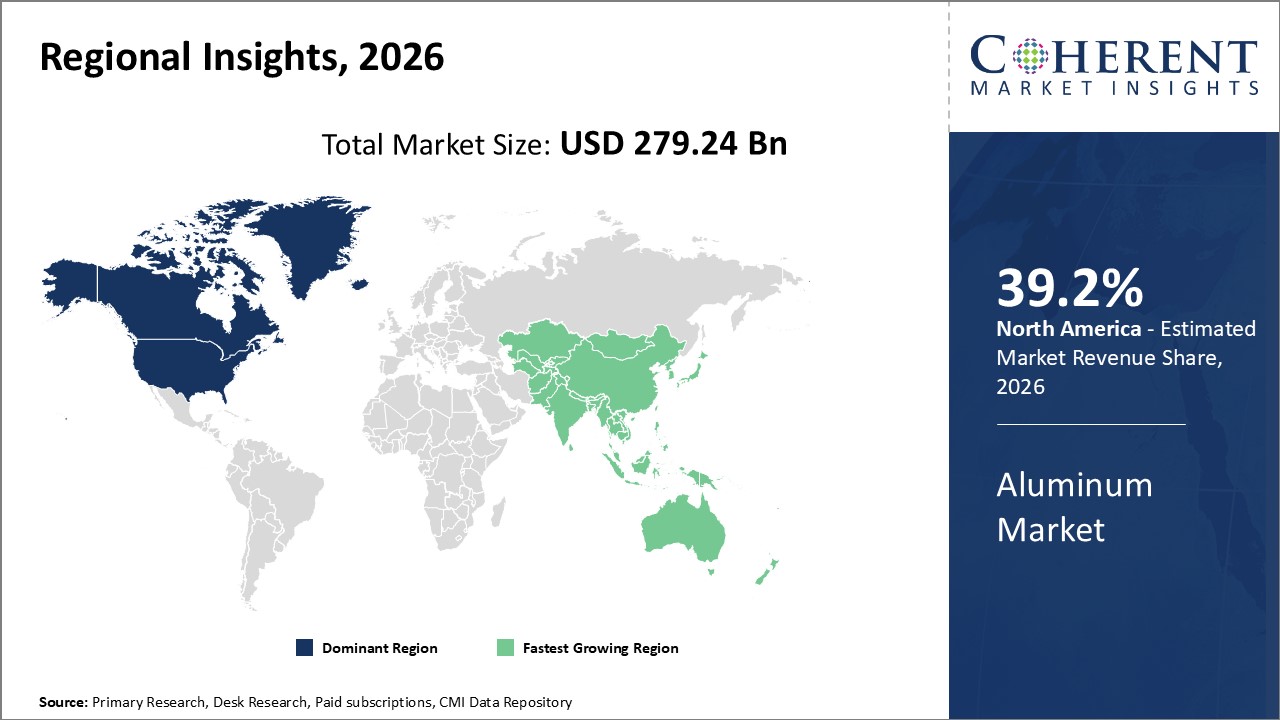
North America Aluminum Market Trends
North America dominates the overall aluminium market demand with an estimated share of 39.2% in 2026. The North American aluminium market evolves as manufacturers and policymakers actively prioritize recycled content and low‑carbon production to advance sustainability and circular practices. Automotive and aerospace companies drive demand by adopting lighter, stronger aluminium components, while packaging and construction sectors rely on the metal for its durability and recyclability. At the same time, trade policies, raw-material supply chains, and regional investments in primary production influence competitiveness and strengthen supply resilience across the United States and Canada. For instance, in May 2026, VulCan Packaging has become North America’s first commercial-scale manufacturer of aTULC™ aluminium cans, using advanced clean technology to set a new standard for eco-friendly beverage packaging.
Asia Pacific Aluminum Market Trends
The Asia‑Pacific aluminium market expands as rapid urbanisation and industrialisation drive China, India, and Southeast Asia to replace traditional materials with aluminium in window frames, facades, and infrastructure. Manufacturers in the electric vehicle and electronics sectors increase demand for lightweight, high-performance aluminium. Governments actively promote low-carbon production and recycling to boost sustainability. Meanwhile, energy-intensive smelting faces cost pressures and supply chain challenges, prompting producers to optimize operations and strengthen regional competitiveness across the Asia‑Pacific market. For instance, in October 2026, Evonik has opened its first alumina production facility, Alu5, in Yokkaichi, Japan, advancing its strategy to supply the Asian market with advanced aluminium oxide solutions.
United States Aluminum Market Trends
The U.S. aluminium market is transforming as producers and supply chain participants actively focus on domestic resilience and sustainability. Automotive, aerospace, and renewable energy manufacturers drive demand by adopting lightweight, high-performance aluminium. Rising import volumes, changing trade policies, and high premiums in the physical market actively influence sourcing strategies and pricing. At the same time, domestic investments in low-carbon production technologies and recycling infrastructure strengthen the industry’s competitiveness and shape a more sustainable and efficient aluminium market. For instance, in August 2026, three leading U.S. and Canadian aluminium extrusion companies have merged to launch Metra North America, bringing over a century of combined expertise in extrusion, fabrication, and finishing for building and industrial markets.
China Aluminum Market Trends
The China aluminium market is shifting as producers move from focusing on volume growth to prioritizing high-quality, sustainable production. Manufacturers actively invest in recycling, clean energy smelting, and industrial chain optimization. Domestic demand evolves as the transport and electronics sectors increasingly drive consumption over traditional construction uses. At the same time, stricter capacity policies and rising raw material imports push companies to adjust supply chains, strengthening China’s position as a leading global aluminium hub. For instance, in December 2024, Jiangnan Shipyard, a subsidiary of China State Shipbuilding Corporation (CSSC), has agreed with a shipowner to jointly implement an aluminum alloy Type B tank in an actual ship project.
Aluminum Market Trend
Sustainability and Recycling Focus
The aluminium market increasingly prioritizes sustainable practices as industries aim to reduce carbon footprints. Manufacturers are adopting recycled aluminium and low-energy smelting technologies to meet environmental regulations and consumer expectations. Circular economy initiatives are gaining traction, encouraging companies to recover and reuse aluminium across production cycles. This trend drives innovation in material recovery, process efficiency, and eco-friendly alloys, positioning aluminium as a key metal in achieving sustainable industrial and consumer applications worldwide.
Lightweighting in Transportation
Automotive and aerospace sectors are accelerating the shift toward lightweight aluminium components to enhance fuel efficiency, reduce emissions, and improve vehicle performance. Designers increasingly integrate high-strength sheets, extrusions, and castings to replace heavier metals. This trend pushes advancements in alloy development, forming techniques, and surface treatments, enabling safer, more durable, and versatile products. Lightweighting also aligns with the growing electric vehicle and aerospace markets, where weight reduction directly impacts energy consumption and overall performance metrics.
Aluminum Market Opportunity
Electric Vehicle and EV Battery Applications
The shift toward electric vehicles creates significant opportunities for aluminium, particularly in battery enclosures, chassis, and lightweight structural components. Manufacturers can capitalize on demand for materials that reduce vehicle weight while maintaining strength and thermal stability. Aluminium producers have the chance to develop specialized alloys and advanced manufacturing techniques tailored for EV applications, enabling longer-range performance, enhanced safety, and alignment with global sustainability goals, positioning aluminium as a critical material in the future of clean transportation.
Market Report Scope
Aluminum Market Report Coverage
| Report Coverage | Details | ||
|---|---|---|---|
| Base Year: | 2025 | Market Size in 2026: | USD 279.24 Bn |
| Historical Data for: | 2020 To 2024 | Forecast Period: | 2026 To 2033 |
| Forecast Period 2026 to 2033 CAGR: | 6.9% | 2033 Value Projection: | USD 445.48 Bn |
| Geographies covered: |
| ||
| Segments covered: |
| ||
| Companies covered: | Alcoa Corporation, Rio Tinto, Rusal Company, Norsk Hydro A.S.A., Emirates Global Aluminium PJSC, Century Aluminum Company, Vedanta Ltd., Chalco, China Hongqiao Group Limited, Hindalco Industries Ltd., Novelis, Xinfal, East Hope Group, Jindal Aluminium Limited, GAL Aluminium Extrusions Pvt. Ltd, Maan Aluminium Ltd, Aluka Extrusion, Kaiser Aluminum, and NALCO India | ||
| Growth Drivers: |
| ||
| Restraints & Challenges: |
| ||
Aluminum Market News
- In September 2025, Golden Aluminum Inc. (GAI) has partnered with SMS group to begin commercial operations of its advanced aluminium strip, nexcast®, at the Fort Lupton, Colorado facility.
- In February 2025, Saudi Aluminum Casting Foundry, a subsidiary of Obeikan Glass Co., has started trial operations at its aluminum casting facility in Al-Madina Al-Munawwara Industrial City, focusing on producing and casting aluminum into various products.
- In April 2025, Steelforce Packaging, a global leader in metal trading and packaging, has launched a dedicated Aluminium Division to expand its business, reinforcing its commitment to sustainability and diversification in key global markets.
Analyst Opinion (Expert Opinion)
- The aluminium sector today is at a crossroads where structural tailwinds remain strong, yet near‑term headwinds threaten margins and strategy. On one hand, auto manufacturers continue to push aluminium content per vehicle: the Aluminum Association estimated vehicle aluminium usage in the U.S. alone could reach 500 lb by 2025, up from 390 lb in 2015.
- Moreover, the market’s fragility is highlighted by supply disruptions: consider the fire at the Novelis sheet‑plant in Oswego, NY, which took it offline until early 2026 and triggered a production cut of 55 % at the Ford Motor Company F‑series truck facility.
- Then there’s the regulatory and trade dimension: U.S. tariffs on aluminium imports and international trade friction are no longer peripheral—they directly squeeze margins in packaging players. For example, the brewer Molson Coors Beverage Company attributed a material part of its profit decline to “indirect tariff impacts” on can‑stock aluminium. Industry jobs are also at risk: the Alcoa CEO warned that up to 100,000 U.S. aluminium jobs could be endangered by tariffs and trade distortions.
Speak to the analyst
Want personalized insights?
Take the findings above to one of our principal consultants, or have the report rebuilt around the segments, geographies and competitors you actually track.
Market Segmentation
- Product Insights (Revenue, USD, 2021 - 2033)
- Flat Rolled
- Castings
- Extrusions
- Forgings
- Pigments & Powder
- Rod & Bar
- Processing Insights (Revenue, USD, 2021 - 2033)
- Rolling
- Extruding
- Drawn
- Casting
- Forging
- Application Insights (Revenue, USD, 2021 - 2033)
- Transport
- Construction
- Electrical & Electronics
- Packaging
- Equipment & Machinery
- Consumer Durables
- Foil stock
- Others
- Regional Insights (Revenue, USD, 2021 - 2033)
- North America
- U.S.
- Canada
- Latin America
- Brazil
- Argentina
- Mexico
- Rest of Latin America
- Europe
- Germany
- U.K.
- Spain
- France
- Italy
- Russia
- Rest of Europe
- Asia Pacific
- China
- India
- Japan
- Australia
- South Korea
- ASEAN
- Rest of Asia Pacific
- Middle East & Africa
- GCC Countries
- Israel
- Rest of Middle East & Africa
- Key Players Insights
- Alcoa Corporation
- Rio Tinto
- Rusal Company
- Norsk Hydro A.S.A.
- Emirates Global Aluminium PJSC
- Century Aluminum Company
- Vedanta Ltd.
- Chalco
- China Hongqiao Group Limited
- Hindalco Industries Ltd.
- Novelis
- Xinfal
- East Hope Group
- Jindal Aluminium Limited
- GAL Aluminium Extrusions Pvt. Ltd
- Maan Aluminium Ltd
- Aluka Extrusion
- Kaiser Aluminum
- NALCO India
Sources
Primary Research interviews
- Interviews with aluminium plant managers, production engineers, and supply chain executives.
- Discussions with automotive, aerospace, and packaging industry procurement heads using aluminium.
- Conversations with construction and infrastructure project managers implementing aluminium solutions.
Databases
- U.S. Geological Survey (USGS) Mineral Resources Data.
- International Aluminium Institute statistical database.
- National Bureau of Statistics of China – Metals & Minerals Data.
- World Bank Commodity Price Data (aluminium).
Magazines
- Light Metal Age – Industry news, trends, and technology updates.
- Aluminium International Today – Reports on market developments and innovations.
- Metal Bulletin – Aluminium market insights and pricing analysis.
Journals
- Journal of Materials Processing Technology – Research on aluminium processing and applications.
- Materials Science and Engineering A – Aluminium alloys and structural studies.
- Transactions of Nonferrous Metals Society of China – Technical developments in aluminium production.
Newspapers
- The Wall Street Journal – Aluminium pricing and industry news.
- Financial Times – Trade, tariffs, and global aluminium market coverage.
- The New York Times – Sustainability and policy impacts on aluminium.
Associations
- The Aluminum Association (U.S.) – Industry reports and production data.
- European Aluminium – European market updates and statistics.
- International Aluminium Institute – Global production, recycling, and usage data.
Public Domain sources
- U.S. Energy Information Administration (EIA) – Energy consumption in aluminium production.
- World Aluminium – Industry insights, sustainability initiatives, and recycling data.
- National Renewable Energy Laboratory (NREL) – Aluminium applications in energy and transportation.
Proprietary Elements
- CMI Data Analytics Tool
- Proprietary CMI Existing Repository of information for last 8 years
Get access to 250+ pages report
Every segment, forecast, competitor profile and data table behind the analysis above — available for instant download.
- ESOMAR Member
- ISO 9001:2015 Certified
- D-U-N-S Registered
- GDPR & CCPA Compliant
Missing comfort of reading report in your local language? Find your preferred language:
Transform your Strategy with Exclusive Trending Reports
Frequently Asked Questions
The Aluminum Market is estimated to be valued at USD 279.24 Bn in 2026, and is expected to reach USD 445.48 Bn by 2033.
The CAGR of the Aluminum Market is projected to be 6.9% from 2026 to 2033.
Rising demand from automotive industry and increasing usage in construction sector are the major factors driving the growth of the global aluminum market.
Fluctuation in raw material prices and stringent environmental regulations are the major factors hampering the growth of the global aluminum market.
In terms of product, flat rolled is estimated to dominate the market revenue share in 2026.
Alcoa Corporation, Rio Tinto, Rusal Company, Norsk Hydro A.S.A., Emirates Global Aluminium PJSC, Century Aluminum Company, Vedanta Ltd., Chalco, China Hongqiao Group Limited, Hindalco Industries Ltd., Novelis, Xinfal, East Hope Group, Jindal Aluminium Limited, GAL Aluminium Extrusions Pvt. Ltd, Maan Aluminium Ltd, Aluka Extrusion, Kaiser Aluminum, and NALCO India are the major players.
North America is expected to lead the global aluminum market.